
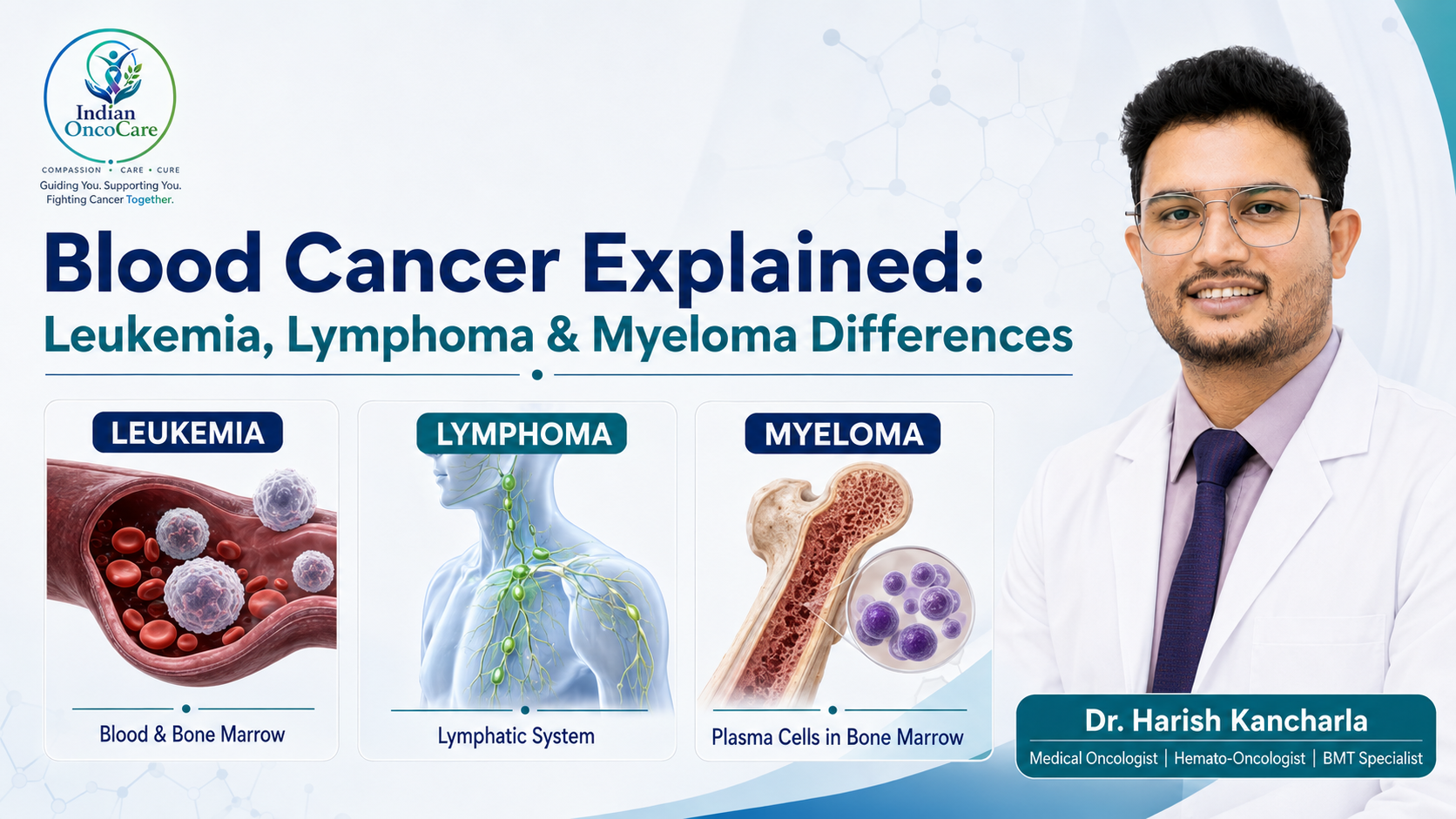
“Blood cancer” is not one disease. The three main types — leukemia, lymphoma and myeloma — behave very differently, are diagnosed differently, and are treated differently. Understanding which is which helps patients and families make sense of a confusing diagnosis.
Leukemia: cancer of the blood-forming cells
Leukemia begins in the bone marrow and affects the blood cells themselves, usually the white cells. It can be acute (fast-moving, needing urgent treatment) or chronic (slower). Common features include fatigue, frequent infections, and easy bruising or bleeding. Diagnosis relies on blood counts and a bone marrow test with molecular studies.
Lymphoma: cancer of the lymphatic system
Lymphoma arises in the lymph nodes and lymphatic tissue. It typically shows up as a painless, enlarging lymph node, sometimes with fevers, night sweats or weight loss. It is divided into Hodgkin and non-Hodgkin types, and diagnosis needs a whole lymph-node biopsy. Many lymphomas are highly curable.
Myeloma: cancer of plasma cells
Multiple myeloma affects plasma cells in the bone marrow and often shows up as bone pain, anaemia, kidney problems or raised calcium. It is generally not curable but is highly treatable, with many patients achieving long remissions.
Leukemia, lymphoma and myeloma are as different from each other as cancers of three separate organs. The name ‘blood cancer’ groups them, but their treatment does not.
How they are diagnosed and treated
Accurate diagnosis is everything, and depends on precise pathology — as our guide on reading your biopsy report explains. Treatment draws on chemotherapy, immunotherapy (including CAR-T for selected cases), targeted therapy, and bone marrow transplant, chosen by the exact type. All three are hemato-oncology conditions, so specialist care matters.
Frequently asked questions
Are all blood cancers the same?
No. Leukemia, lymphoma and myeloma are distinct diseases with different symptoms, tests and treatments.
Are blood cancers curable?
Many are. Several leukemias and lymphomas are curable; myeloma is very treatable with long remissions.
Do all need a bone marrow transplant?
No — transplant is used in selected cases, not all.
Who treats blood cancers?
A hemato-oncologist. Explore our services and specialist pages.
Related reading: Leukemia Specialist · Lymphoma Specialist · Multiple Myeloma Specialist · Bone Marrow Transplant · Immunotherapy · CAR-T & Immunotherapy Cost in India · Understanding Your Biopsy Report · Our Services
Further reading:
National Cancer Institute — Leukemia · National Cancer Institute — Lymphoma · National Cancer Institute — Multiple MyelomaReviewed by Dr. Harish Kancharla
DM (Medical Oncology), AIIMS, New Delhi · MD (Internal Medicine), PGIMER, Chandigarh
Senior Consultant – Medical Oncology & Hemato-Oncology, Yashoda Hospitals, Somajiguda, Hyderabad
Telangana State Medical Council Registration No. 77186
Last reviewed: August 2026
This article is general information, not personal medical advice. Cancer decisions depend on your individual diagnosis, stage, test results and overall health. Please see our Medical Disclaimer.