

What is immunotherapy?
Immunotherapy does not attack cancer cells directly. It works by removing the brakes that a tumour uses to hide from your immune system, so that your own T-cells can recognise the cancer and destroy it.
This is a fundamentally different mechanism from chemotherapy, which kills rapidly dividing cells throughout the body. Because immunotherapy trains the immune system rather than poisoning dividing cells, it causes a different pattern of side effects, follows a different treatment schedule, and in a proportion of patients produces responses that continue long after the drug is stopped.
Immunotherapy is not suitable for every cancer or every patient. Whether it will help you depends on your tumour type and on specific biomarker tests, which is why the assessment matters as much as the drug.
Types of cancer immunotherapy
"Immunotherapy" covers several distinct treatment classes:
- Immune checkpoint inhibitors — the most widely used group. PD-1, PD-L1 and CTLA-4 inhibitors release the immune system's natural off-switches. Given as an intravenous infusion in day care.
- Monoclonal antibodies — laboratory-made antibodies that attach to a specific protein on cancer cells and flag them for immune destruction.
- CAR-T cell therapy — your own T-cells are collected, genetically reprogrammed to attack the cancer, and returned to you. Used in selected relapsed or refractory blood cancers.
- Cytokine therapy — interferon and interleukin-based treatments, used in specific situations.
- Intravesical BCG — a bladder instillation that provokes a local immune response in early bladder cancer.
- Therapeutic cancer vaccines — a developing area, currently used mainly within clinical trials.
Which cancers respond to immunotherapy
Immunotherapy is now an established part of treatment in non-small cell lung cancer, melanoma, kidney cancer, bladder and urothelial cancers, head and neck cancers, Hodgkin lymphoma, liver cancer, oesophageal and stomach cancers, cervical cancer and triple-negative breast cancer, among others.
It is also used across tumour types when a tumour shows high microsatellite instability (MSI-High) or mismatch repair deficiency (dMMR) — in these cases the site of origin matters less than the molecular finding.
Being on this list does not mean immunotherapy is automatically right for you. Stage, prior treatment, organ function and your biomarker results all determine whether it is offered, whether it is given alone, or whether it is combined with other treatment.
Testing that comes before treatment
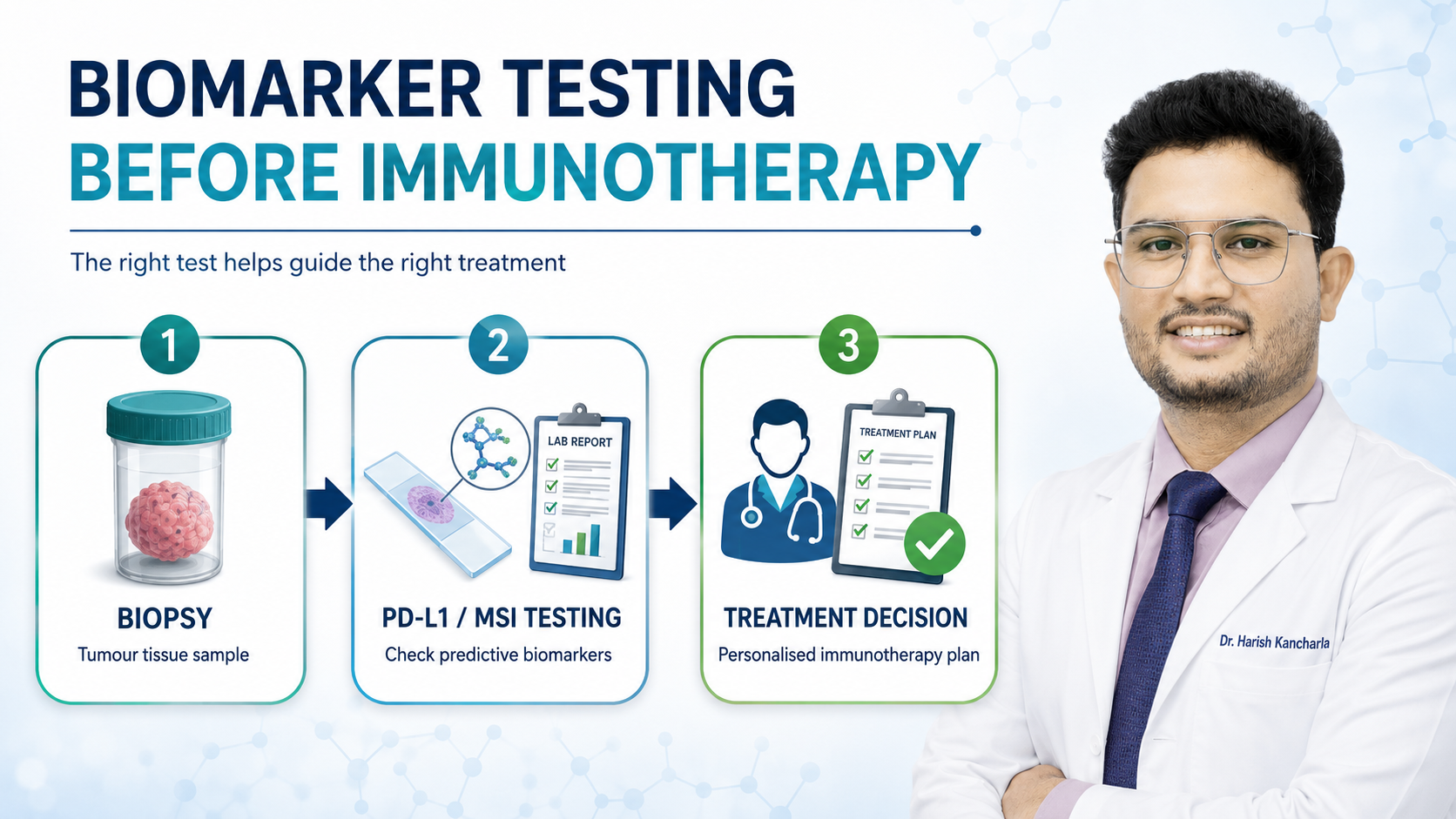
Immunotherapy should never be started on assumption. Before it is recommended, your tumour tissue is tested to predict whether it is likely to respond:
- PD-L1 expression — measured on the biopsy sample and reported as a score. Higher expression generally predicts better benefit in several cancers.
- MSI-H / dMMR status — identifies tumours with a defective DNA repair mechanism, which tend to respond particularly well.
- Tumour mutational burden (TMB) — an estimate of how many mutations a tumour carries, used in selected situations.
- Driver mutation testing — because certain mutations mean a targeted therapy, not immunotherapy, is the correct first treatment.
Immunotherapy or chemotherapy — or both?
This is the question most patients arrive with, and it is rarely an either-or choice.
Chemotherapy works fastest and remains the right first treatment where a tumour needs to be brought under control quickly, where no immunotherapy biomarker is present, or where the evidence in that cancer favours it. Immunotherapy works more slowly but can produce longer-lasting control in the patients who respond, and is generally easier to tolerate day to day.
In many current protocols the two are given together rather than in sequence. Combined chemo-immunotherapy is now standard first-line treatment in several lung cancers and in some stomach, oesophageal and breast cancers, because chemotherapy exposes tumour antigens that make the immune attack more effective.
You can read how chemotherapy is planned and delivered on our chemotherapy treatment page. Which of the two — or which combination — applies to your case is decided from your histopathology report, biomarker results and stage, not from the treatment's general reputation.
How immunotherapy is given
Most immunotherapy is an intravenous infusion given in the day-care unit, usually taking thirty to sixty minutes, after which you go home the same day. Some agents are now available as a subcutaneous injection, which is quicker still.
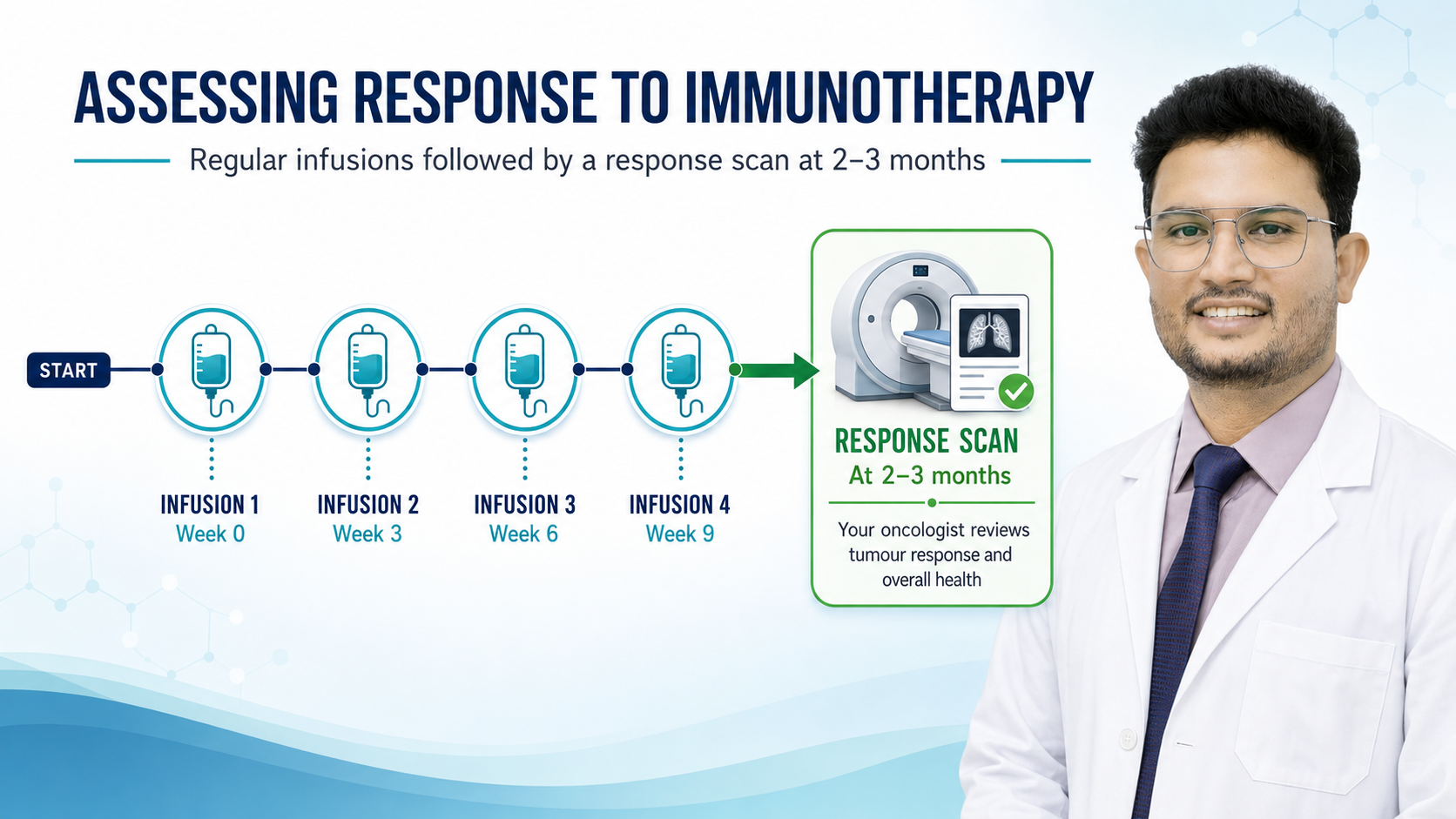
Infusions are scheduled every two, three, four or six weeks depending on the drug and the dose schedule chosen for you. Unlike chemotherapy, heavy pre-medication is usually not required and most patients do not feel unwell on the day of treatment.
The duration is also different. Chemotherapy runs for a defined number of cycles; immunotherapy is often continued for up to two years, or until the disease progresses or side effects require it to stop. In the adjuvant setting after surgery, a fixed course of around one year is common.
Before each cycle, blood tests check your blood counts, kidney and liver function, thyroid hormones and blood sugar — the last two specifically because immunotherapy can affect hormone-producing glands.
How quickly does it work?
Immunotherapy usually takes longer to show its effect than chemotherapy. Response is generally assessed on a scan after roughly two to three months rather than after each cycle.
Occasionally a scan taken early shows what appears to be enlargement of the tumour when the treatment is in fact working — immune cells flooding into the tumour temporarily increase its size. This is called pseudoprogression, and it is why your oncologist may recommend continuing treatment and repeating the scan rather than switching immediately.
The other side of this is that immunotherapy does not help everyone. Where scans and symptoms show genuine progression, the plan is changed. Setting realistic expectations before the first infusion is part of the consultation, not an afterthought.
Side effects of immunotherapy
Immunotherapy does not cause the hair loss, vomiting and low blood counts associated with chemotherapy. Most patients tolerate it well and continue normal activity.
Its side effects come from a different source: an immune system that has been released can occasionally begin attacking healthy organs. These immune-related adverse events are usually mild and manageable, but they must be recognised early.
The most common are skin rash and itching, fatigue, diarrhoea or colitis, and thyroid disturbance — an underactive or overactive thyroid, which may need hormone tablets, sometimes permanently. Less commonly, the lungs (pneumonitis, causing cough or breathlessness), liver, pituitary and adrenal glands, kidneys, joints or nerves can be affected. Inflammation of the heart muscle is rare but serious.
Two points matter more than the list itself. First, these effects can appear weeks or months after starting treatment, and sometimes even after treatment has finished — so a new symptom months in is still worth reporting. Second, they are treated with steroids and other immune-suppressing medicines, which work well when started early and much less well when started late.
Symptoms that need urgent attention
Never start or stop steroids on your own during immunotherapy, and never treat diarrhoea with over-the-counter medicine without telling us first. Both can mask an immune reaction that needs specific treatment.
Contact the team promptly if you develop:
- Loose motions more than two or three times above your normal, or blood or mucus in stools
- New or worsening cough, breathlessness or chest pain
- Skin rash that is spreading, blistering or involves the mouth
- Yellowing of eyes or skin, or dark urine
- Persistent headache, visual disturbance or extreme fatigue
- Unusual thirst, frequent urination or rapid unexplained weight loss
- Palpitations, fainting, or swelling of the legs
- Fever, muscle weakness or new severe joint pain
Who may not be suitable for immunotherapy
Immunotherapy needs careful individual assessment if you have an active autoimmune disease such as rheumatoid arthritis, inflammatory bowel disease or autoimmune thyroid disease; if you have had an organ transplant; if you are on long-term high-dose steroids or other immunosuppressants; or if you have significant existing lung disease.
None of these is an automatic disqualification. Each is a reason for the risk and benefit to be weighed carefully by a medical oncologist who has your full history — which is precisely what the planning consultation is for.
Immunotherapy is not the same as "boosting immunity"
Cancer immunotherapy refers to specific, licensed drugs, given intravenously under specialist supervision, chosen on the basis of laboratory testing of your tumour.
It has nothing in common with immunity-boosting supplements, tonics, detox programmes or alternative preparations sold for cancer. Several of those products interact with genuine cancer treatment, and some directly interfere with it. Tell your oncologist about anything you are taking, including ayurvedic, homeopathic and herbal preparations.
Availability, cost and second opinions
The major checkpoint inhibitors are approved and available in India, and Indian biosimilars have brought the cost of several agents down substantially in recent years. Cost still depends on the specific drug, the dose schedule, the expected duration and your insurance or scheme coverage — share your diagnosis with the coordination team and you will be given an indicative estimate before treatment starts.
Because immunotherapy is a long and significant commitment, a second opinion before starting is entirely reasonable. Send your histopathology report, biomarker results and recent scans through the enquiry form or WhatsApp. Patients outside Hyderabad and overseas usually begin with an online consultation and continue treatment in person at Yashoda Hospitals, Somajiguda.
Frequently asked questions
Q1. Is immunotherapy better than chemotherapy?
Neither is universally better. Immunotherapy can give longer-lasting control in patients whose tumours carry the right biomarkers, and is usually easier to tolerate. Chemotherapy acts faster and works in cancers where immunotherapy has no proven role. Many patients receive both together. See our chemotherapy page for how that treatment is planned.
Q2. Can I take immunotherapy along with chemotherapy?
Yes — combined chemo-immunotherapy is standard first-line treatment in several cancers, particularly lung cancer. The chemotherapy dose used in these combinations is usually lower than chemotherapy given alone.
Q3. How long will I be on immunotherapy?
Commonly up to two years, or about one year when given after surgery, provided the disease is responding and side effects remain manageable. Your planned duration is explained before the first infusion.
Q4. Will I lose my hair or feel nauseated?
Immunotherapy alone does not usually cause hair loss or significant nausea. If it is combined with chemotherapy, the side effects of the chemotherapy component still apply.
Q5. How will I know it is working?
Response is assessed by scan, usually after two to three months, along with your symptoms and blood results. An early scan showing apparent growth does not always mean failure — this is discussed with you if it occurs.
Q6. Are the side effects permanent?
Most settle with treatment. The main exception is thyroid or other hormone gland involvement, which can require lifelong hormone replacement tablets — a manageable condition, but a permanent one.
Q7. Is immunotherapy available in Hyderabad?
Yes. Checkpoint inhibitor therapy, including biosimilar agents, is administered through the day-care and inpatient facilities at Yashoda Hospitals, Somajiguda. CAR-T cell therapy is assessed and coordinated separately for eligible blood cancer patients.
Q8. Who will supervise my treatment?
Dr. Harish Kancharla, DM (Medical Oncology, AIIMS Delhi), MD (Internal Medicine, PGIMER Chandigarh), Senior Consultant – Medical Oncology & Hemato-Oncology at Yashoda Hospitals, Somajiguda, reviews each cycle personally.
Related treatments: Chemotherapy · Precision Oncology — Targeted Therapy · Cellular Therapy (CAR-T) · Bone Marrow Transplantation · Patient Support
Medically reviewed by Dr. Harish Kancharla, DM (Medical Oncology), MD (Internal Medicine), Senior Consultant – Medical Oncology & Hemato-Oncology, Yashoda Hospitals, Somajiguda, Hyderabad. Telangana Medical Council Registration No. 77186.
Last reviewed: July 2026.
This page is general information about immunotherapy and is not a substitute for personal medical advice. Immunotherapy is not appropriate for every cancer or every patient, and treatment decisions must be made with a qualified oncologist who has reviewed your reports.