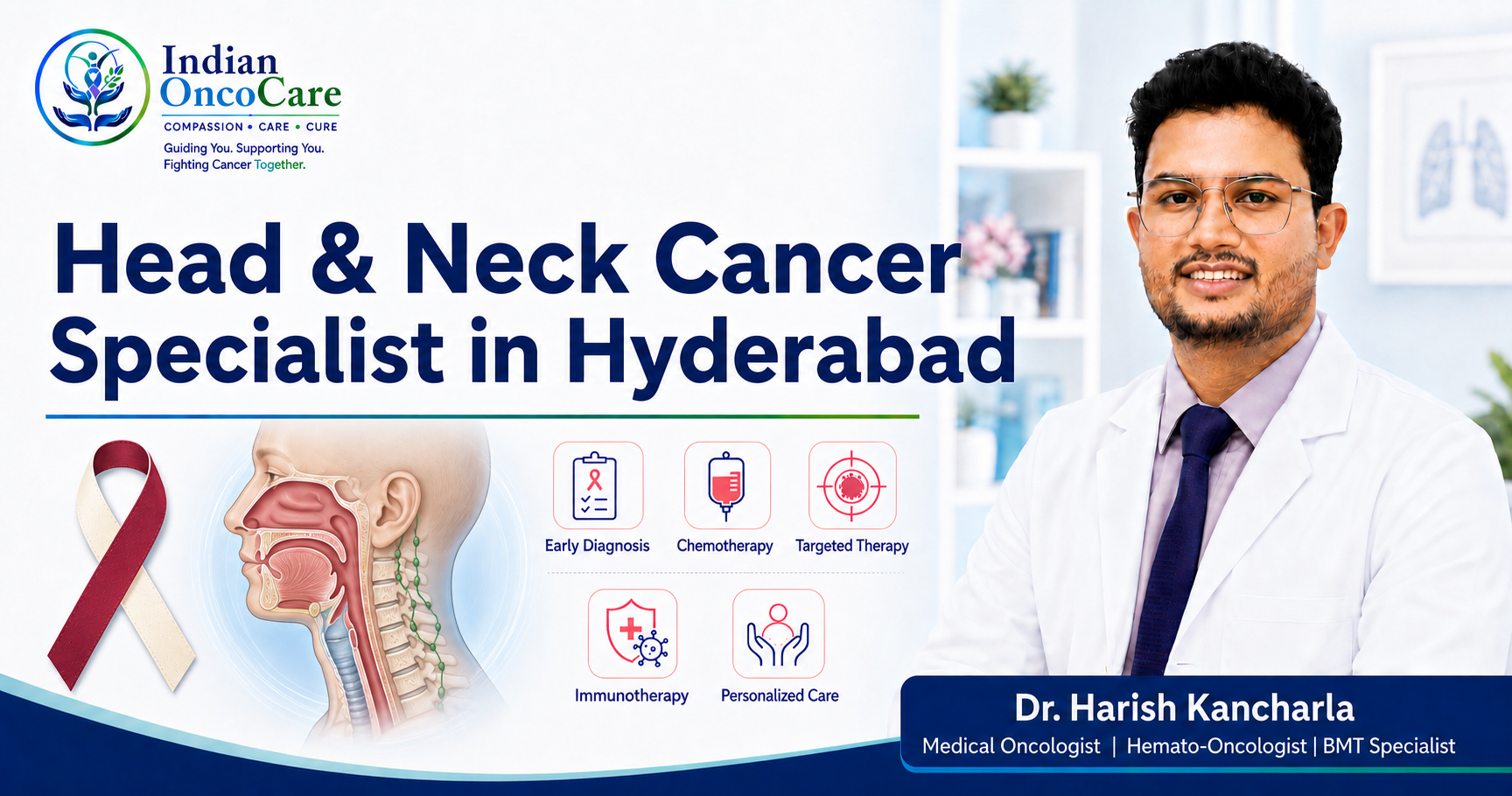
Head and neck cancers include cancers of the mouth and tongue, throat (pharynx and larynx), salivary glands and sinuses. In India they are among the most common cancers, driven largely by tobacco — both smoking and smokeless forms such as gutka and khaini — alcohol, areca (betel) nut, and, for throat cancers, HPV infection.
At Indian OncoCare, head and neck cancer treatment is planned and supervised personally by Dr. Harish Kancharla, DM (Medical Oncology, AIIMS Delhi), MD (Internal Medicine, PGIMER Chandigarh), Senior Consultant – Medical Oncology & Hemato-Oncology at Yashoda Hospitals, Somajiguda, Hyderabad, working with head and neck surgeons, radiation oncologists and pathologists as one team.
When to see a head and neck cancer specialist
Because these symptoms are easy to mistake for a persistent infection, any that last more than two to three weeks deserve evaluation:
- A mouth ulcer or sore that does not heal
- A white or red patch inside the mouth
- A persistent sore throat, hoarseness or change in voice
- Difficulty or pain on swallowing
- A lump in the neck, or persistent ear pain on one side
- Difficulty opening the mouth fully
Anyone who uses tobacco in any form, or chews areca/betel nut, is at higher risk and should take these symptoms seriously.
How head and neck cancer is diagnosed
Diagnosis usually combines a clinical and endoscopic examination of the mouth and throat, a biopsy of the suspicious area, and imaging (CT, MRI or PET-CT) to assess the extent of disease and the neck lymph nodes. For throat cancers, the tissue is often tested for HPV (p16), which affects both prognosis and treatment. PD-L1 testing may guide immunotherapy in advanced disease.
Treatment options
Head and neck cancer treatment is highly multidisciplinary and combines:
- Surgery — to remove the tumour and, where needed, neck lymph nodes, with reconstruction to preserve function.
- Radiation therapy — a mainstay, used alone or with chemotherapy.
- Chemotherapy — combined with radiation (chemoradiation), before other treatment, or for advanced disease.
- Targeted therapy and immunotherapy — used in advanced or recurrent disease, guided by the tumour’s features.
The order of surgery, radiation and drug therapy is decided jointly by the team, and has a direct bearing on both cure and the ability to speak and swallow afterwards.
Why choose Indian OncoCare
Your plan is prepared and reviewed personally by Dr. Harish Kancharla, DM (Medical Oncology, AIIMS Delhi), MD (Internal Medicine, PGIMER Chandigarh), and delivered through the day-care and inpatient facilities at Yashoda Hospitals, Somajiguda, Hyderabad. Surgical, radiation and medical oncology work as one coordinated team. Explore our cancer services and the patient journey, or our other specialist pages for lung, stomach and ovarian cancer.
Support for patients and families
A cancer diagnosis affects the whole family, and practical support matters as much as medical treatment. Our patient support resources help you prepare for consultations and understand each step, while our financial guidance can help you understand treatment costs and the insurance or assistance options that may be available.
You can find more guidance and checklists in our patient resources section. Patients travelling from outside Hyderabad or from abroad usually begin with an online consultation before continuing in person — see our international patients page for how this is coordinated.
Frequently asked questions
Is tobacco really the main cause?
In India, yes — smoking and smokeless tobacco and areca nut account for most head and neck cancers. Stopping tobacco at any stage improves outcomes and lowers the risk of a second cancer.
Will treatment affect my speech or swallowing?
It can, which is why treatment is planned to preserve function wherever possible, with rehabilitation support. The team balances cure against quality of life for your specific tumour.
Does every case need surgery?
No. Some cancers, especially of the throat and voice box, are treated primarily with radiation and chemotherapy to preserve the organ. The best approach depends on site and stage.
Who supervises my treatment?
Dr. Harish Kancharla, DM (Medical Oncology, AIIMS Delhi), MD (Internal Medicine, PGIMER Chandigarh), Senior Consultant – Medical Oncology & Hemato-Oncology at Yashoda Hospitals, Somajiguda, Hyderabad, plans and reviews the medical-oncology component of your care personally.
Related reading: Chemotherapy · Targeted Therapy · Immunotherapy · Second Opinion in Hyderabad · Precision Medicine · Patient Support · Blog
Medically reviewed by Dr. Harish Kancharla, DM (Medical Oncology, AIIMS Delhi), MD (Internal Medicine, PGIMER Chandigarh), Senior Consultant – Medical Oncology & Hemato-Oncology, Yashoda Hospitals, Somajiguda, Hyderabad. Telangana State Medical Council Registration No. 77186.
Last reviewed: August 2026.
This page is general information about head and neck cancer and its treatment and is not a substitute for personal medical advice. Treatment decisions must be made with a qualified oncologist who has reviewed your reports.