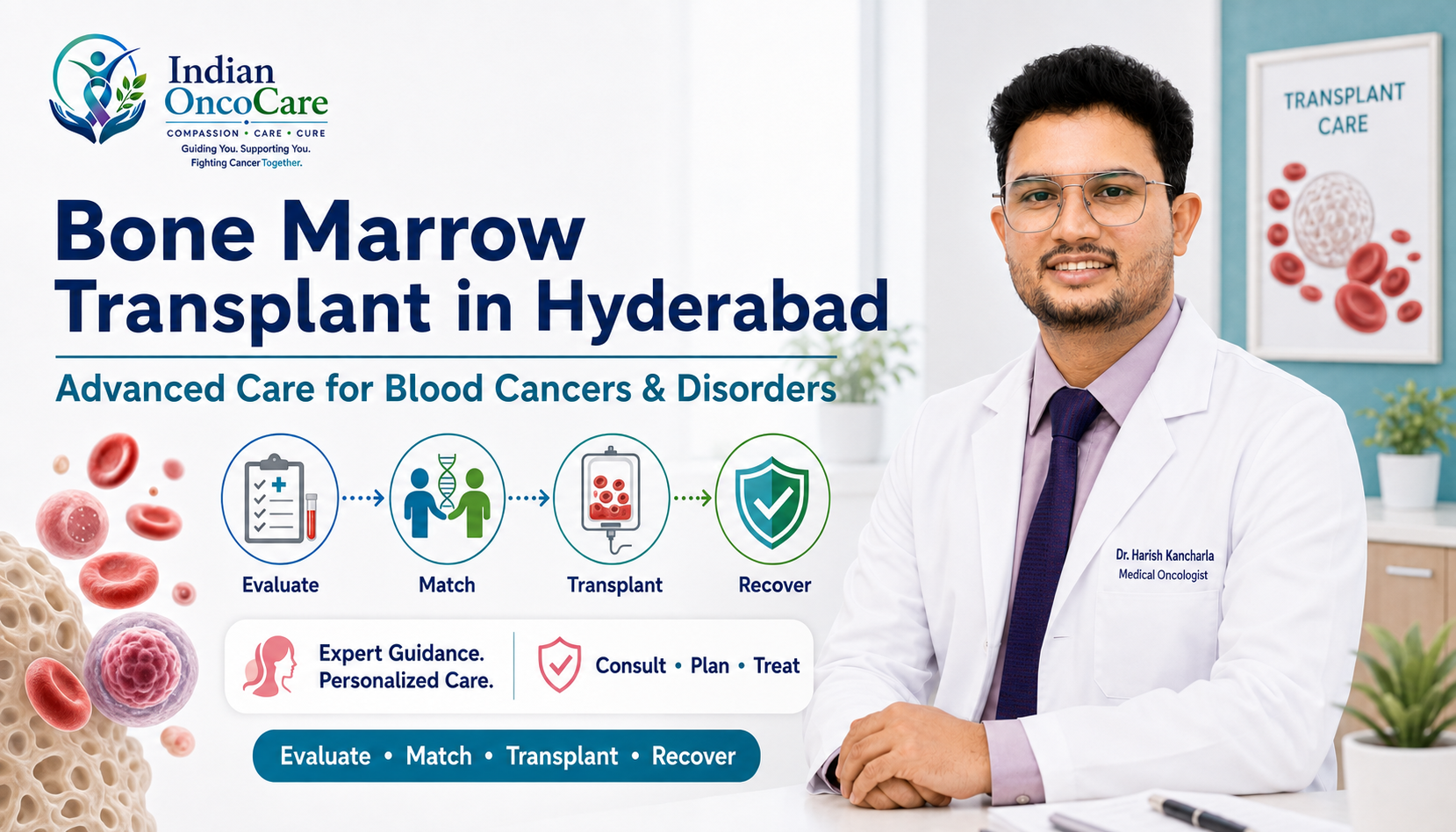
Quick answer: A bone marrow transplant (BMT) — clinically a haematopoietic stem cell transplant (HSCT) — replaces diseased bone marrow with healthy blood-forming stem cells, and is a potentially curative treatment for leukemia, lymphoma, multiple myeloma and certain blood disorders. At Indian OncoCare in Hyderabad, transplant evaluation and care are led personally by Dr. Harish Kancharla, DM (Medical Oncology, AIIMS New Delhi), Senior Consultant – Medical Oncology & Hemato-Oncology, in coordination with the transplant unit at Yashoda Hospitals, Somajiguda, Hyderabad. Consultations are available in person and online for patients across India and abroad.
How much does a bone marrow transplant cost in Hyderabad?
There is no single figure. Cost depends on the type of transplant (autologous is generally less involved than allogeneic), donor search requirements, the conditioning regimen, length of hospital stay, and whether complications arise. India is widely regarded as one of the more affordable destinations for advanced transplant care relative to Western countries. Rather than a headline number, you receive a personalised estimate after your reports are reviewed. For context, see the cost of cancer treatment in India and our financial guidance page on insurance and assistance.
How long does recovery take?
Early recovery in and around hospital takes several weeks while blood counts recover, followed by fuller immune recovery over months, during which close monitoring is essential. Caregivers play a vital role in this period — see our caregiver guide.
What is the success rate of a bone marrow transplant?
Outcomes vary considerably and cannot be reduced to one number. They depend on the disease and its subtype, disease stage and risk, the timing of transplant, donor match, and your overall fitness. In general, transplanting at the right time — often in remission or early in the disease course — gives the best chance of long-term control or cure. Your individual prognosis is discussed honestly at consultation, based on your specific reports, rather than a generic statistic.
Care for patients travelling to Hyderabad
Patients from across India and abroad regularly seek transplant evaluation here, and the pathway is designed to work smoothly from a distance:
- Start online. Overseas and out-of-state patients usually begin with an online consultation and report review before travelling, so the plan is clear before flights are booked.
- Coordinated arrival. Once agreed, in-person care continues at Yashoda Hospitals, Somajiguda, with the transplant unit and Dr. Kancharla's team.
- Practical support. Our international patients service assists with report review, estimates and hospital coordination, while patient support resources help you and your family prepare for each stage.
Why choose Indian OncoCare
Transplant is a specialised area of haemato-oncology, and your care is overseen personally by Dr. Harish Kancharla — DM (Medical Oncology), BRAIRCH, AIIMS New Delhi; MD (Internal Medicine), PGIMER Chandigarh; NMC Reg. No. 77186 — delivered through the facilities at Yashoda Hospitals, Somajiguda, Hyderabad. What this means for you:
- One consultant across the journey, rather than fragmented handovers.
- A dedicated hospital transplant unit with protected inpatient care, donor coordination and GVHD management.
- Biology-led decisions using genetic testing and molecular profiling to confirm a transplant is the right choice and to time it correctly.
- Support for the whole family, including caregivers.
Frequently asked questions
Is a bone marrow transplant a major operation? No. Stem cells are given through a drip, like a transfusion. The intensive part is the preparation and the recovery period afterwards.
What is the difference between autologous and allogeneic? Autologous uses your own stem cells; allogeneic uses a matched donor's. The choice depends on your specific condition and disease risk.
How long is recovery? Early recovery takes several weeks in and around hospital, with fuller immune recovery over months of close monitoring.
Can international and out-of-state patients be treated here? Yes. Most begin with an online consultation and report review, then continue in person at Yashoda Hospitals, Somajiguda.
Who oversees the transplant? Dr. Harish Kancharla, a hemato-oncologist, oversees your transplant evaluation and care personally, in coordination with the hospital transplant unit.
Related services at Indian OncoCare
Leukemia · Lymphoma · Multiple Myeloma · Chemotherapy · Day Care Chemotherapy · Immunotherapy · Precision Medicine · Molecular Oncology · Liquid Biopsy · Cancer Genetic Testing · Second Opinion · Head & Neck Cancer · Stomach Cancer · Liver Cancer · Pancreatic Cancer · Colorectal Cancer · Ovarian Cancer
Further reading (external, authoritative)
- U.S. National Cancer Institute — Stem Cell Transplant
- American Cancer Society — Stem Cell or Bone Marrow Transplant
- Leukemia & Lymphoma Society — Stem Cell Transplantation
- NMDP / Be The Match — Bone Marrow & Donor Registry
- European Society for Blood and Marrow Transplantation (EBMT) — Patient Information
Medically reviewed by Dr. Harish Kancharla, DM (Medical Oncology, AIIMS New Delhi), MD (Internal Medicine, PGIMER Chandigarh), Senior Consultant – Medical Oncology & Hemato-Oncology, Yashoda Hospitals, Somajiguda, Hyderabad. NMC Reg. No. 77186. Last reviewed: August 2026.
This page is general information about bone marrow (stem cell) transplant and is not a substitute for personal medical advice. Treatment decisions must be made with a qualified oncologist who has reviewed your reports.