
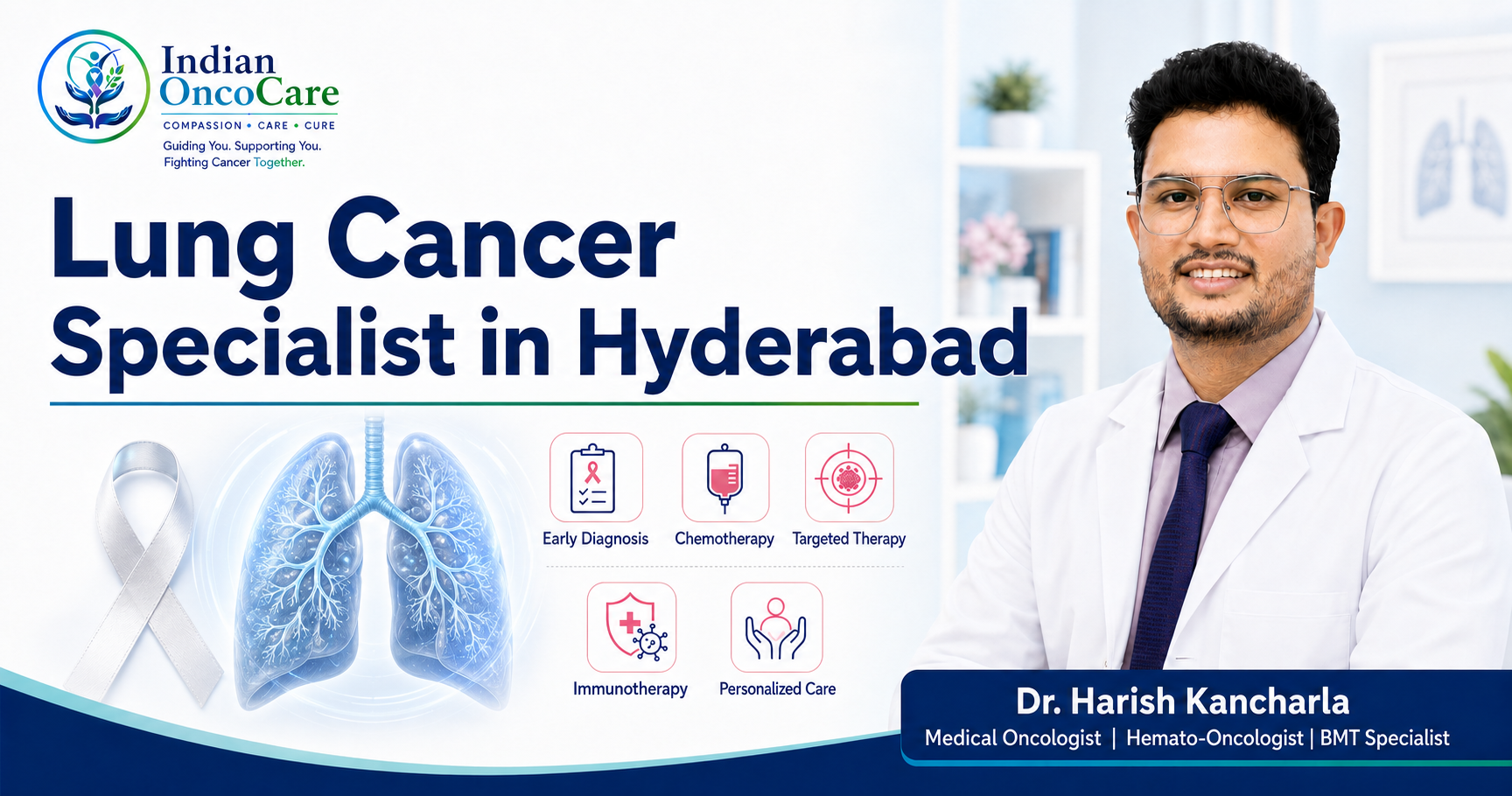
Lung cancer is one of the most commonly diagnosed cancers in India, and it is also one where treatment has changed the most in the last decade. What was once a single chemotherapy pathway is now a set of very different treatments — chosen from the tumour’s molecular profile — and getting that choice right at the start makes a real difference to how well treatment works.
At Indian OncoCare, lung cancer treatment is planned and supervised personally by Dr. Harish Kancharla, DM (Medical Oncology, AIIMS Delhi), Senior Consultant – Medical Oncology & Hemato-Oncology at Yashoda Hospitals, Somajiguda, Hyderabad, working alongside thoracic surgeons, radiation oncologists and pathologists as one team.
Whether you have an abnormal chest scan, a biopsy report already in hand, or are seeking a second opinion on a plan advised elsewhere, this page explains how lung cancer is diagnosed, why molecular testing matters so much, and how your individual treatment plan is decided.
When to see a lung cancer specialist
Many early lung cancer symptoms are easy to mistake for a chest infection or a smoker’s cough, which is why persistent symptoms deserve proper evaluation. See a specialist if you have:
- A cough that persists for more than two to three weeks, or a change in a long-standing cough
- Coughing up blood, or blood-stained phlegm
- Breathlessness, wheezing or a hoarse voice that does not settle
- Chest, shoulder or back pain that is persistent
- Repeated chest infections that keep coming back
- Unexplained weight loss, loss of appetite or persistent fatigue
Lung cancer is not limited to smokers. A significant number of patients in India have never smoked, so these symptoms are worth checking regardless of smoking history — particularly if a chest X-ray or CT has already shown a nodule or shadow.
Types of lung cancer and why the type matters
Lung cancer falls into two broad groups that behave differently and are treated differently:
- Non-small cell lung cancer (NSCLC) — around 80–85% of cases. It includes adenocarcinoma (the most common, and the type most often found in non-smokers), squamous cell carcinoma and large cell carcinoma.
- Small cell lung cancer (SCLC) — a faster-growing type, strongly linked to smoking, which is treated primarily with chemotherapy and radiation rather than surgery in most cases.
Within NSCLC, the subtype and — crucially — the tumour’s molecular profile decide the treatment. Two patients with the same adenocarcinoma on the microscope can receive completely different drugs depending on which mutation their tumour carries. This is why accurate typing and molecular testing come before any treatment decision.
How lung cancer is diagnosed
Diagnosing lung cancer usually involves several steps, each building on the last:
- Imaging — a CT scan of the chest, and a PET-CT to assess whether the disease has spread. An MRI of the brain may be added in certain situations.
- Biopsy — a tissue sample is essential to confirm the diagnosis. Depending on where the tumour sits, this may be taken by bronchoscopy, an EBUS-guided needle, or a CT-guided biopsy through the chest wall.
- Pathology and molecular testing — the sample confirms the type, and is then tested for driver mutations and PD-L1, which determine treatment.
Because so much depends on the biopsy, it is important that enough tissue is taken to allow full molecular testing — not just enough to confirm cancer. Where a tissue biopsy is difficult or insufficient, a blood-based liquid biopsy can sometimes detect the key mutations instead.
Molecular testing — the step that decides treatment
In modern lung cancer care, molecular testing is not optional — it is what the treatment plan is built on. Your tumour is tested for the specific faults that drive its growth, and for markers that predict response to immunotherapy:
- Driver mutations — EGFR, ALK, ROS1, KRAS (including KRAS G12C), BRAF, MET, RET and NTRK, among others. Where one of these is present, a matched targeted therapy tablet is often the best first treatment — more effective and better tolerated than chemotherapy.
- PD-L1 expression — measured on the biopsy and reported as a score. A higher score predicts greater benefit from immunotherapy, which is now central to treating NSCLC without a driver mutation.
Next-generation sequencing (NGS) can read many of these genes from a single sample at once, and is increasingly the standard first test in advanced lung cancer. Testing is usually performed on your existing biopsy block, so a repeat procedure is often not needed — if your diagnosis was made elsewhere, carry the paraffin block and slides with you.
Lung cancer treatment options
Lung cancer treatment is chosen from the type, stage and molecular profile, and often combines more than one approach:
- Surgery — removal of the tumour (lobectomy or, less often, removal of a whole lung) is the main treatment in early-stage NSCLC, planned with the thoracic surgical team.
- Chemotherapy — used before or after surgery, as part of chemoradiation, or in advanced disease, and remains central in small cell lung cancer.
- Radiation therapy — including precise techniques such as SBRT for small early tumours in patients unfit for surgery, and chemoradiation for locally advanced disease.
- Targeted therapy — daily tablets matched to a specific driver mutation such as EGFR or ALK, often the preferred first treatment when that mutation is present.
- Immunotherapy — checkpoint inhibitors, used alone or with chemotherapy, guided by PD-L1 status; now a standard part of NSCLC treatment.
If your plan is likely to involve drug therapy, our guide on what to expect during your first chemotherapy cycle walks through a treatment day step by step.
How your treatment plan is decided
No two lung cancer plans are identical. Before treatment begins, the following are reviewed together: the type and molecular profile from your biopsy; the stage, from PET-CT and other imaging; your lung function and general fitness; and any other medical conditions you have.
Because lung cancer treatment can span surgery, radiation and drug therapy, your case is discussed jointly by medical, surgical and radiation oncology — a multidisciplinary approach that decides not only which treatments you need, but the order in which they are given. In lung cancer especially, waiting for the molecular report before committing to a plan often changes the first treatment entirely, and is time well spent.
Early, locally advanced and advanced lung cancer
In early-stage lung cancer, the goal is cure — usually through surgery, sometimes followed by chemotherapy, targeted therapy or immunotherapy to reduce the chance of the cancer returning. Small early tumours in patients unfit for surgery can often be treated with precise radiation (SBRT) instead.
In locally advanced disease, chemoradiation followed by immunotherapy is a common approach. In advanced or metastatic lung cancer, treatment focuses on controlling the disease and maintaining quality of life — and this is where targeted therapy and immunotherapy have most transformed outcomes, with many patients now living well for years on treatment that was not available a decade ago.
Wherever you are on this spectrum, the realistic goal for your situation is explained to you honestly at consultation.
Lung cancer in non-smokers
A common and harmful myth is that lung cancer only affects smokers. In India, a substantial proportion of lung cancer patients have never smoked — and non-smokers’ tumours are more likely to carry treatable driver mutations such as EGFR and ALK.
This is precisely why molecular testing matters for every patient, smoker or not. A never-smoker with an EGFR-positive tumour may do very well on a targeted tablet, an option that would be missed without testing. If you have been diagnosed with lung cancer and no mutation testing has been done, it is worth asking why.
Seeking a second opinion on lung cancer treatment
A second opinion before starting lung cancer treatment is reasonable and common. In lung cancer it is particularly valuable, because a plan built before the molecular and PD-L1 results are available may not be the right one — and the difference between a targeted tablet and chemotherapy is significant.
Our guide on getting a cancer second opinion in Hyderabad sets out exactly which reports, pathology blocks and scans to send so that the review is genuinely useful.
Why choose Indian OncoCare for lung cancer treatment
Lung cancer treatment is complex and often long, and coordinated care matters. At Indian OncoCare:
- Your plan is prepared and reviewed personally by Dr. Harish Kancharla, DM (Medical Oncology, AIIMS Delhi), MD (Internal Medicine, PGIMER Chandigarh).
- Treatment is delivered through the day-care and inpatient facilities at Yashoda Hospitals, Somajiguda, one of Hyderabad’s largest tertiary cancer centres.
- Surgical, radiation and medical oncology work together as one team, so your care is coordinated rather than fragmented.
- Molecular reports are interpreted carefully, and treatment is matched to your tumour rather than to a generic protocol.
Explore the full range of cancer services we offer, read about the patient journey from first enquiry to follow-up, or see our dedicated breast cancer specialist page for another area of focused care.
Support for patients and families
A lung cancer diagnosis affects the whole family, and practical support matters as much as medical treatment. Our patient support resources help you prepare for consultations and understand each step, while our financial guidance can help you understand treatment costs and the insurance or assistance options that may be available.
You can find more guidance and checklists in our patient resources section. Patients travelling from outside Hyderabad or from abroad usually begin with an online consultation before continuing treatment in person — see our international patients page for how this is coordinated.
Frequently asked questions
Q1. Which specialist treats lung cancer?
Lung cancer care involves several specialists — a thoracic surgeon for surgery, a radiation oncologist for radiotherapy, and a medical oncologist who plans and supervises chemotherapy, targeted therapy and immunotherapy. At Indian OncoCare these teams work together, with Dr. Kancharla coordinating the drug-therapy component of your care.
Q2. Does every lung cancer need chemotherapy?
No. If your tumour carries a driver mutation such as EGFR or ALK, a targeted therapy tablet is often the better first treatment. If PD-L1 is high, immunotherapy may lead. Chemotherapy remains important in many cases, especially small cell lung cancer, but it is no longer the automatic first step.
Q3. I have never smoked — can I still have lung cancer?
Yes. A significant number of lung cancer patients in India have never smoked, and their tumours are more likely to carry treatable driver mutations. This is exactly why molecular testing is recommended for every patient, regardless of smoking history.
Q4. Why is mutation testing so important in lung cancer?
Because it changes the treatment. A tumour with an EGFR, ALK or ROS1 mutation is often best treated with a matched tablet rather than chemotherapy. Starting treatment without this information risks choosing the wrong first-line therapy.
Q5. Can lung cancer be cured?
Early-stage lung cancer can often be cured, usually with surgery. In advanced disease, cure is less likely, but modern targeted therapy and immunotherapy can control the cancer and maintain good quality of life for extended periods. The realistic goal for your stage is explained honestly at consultation.
Q6. Do I need a fresh biopsy for testing or a second opinion?
Usually not. Molecular testing is generally performed on your existing biopsy block — carry the paraffin block and unstained slides from the original lab. Where tissue is insufficient, a blood-based liquid biopsy may be used. Our second opinion guide explains exactly what to bring.
Q7. How long does lung cancer treatment take?
It varies with type, stage and treatment. Surgery-based treatment for early disease spans a few months; targeted therapy and immunotherapy for advanced disease are continued for as long as they are working and tolerated. Your planned course is explained at the start.
Q8. Who will supervise my treatment?
Dr. Harish Kancharla, DM (Medical Oncology, AIIMS Delhi), MD (Internal Medicine, PGIMER Chandigarh), Senior Consultant – Medical Oncology & Hemato-Oncology at Yashoda Hospitals, Somajiguda, interprets the molecular reports and reviews the medical-oncology component of your treatment personally.
Related reading: Targeted Therapy · Immunotherapy · Chemotherapy · Breast Cancer Specialist · Cancer Second Opinion in Hyderabad · Your First Chemotherapy Cycle · Patient Support · Blog
Further reading:
National Cancer Institute — Lung Cancer · American Cancer Society — What Is Lung Cancer? · Centers for Disease Control and Prevention — Lung Cancer BasicsMedically reviewed by Dr. Harish Kancharla, DM (Medical Oncology, AIIMS Delhi), MD (Internal Medicine, PGIMER Chandigarh), Senior Consultant – Medical Oncology & Hemato-Oncology, Yashoda Hospitals, Somajiguda, Hyderabad. Telangana State Medical Council Registration No. 77186.
Last reviewed: August 2026.
This page is general information about lung cancer and its treatment and is not a substitute for personal medical advice. Treatment decisions must be made with a qualified oncologist who has reviewed your reports.