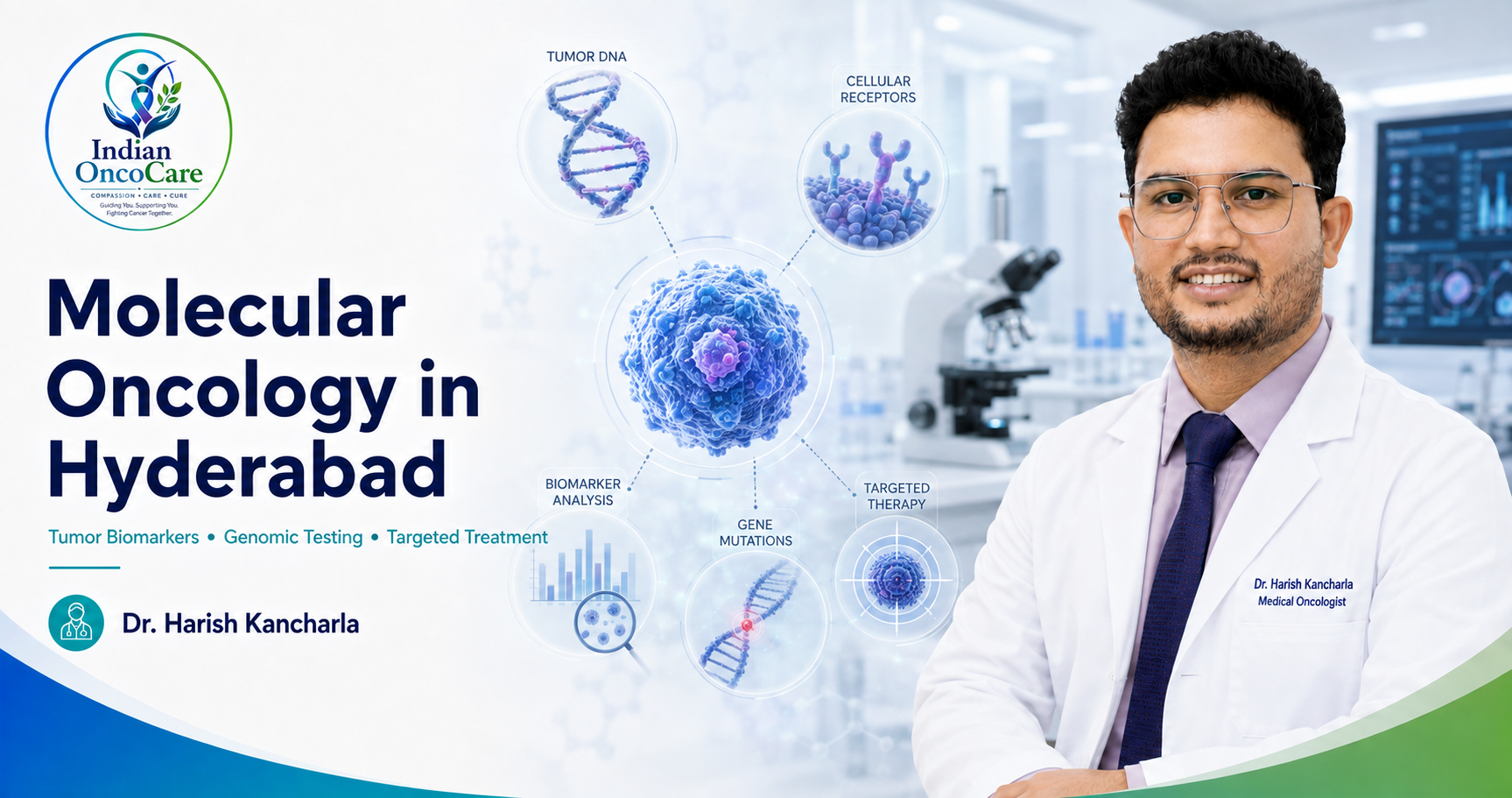
Quick answer: Molecular oncology is the testing that reads the genetic and molecular changes inside cancer cells — the "engine" behind precision medicine. Using techniques such as next-generation sequencing (NGS), immunohistochemistry (IHC), FISH and PCR, it identifies exactly what is driving your cancer and which treatments are most likely to work. At Indian OncoCare in Hyderabad, molecular results are interpreted and applied personally by Dr. Harish Kancharla, DM (Medical Oncology, AIIMS New Delhi), Senior Consultant – Medical Oncology & Hemato-Oncology at Yashoda Hospitals, Somajiguda, Hyderabad, with consultations in person and online for patients across India and abroad
Key facts at a glance
- What it is: laboratory testing of a tumour's genes and proteins — far beyond what a microscope alone can show.
- Techniques: NGS, IHC, FISH and PCR on tumour tissue, and circulating-tumour-DNA testing via a liquid biopsy from blood.
- What it finds: driver mutations, gene fusions, protein markers (HER2, PD-L1) and features such as microsatellite instability (MSI).
- Why it matters: each finding points to an action — a targeted therapy, an immunotherapy, or confirmation that standard chemotherapy is the best route.
- The key step: expert interpretation — a report is only useful when it is read correctly and acted on.
What is molecular oncology?
Molecular oncology is the study and testing of the genetic and molecular changes inside cancer cells. It is the diagnostic engine behind modern precision medicine — the detailed testing that tells your oncologist exactly what is driving your cancer and which treatments are most likely to work.
Where standard pathology confirms what a cancer is under the microscope, molecular oncology defines how it behaves at the level of its genes and proteins. That extra layer of information increasingly determines the entire treatment plan.
What does molecular testing look for?
Molecular testing identifies the specific features that shape treatment:
- Gene mutations — for example EGFR, KRAS or BRAF.
- Gene fusions and rearrangements — such as ALK, ROS1, RET or NTRK.
- Protein markers — such as HER2, hormone receptors, and PD-L1 (which helps select immunotherapy).
- Genomic features — such as microsatellite instability (MSI/dMMR) and tumour mutational burden (TMB).
These findings define the tumour's biology far beyond what the microscope alone can show — and some, like MSI-high or NTRK fusions, can guide treatment regardless of where the cancer started.
Which techniques are used?
Molecular oncology draws on several complementary laboratory methods, chosen to fit the question being asked:
- Next-generation sequencing (NGS) — reads many genes at once from DNA and RNA, efficient when several targets need checking.
- Immunohistochemistry (IHC) — measures protein expression on tissue, used for markers such as HER2, PD-L1, hormone receptors and mismatch-repair proteins.
- FISH (fluorescence in situ hybridisation) — detects gene amplifications and fusions, such as HER2 amplification or ALK rearrangement.
- PCR / RT-PCR — pinpoints specific known mutations or fusions quickly.
- Liquid biopsy (circulating tumour DNA) — a blood test that detects tumour DNA, valuable when tissue is limited or to track the cancer over time via liquid biopsy.
The right combination depends on your cancer type and the clinical decision at hand — testing is targeted, not indiscriminate.
How molecular testing guides your treatment
Each finding points to an action. A driver mutation may indicate a matched targeted therapy; PD-L1 or MSI may point to immunotherapy; other markers may confirm that standard chemotherapy is the best route. This is the core of turning molecular data into a real precision-medicine plan.
Testing can also guide treatment over time — at relapse, repeat testing may reveal a resistance mutation and open a new line of therapy. Understanding the underlying pathology first — see our guide to understanding your biopsy report — makes these results far easier to act on.
Do I need a new biopsy?
Usually not. Testing is typically done on your existing tumour block from an earlier biopsy or surgery. Where tissue is insufficient or difficult to obtain, a blood-based liquid biopsy is often a practical alternative. Your oncologist advises which sample is best for your situation.
How long do molecular results take?
It varies by test. A single-gene PCR result can return in a few days, while comprehensive NGS panels typically take one to a few weeks. Your oncologist plans treatment with the timeline in mind, so that waiting for results does not compromise care.
Is molecular testing the same as genetic testing?
Not quite. Molecular (biomarker) testing looks at changes in the tumour to guide treatment. Inherited genetic testing looks at changes you were born with that affect cancer risk — for you and your relatives. Both can be relevant, and both are available and coordinated here; your oncologist explains which applies and when.
Care for patients travelling to Hyderabad
Molecular oncology is well suited to remote, report-led care:
- Start online. Overseas and out-of-state patients usually begin with an online consultation and report review — molecular results and pathology blocks can often be assessed before you travel.
- Coordinated testing and treatment. Sample logistics, testing and treatment continue in person at Yashoda Hospitals, Somajiguda.
- Practical support. Our international patients service assists with report review, estimates and coordination, while patient support resources help you and your family prepare for each step.
If treatment has already been planned elsewhere, a second opinion that re-examines your molecular results is often worthwhile — an actionable target is sometimes present but not yet acted on.
Why choose Indian OncoCare
A molecular report is only useful when it is interpreted correctly and acted on. Your care is led personally by Dr. Harish Kancharla — DM (Medical Oncology), BRAIRCH, AIIMS New Delhi; MD (Internal Medicine), PGIMER Chandigarh; Telangana State Medical Council Reg. No. 77186 — who translates molecular findings into a practical, individualised treatment plan, delivered through Yashoda Hospitals, Somajiguda, Hyderabad. What this means for you:
- Expert interpretation, not just a lab report — the value lies in reading the biology correctly.
- One consultant across the journey, from testing through treatment and follow-up.
- The full diagnostic toolkit — molecular profiling, liquid biopsy and cancer genetic testing — feeding directly into your precision-medicine plan.
- Support for the whole family, including practical and financial guidance.
Frequently asked questions
Is molecular testing the same as genetic testing? Not quite. Molecular (biomarker) testing looks at changes in the tumour to guide treatment; inherited genetic testing looks at changes you were born with that affect risk. Both can be useful.
Do I need a new biopsy? Usually testing is done on your existing tumour block. Sometimes a blood-based liquid biopsy is an alternative.
How long do results take? It varies by test; NGS panels typically take one to a few weeks. Your oncologist plans treatment with this in mind.
Can international and out-of-state patients access this? Yes. Many begin with an online consultation and report review before travelling, then continue in person at Yashoda Hospitals, Somajiguda.
Who interprets the results? Dr. Harish Kancharla, DM (Medical Oncology, AIIMS New Delhi), interprets the molecular findings and plans treatment personally.
Related services at Indian OncoCare
Precision Medicine · Liquid Biopsy · Cancer Genetic Testing · Targeted Therapy · Immunotherapy · Chemotherapy · Day Care Chemotherapy · Second Opinion · Lung Cancer · Colorectal Cancer · Breast Cancer · Ovarian Cancer · Lymphoma · Head & Neck Cancer · Stomach Cancer · Liver Cancer · Pancreatic Cancer · Leukemia · Multiple Myeloma · Bone Marrow Transplant
Further reading (external, authoritative)
- U.S. National Cancer Institute — Biomarker Testing for Cancer Treatment
- U.S. National Cancer Institute — Tumor DNA Sequencing in Cancer Treatment
- American Cancer Society — Tumor Marker Tests
- ASCO / Cancer.Net — Biomarker Testing for Cancer
- European Society for Medical Oncology (ESMO) — Patient Guides
Medically reviewed by Dr. Harish Kancharla, DM (Medical Oncology, AIIMS New Delhi), MD (Internal Medicine, PGIMER Chandigarh), Senior Consultant – Medical Oncology & Hemato-Oncology, Yashoda Hospitals, Somajiguda, Hyderabad. Telangana State Medical Council Reg. No. 77186. Last reviewed: August 2026.
This page is general information about molecular oncology testing and is not a substitute for personal medical advice. Treatment decisions must be made with a qualified oncologist who has reviewed your reports.