Colorectal cancer — cancer of the colon or rectum — is among the most common cancers worldwide, and one of the most treatable when caught early. It is also rising in younger adults, which makes awareness of symptoms and screening more important than ever.
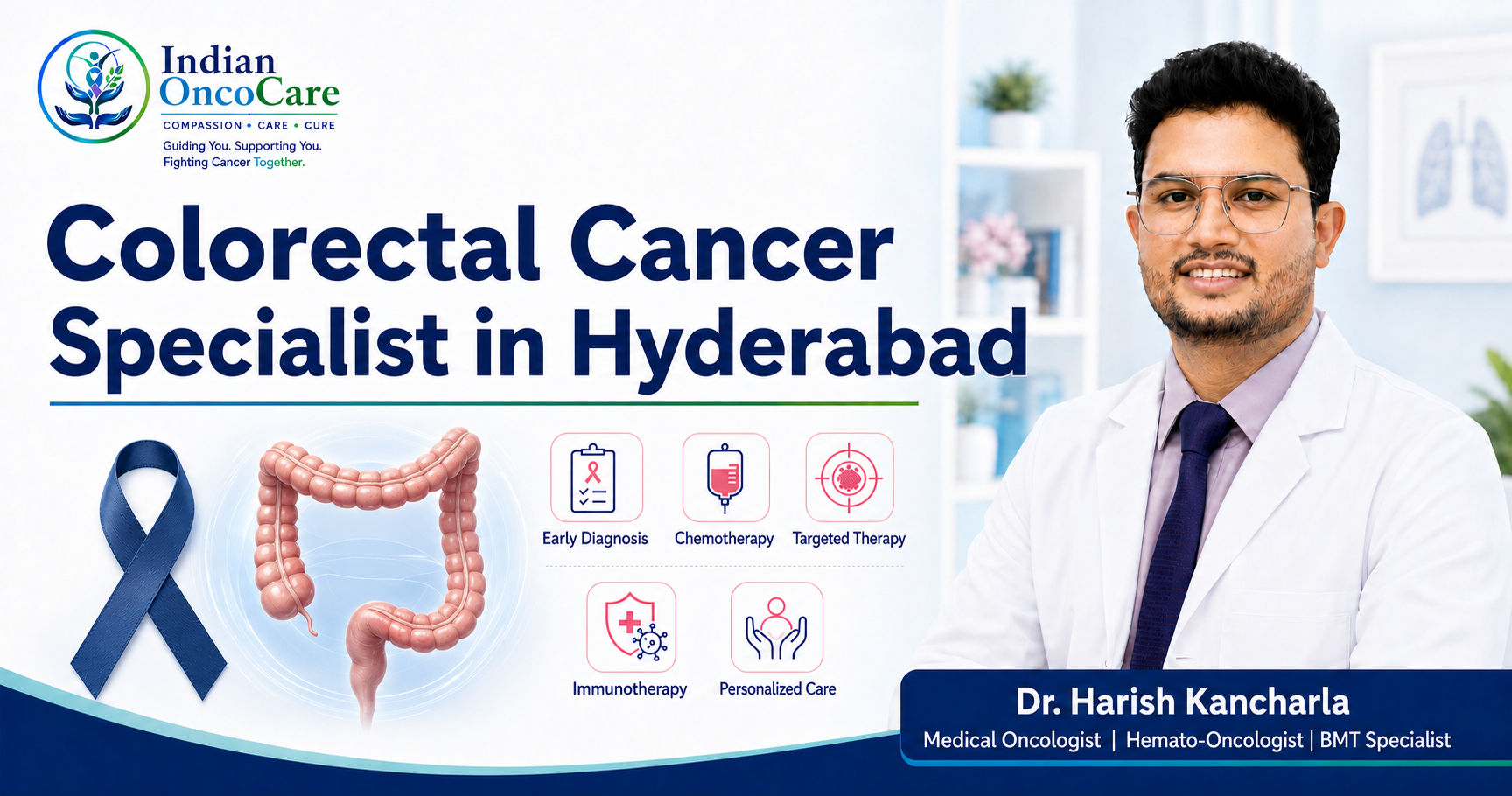
At Indian OncoCare, colorectal cancer treatment is planned and supervised personally by Dr. Harish Kancharla, DM (Medical Oncology, AIIMS Delhi), Senior Consultant – Medical Oncology & Hemato-Oncology at Yashoda Hospitals, Somajiguda, Hyderabad, working alongside colorectal and GI surgeons, radiation oncologists and pathologists as one team.
Whether you have an abnormal colonoscopy, a biopsy report already in hand, or are seeking a second opinion on a plan advised elsewhere, this page explains how colorectal cancer is diagnosed, why biomarker testing matters, and how your individual treatment plan is decided.
When to see a colorectal cancer specialist
Many colorectal cancer symptoms overlap with common, harmless conditions such as piles or infection, which is why persistent symptoms should be checked rather than assumed. See a specialist if you have:
- A lasting change in bowel habit — looser stools, constipation, or going more often
- Blood in the stool, or bleeding from the back passage
- A feeling that the bowel does not empty completely
- Persistent abdominal pain, cramping, bloating or discomfort
- Unexplained weight loss, weakness or tiredness
- Iron-deficiency anaemia found on a blood test with no obvious cause
Rectal bleeding is very often due to piles — but it should never be assumed to be piles without proper evaluation, particularly over the age of 40 or with a family history of bowel cancer.
Screening — the step that prevents and catches it early
Colorectal cancer is one of the few cancers that screening can actually prevent, not just detect early. Most bowel cancers begin as small growths called polyps, and removing a polyp at colonoscopy stops it ever becoming cancer.
Screening is generally recommended from around age 45, and earlier for those with a family history or a genetic risk. The main options are a colonoscopy — which both finds and removes polyps in one procedure — and stool-based tests such as the faecal immunochemical test (FIT). If you have symptoms, a diagnostic colonoscopy is arranged directly rather than waiting for routine screening.
If a colonoscopy has already shown a suspicious growth or a biopsy has confirmed cancer, the next step is proper staging and a treatment plan — which is where specialist review begins.
Colon cancer and rectal cancer — grouped, but not identical
Colon cancer and rectal cancer are grouped together as colorectal cancer because they share many features, but their treatment can differ significantly depending on exactly where the tumour sits.
Colon cancer is usually treated with surgery first, sometimes followed by chemotherapy. Rectal cancer, because of the rectum’s position deep in the pelvis, more often needs radiation and chemotherapy before surgery to give the best chance of clearance and to preserve function. This distinction is decided early, and it shapes the entire sequence of treatment.
How colorectal cancer is diagnosed
Confirming and staging colorectal cancer usually involves several steps:
- Colonoscopy and biopsy — the key test, allowing the tumour to be seen directly and a tissue sample taken for the pathologist.
- Imaging — a CT scan of the chest, abdomen and pelvis to check for spread, and an MRI of the pelvis for rectal cancers to plan surgery and radiation precisely.
- CEA blood test — a tumour marker measured at baseline and used to monitor response and follow-up.
- Pathology and biomarker testing — the biopsy or surgical specimen is tested for the genetic markers that guide drug treatment.
Accurate staging before treatment is essential in colorectal cancer, because the plan for a stage I tumour and a stage III or IV tumour are entirely different.
Biomarker testing — what guides drug treatment
In colorectal cancer, particularly advanced disease, biomarker testing directly determines which drugs will and will not work:
- RAS (KRAS and NRAS) and BRAF — these mutations decide whether certain targeted therapy antibodies will help. A RAS mutation, for example, means anti-EGFR drugs are unlikely to work, sparing you an ineffective treatment.
- MSI-H / dMMR — microsatellite instability or mismatch-repair deficiency. Tumours with this feature respond particularly well to immunotherapy, and it can also point to an inherited (Lynch) syndrome worth testing the family for.
- HER2 and NTRK — less common, but where present they open up additional targeted options.
The side of the colon the tumour arises from (left versus right) also influences drug choice. Testing is usually performed on your existing biopsy or surgical block, so a repeat procedure is generally not needed.
Colorectal cancer treatment options
Colorectal cancer treatment is chosen from the location, stage and biomarker profile, and often combines more than one approach:
- Surgery — the main treatment for localised disease, removing the affected segment of bowel and nearby lymph nodes, planned with the colorectal surgical team.
- Chemotherapy — given after surgery to reduce recurrence (adjuvant), before surgery in some cases, or as the backbone of treatment for advanced disease.
- Radiation therapy — used mainly in rectal cancer, frequently combined with chemotherapy before surgery (chemoradiation).
- Targeted therapy — anti-VEGF and, in RAS wild-type tumours, anti-EGFR antibodies, added to chemotherapy in advanced disease.
- Immunotherapy — highly effective in the subset of tumours that are MSI-H / dMMR.
In selected patients whose cancer has spread to the liver or lung, those secondary deposits can sometimes be removed surgically with curative intent — an important option that a specialist review looks for. If your plan involves drug therapy, our guide on what to expect during your first chemotherapy cycle walks through a treatment day step by step.
Rectal cancer — why it is treated differently
Rectal cancer deserves its own mention because its treatment has advanced considerably. For many rectal cancers, chemotherapy and radiation are given before surgery to shrink the tumour, improve clearance and protect bowel and continence function.
In some patients, an approach called total neoadjuvant therapy — giving all the chemotherapy and radiation before surgery — achieves such a good response that, in carefully selected cases with a complete response, surgery may even be deferred under close surveillance. These are specialised decisions made jointly by the surgical, radiation and medical oncology teams, and they are exactly why a coordinated, multidisciplinary plan matters in rectal cancer.
How your treatment plan is decided
No two colorectal cancer plans are identical. Before treatment begins, the following are reviewed together: the exact location (colon or rectum, and which part); the stage, from imaging and, for rectal cancer, pelvic MRI; the biomarker profile from your pathology; and your general fitness and other medical conditions.
Because treatment can span surgery, radiation and drug therapy, your case is discussed jointly by medical, surgical and radiation oncology. This multidisciplinary approach decides not only which treatments you need, but the order in which they are given — sequencing that, in rectal cancer especially, has a direct bearing on both cure and quality of life.
Early, locally advanced and advanced colorectal cancer
Early-stage colorectal cancer is often cured by surgery alone, sometimes with a course of chemotherapy afterwards to reduce the chance of return. Locally advanced disease — especially in the rectum — usually combines chemotherapy, radiation and surgery in a planned sequence.
In advanced or metastatic colorectal cancer, treatment aims to control the disease, relieve symptoms and prolong good-quality life — and modern chemotherapy combined with targeted therapy or immunotherapy has extended survival substantially. Importantly, a proportion of patients with limited spread to the liver or lung can still be treated with the aim of cure, which is why every advanced case deserves careful, individual assessment rather than a blanket approach.
Family history and hereditary colorectal cancer
Most colorectal cancer is not inherited, but a meaningful minority is linked to genetic conditions such as Lynch syndrome (HNPCC) or familial adenomatous polyposis (FAP). These matter for two reasons: they may change your own treatment, and they have direct implications for your close relatives.
An MSI-H / dMMR result on your tumour, colorectal cancer at a young age, or a strong family pattern of bowel, uterine or related cancers are all reasons to consider genetic counselling and testing. Where an inherited syndrome is confirmed, family members can be offered earlier screening — which, in a preventable cancer like this one, can be genuinely life-saving.
Seeking a second opinion on colorectal cancer treatment
A second opinion before starting colorectal cancer treatment is reasonable and common — particularly for rectal cancer, where the sequence of surgery, radiation and chemotherapy is complex, and for advanced disease, where biomarker results should shape the drug plan.
Our guide on getting a cancer second opinion in Hyderabad sets out exactly which reports, pathology blocks and scans to send so that the review is genuinely useful.
Why choose Indian OncoCare for colorectal cancer treatment
Colorectal cancer treatment often involves several teams over several months, and coordination matters. At Indian OncoCare:
- Your plan is prepared and reviewed personally by Dr. Harish Kancharla, DM (Medical Oncology, AIIMS Delhi), MD (Internal Medicine, PGIMER Chandigarh).
- Treatment is delivered through the day-care and inpatient facilities at Yashoda Hospitals, Somajiguda, one of Hyderabad’s largest tertiary cancer centres.
- Surgical, radiation and medical oncology work together as one team, so your care is coordinated rather than fragmented.
- Biomarker reports are interpreted carefully, and treatment is matched to your tumour rather than to a generic protocol.
Explore the full range of cancer services we offer, read about the patient journey, or see our dedicated breast cancer specialist and lung cancer specialist pages for other areas of focused care.
Support for patients and families
A colorectal cancer diagnosis affects the whole family, and practical support matters as much as medical treatment. Our patient support resources help you prepare for consultations and understand each step, while our financial guidance can help you understand treatment costs and the insurance or assistance options that may be available.
You can find more guidance and checklists in our patient resources section. Patients travelling from outside Hyderabad or from abroad usually begin with an online consultation before continuing treatment in person — see our international patients page for how this is coordinated.
Frequently asked questions
Q1. Which specialist treats colorectal cancer?
Colorectal cancer care involves several specialists — a colorectal or GI surgeon for surgery, a radiation oncologist (especially for rectal cancer), and a medical oncologist who plans and supervises chemotherapy, targeted therapy and immunotherapy. At Indian OncoCare these teams work together, with Dr. Kancharla coordinating the drug-therapy component of your care.
Q2. At what age should I get screened?
Screening is generally recommended from around age 45, and earlier if you have a family history or a known genetic risk. A colonoscopy is the most complete test because it both finds and removes polyps. If you have symptoms, see a doctor promptly regardless of age.
Q3. Does every colorectal cancer need chemotherapy?
No. Many early colon cancers are cured by surgery alone. Chemotherapy is added mainly for higher-stage disease, and rectal cancer often involves chemoradiation before surgery. See our chemotherapy page for how this is decided and planned.
Q4. How is colon cancer treatment different from rectal cancer?
Colon cancer is usually operated on first, sometimes with chemotherapy afterwards. Rectal cancer more often needs radiation and chemotherapy before surgery because of the rectum’s position in the pelvis. The distinction is decided early and shapes the whole plan.
Q5. Can colorectal cancer be cured?
Yes — particularly when found early, where surgery alone is often curative. Even when the cancer has spread to the liver or lung in a limited way, selected patients can still be treated with the aim of cure. The realistic goal for your stage is explained honestly at consultation.
Q6. Why is RAS / MSI testing important?
Because it decides which drugs work. RAS and BRAF results determine whether certain targeted antibodies will help, and an MSI-H / dMMR result identifies tumours that respond very well to immunotherapy. Testing avoids ineffective treatment and finds effective options.
Q7. Is colorectal cancer hereditary?
Most is not, but conditions such as Lynch syndrome and FAP run in families. A young age at diagnosis, an MSI-H result, or a strong family history are reasons to consider genetic counselling — which can protect relatives through earlier screening.
Q8. Who will supervise my treatment?
Dr. Harish Kancharla, DM (Medical Oncology, AIIMS Delhi), MD (Internal Medicine, PGIMER Chandigarh), Senior Consultant – Medical Oncology & Hemato-Oncology at Yashoda Hospitals, Somajiguda, plans and reviews the medical-oncology component of your treatment personally.
Related reading: Chemotherapy · Targeted Therapy · Immunotherapy · Breast Cancer Specialist · Lung Cancer Specialist · Cancer Second Opinion in Hyderabad · Your First Chemotherapy Cycle · Patient Support · Blog
Further reading:
National Cancer Institute — Colorectal Cancer · American Cancer Society — Colorectal Cancer · Centers for Disease Control and Prevention — Colorectal Cancer BasicsMedically reviewed by Dr. Harish Kancharla, DM (Medical Oncology, AIIMS Delhi), MD (Internal Medicine, PGIMER Chandigarh), Senior Consultant – Medical Oncology & Hemato-Oncology, Yashoda Hospitals, Somajiguda, Hyderabad. Telangana State Medical Council Registration No. 77186.
Last reviewed: August 2026.
This page is general information about colorectal cancer and its treatment and is not a substitute for personal medical advice. Treatment decisions must be made with a qualified oncologist who has reviewed your reports.