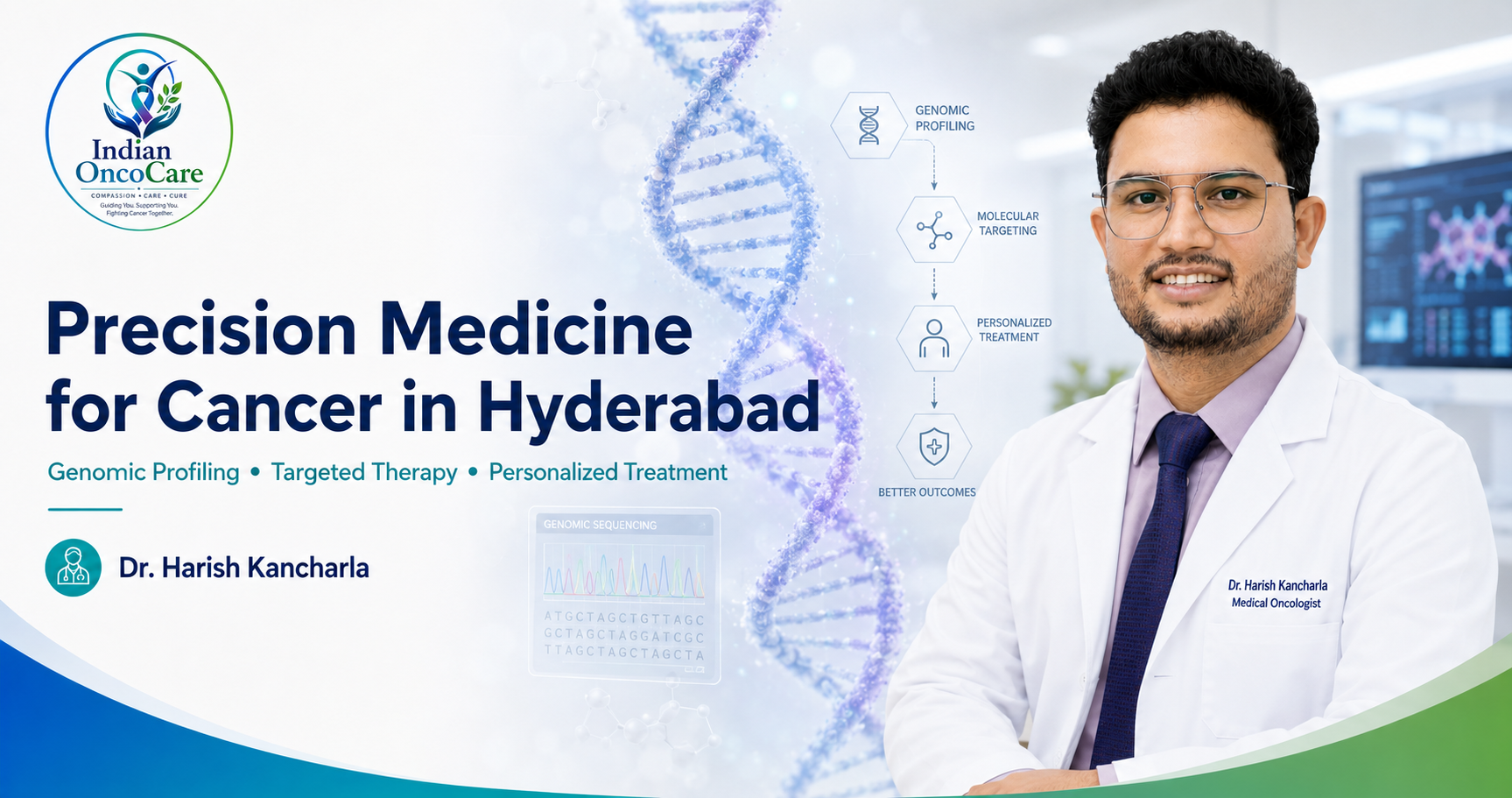
Quick answer: Precision medicine (also called personalised medicine) matches cancer treatment to the specific molecular profile of your tumour — its genes, proteins and biomarkers — rather than treating everyone with the same cancer in the same way. By testing what is actually driving your cancer, treatment can be matched to a targeted therapy or immunotherapy most likely to work, while sparing you those unlikely to help. At Indian OncoCare in Hyderabad, precision-medicine care is led personally by Dr. Harish Kancharla, DM (Medical Oncology, AIIMS New Delhi), Senior Consultant – Medical Oncology & Hemato-Oncology at Yashoda Hospitals, Somajiguda, Hyderabad, with consultations available in person and online for patients across India and abroad.
Key facts at a glance
- What it is: treatment guided by your tumour's biology, not a one-size-fits-all protocol.
- How it starts: molecular oncology and biomarker testing on a tumour sample — and, where useful, a liquid biopsy from blood.
- What it enables: targeted therapy matched to a specific mutation, or immunotherapy selected using markers such as PD-L1 or MSI.
- Where it helps most: lung, colorectal, breast and ovarian cancers, and many advanced or hard-to-treat cancers.
- Led by: a medical oncologist who interprets the results and builds a practical plan — testing alone is not enough.
What is precision medicine?
Precision medicine means tailoring cancer treatment to the specific biology of your tumour rather than treating every patient with the same diagnosis identically. Two people with the "same" lung or breast cancer can have very different genetic drivers — and therefore respond to very different treatments. By understanding the genes and proteins fuelling a particular cancer, oncologists can choose the treatment most likely to be effective.
This is not experimental. For many cancers, biomarker-guided treatment is now the standard of care, and it sits alongside surgery, radiation and chemotherapy as a core part of modern oncology.
How does precision medicine work?
The starting point is testing the tumour to find the specific changes driving it. Those results then guide treatment:
- Testing — biomarker and molecular testing on your tumour sample (and sometimes a blood-based liquid biopsy) identifies the mutations, fusions or protein markers present.
- Matching — a targeted therapy is matched to a particular mutation, or immunotherapy is selected using markers such as PD-L1, MSI or tumour mutational burden.
- Planning — results are interpreted in the context of your diagnosis, stage and overall health, and turned into a treatment plan.
The aim is to choose treatments most likely to help while sparing you those unlikely to work — reducing wasted time, cost and side effects.
Who benefits from precision medicine?
Precision medicine is now part of routine care in several cancers, for example:
- Lung cancer — EGFR, ALK, ROS1 and other drivers (a major reason lung cancer in people who never smoked is often highly treatable).
- Colorectal cancer — RAS, BRAF and MSI status.
- Breast cancer — HER2 and hormone-receptor status.
- Ovarian cancer — BRCA and HRD status.
What tests are involved?
- Tumour biomarker testing on a biopsy or surgical sample — the foundation of a precision plan. Understanding your biopsy and pathology report is the first step.
- Molecular oncology / next-generation sequencing (NGS) — panels that read many genes at once to find actionable changes.
- Liquid biopsy — a blood test detecting tumour DNA, useful when tissue is limited or to monitor response over time.
- Cancer genetic testing — germline testing where a hereditary risk is suspected, which can guide both treatment and family screening.
Your oncologist advises which of these is actually useful in your situation, rather than ordering every test by default.
How much does precision medicine cost in Hyderabad?
There is no single figure. Cost depends on the type of test (a single biomarker versus a large NGS panel), whether tissue or a liquid biopsy is used, and the treatment that follows — a targeted drug or immunotherapy differs in price from standard chemotherapy. Testing done well can also save cost by avoiding treatments unlikely to work. You receive a personalised estimate after your reports are reviewed. For context, see the cost of cancer treatment in India and our financial guidance page on insurance and assistance.
Does precision medicine replace chemotherapy?
Not always. Sometimes a targeted drug or immunotherapy is preferred; often precision medicine works alongside chemotherapy rather than instead of it. Even where no actionable biomarker is found, standard treatment remains effective and is still personalised to your cancer's type and stage. Where treatment does involve chemotherapy, it can be delivered conveniently through day-care chemotherapy.
Care for patients travelling to Hyderabad
Precision medicine is well suited to remote, report-led care:
- Start online. Overseas and out-of-state patients usually begin with an online consultation and report review — often molecular results can be assessed before you travel.
- Coordinated care. Testing and treatment continue in person at Yashoda Hospitals, Somajiguda, with Dr. Kancharla's team.
- Practical support. Our international patients service assists with report review, estimates and coordination, while patient support resources help you and your family prepare for each step.
If a plan has already been made elsewhere, a second opinion that includes a fresh look at your molecular results is often worthwhile — sometimes an actionable biomarker has been missed.
Why choose Indian OncoCare
Precision medicine is only as good as the interpretation behind it. Your care is led personally by Dr. Harish Kancharla — DM (Medical Oncology), BRAIRCH, AIIMS New Delhi; MD (Internal Medicine), PGIMER Chandigarh; Telangana State Medical Council Reg. No. 77186 — who reviews molecular results carefully and translates them into a practical, individualised plan, delivered through Yashoda Hospitals, Somajiguda, Hyderabad. What this means for you:
- Expert interpretation, not just a test report — the right treatment depends on reading the biology correctly.
- One consultant across the journey, from testing through treatment and follow-up.
- The full toolkit under one roof — molecular oncology, liquid biopsy and genetic testing.
- Support for the whole family, including practical and financial guidance.
Frequently asked questions
Is precision medicine right for every cancer? Not yet. It is standard in some cancers and emerging in others. Even where it does not apply, standard treatment remains effective and is still personalised to your cancer's type and stage.
What test is needed? Usually biomarker or molecular testing on your tumour sample, and sometimes a blood-based liquid biopsy. Your oncologist advises what is useful in your situation.
Does it replace chemotherapy? Not always. Sometimes a targeted drug or immunotherapy is preferred; often precision medicine works alongside chemotherapy.
Can international and out-of-state patients access this? Yes. Many begin with an online consultation and molecular-report review before travelling, then continue in person at Yashoda Hospitals, Somajiguda.
Who guides this for me? Dr. Harish Kancharla, DM (Medical Oncology, AIIMS New Delhi), interprets the results and plans treatment personally.
Related services at Indian OncoCare
Molecular Oncology · Liquid Biopsy · Cancer Genetic Testing · Targeted Therapy · Immunotherapy · Chemotherapy · Day Care Chemotherapy · Second Opinion · Lung Cancer · Colorectal Cancer · Breast Cancer · Ovarian Cancer · Head & Neck Cancer · Stomach Cancer · Liver Cancer · Pancreatic Cancer · Lymphoma · Leukemia · Multiple Myeloma · Bone Marrow Transplant
Further reading (external, authoritative)
- U.S. National Cancer Institute — Precision Medicine in Cancer Treatment
- U.S. National Cancer Institute — Biomarker Testing for Cancer Treatment
- American Cancer Society — Precision or Personalized Medicine
- ASCO / Cancer.Net — Biomarker Testing for Cancer
- European Society for Medical Oncology (ESMO) — Patient Guides
Medically reviewed by Dr. Harish Kancharla, DM (Medical Oncology, AIIMS New Delhi), MD (Internal Medicine, PGIMER Chandigarh), Senior Consultant – Medical Oncology & Hemato-Oncology, Yashoda Hospitals, Somajiguda, Hyderabad. Telangana State Medical Council Reg. No. 77186. Last reviewed: August 2026.
This page is general information about precision (personalised) cancer medicine and is not a substitute for personal medical advice. Treatment decisions must be made with a qualified oncologist who has reviewed your reports.