Ovarian cancer is often called a “silent” cancer because its early symptoms are vague and easily mistaken for everyday digestive or bladder problems. It is one of the more challenging gynaecological cancers, but treatment has advanced considerably — particularly with the arrival of PARP-inhibitor maintenance therapy — and getting the plan right from the start makes a real difference.
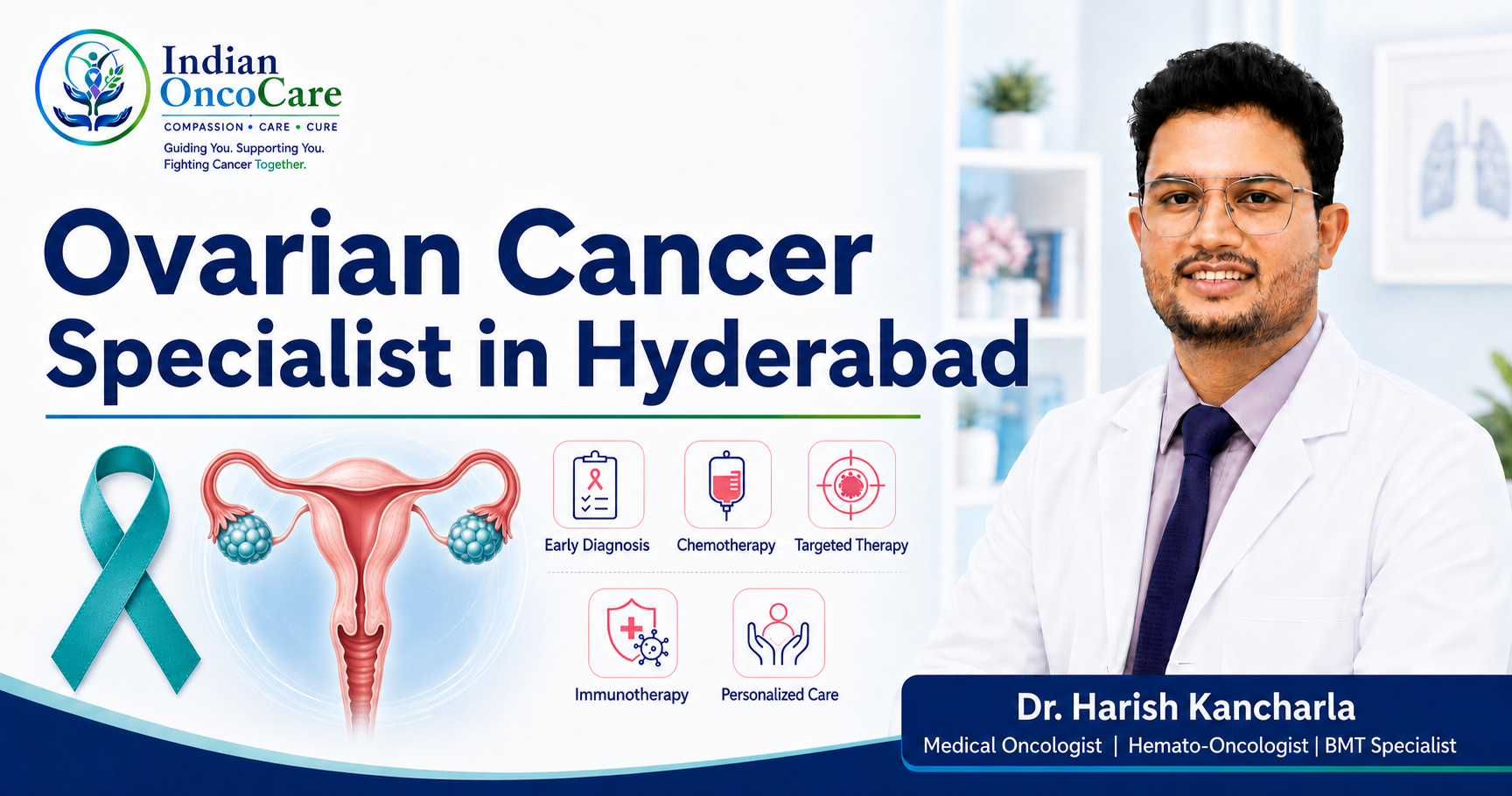
At Indian OncoCare, ovarian cancer treatment is planned and supervised personally by Dr. Harish Kancharla, DM (Medical Oncology, AIIMS Delhi), Senior Consultant – Medical Oncology & Hemato-Oncology at Yashoda Hospitals, Somajiguda, Hyderabad, working alongside gynaecological-oncology surgeons and pathologists as one team.
Whether you have an abnormal scan or a raised CA-125, a biopsy or surgical report already in hand, or are seeking a second opinion on a plan advised elsewhere, this page explains how ovarian cancer is diagnosed, why genetic testing matters, and how your individual treatment plan is decided.
When to see an ovarian cancer specialist
The symptoms of ovarian cancer are frequently subtle, which is why persistent, new or worsening symptoms should be checked rather than dismissed. See a specialist if you have:
- Persistent bloating or an increase in abdominal size
- Pelvic or abdominal pain that does not settle
- Feeling full quickly, or difficulty eating
- Needing to pass urine more often or more urgently
- Unexplained tiredness, weight loss or a change in bowel habit
Individually these are common and usually harmless. What matters is when they are new, persistent (present on most days for more than two to three weeks), and unlike your normal pattern — especially over the age of 50, or with a family history of ovarian or breast cancer.
Why ovarian cancer is often found late
Unlike cervical or colorectal cancer, there is no reliable screening test for ovarian cancer in women at average risk. CA-125 blood tests and ultrasound scans are useful once there is a concern, but they are not accurate enough to screen the general population, and a normal CA-125 does not rule cancer out.
This is precisely why symptom awareness and, for those with a family history, genetic testing matter so much. Women known to carry a BRCA mutation or a strong hereditary risk can be offered closer monitoring and risk-reducing options — the closest thing we currently have to prevention.
Types of ovarian cancer
Ovarian cancer is not a single disease, and the type strongly influences treatment:
- Epithelial ovarian cancer — by far the most common (over 90%), and includes high-grade serous (the commonest and most aggressive), low-grade serous, endometrioid, clear cell and mucinous subtypes.
- Germ cell tumours — less common, often affecting younger women, and usually very treatable.
- Sex-cord stromal tumours — rarer, sometimes hormone-producing.
Because they behave so similarly, fallopian tube cancer and primary peritoneal cancer are staged and treated in the same way as epithelial ovarian cancer. Identifying the exact type and subtype guides both the surgery and the drug treatment that follow.
How ovarian cancer is diagnosed and staged
Diagnosing and staging ovarian cancer usually involves several steps:
- Examination and ultrasound — a pelvic examination and a transvaginal ultrasound to assess the ovaries.
- CA-125 and other markers — a blood test used alongside imaging and to monitor response, though not diagnostic on its own.
- CT or MRI — to assess the extent of disease within the abdomen and pelvis.
- Tissue diagnosis — the definitive diagnosis is usually made from tissue obtained at surgery; where surgery is not the first step, an image-guided biopsy or fluid sample may be used.
Ovarian cancer is staged surgically using the FIGO system, from stage I (confined to the ovaries) to stage IV (spread beyond the abdomen). The stage, together with the type and how completely the tumour can be removed, shapes the whole treatment plan.
Genetic testing — BRCA, HRD and why it matters
Genetic testing is now a standard and important part of ovarian cancer care — recommended for essentially all women with epithelial ovarian cancer, not only those with a family history. It matters for two reasons:
- It guides your treatment. Tumours with a BRCA1/BRCA2 mutation or homologous-recombination deficiency (HRD) respond especially well to PARP-inhibitor targeted therapy, which has transformed outcomes in ovarian cancer.
- It protects your family. An inherited BRCA mutation is part of hereditary breast and ovarian cancer syndrome — so relatives can be offered testing, screening and risk-reducing options. This is the same gene change central to some breast cancers; see our breast cancer specialist page for the wider picture.
Testing may be done on a blood sample (germline) and on the tumour itself (somatic), and genetic counselling helps you and your family understand the results.
Ovarian cancer treatment options
Ovarian cancer treatment is built around two pillars — surgery and chemotherapy — with targeted therapy increasingly used to keep the cancer in remission:
- Surgery — cytoreductive (“debulking”) surgery to remove as much visible tumour as possible, performed by a gynaecological-oncology surgeon. Removing all visible disease is one of the strongest predictors of a good outcome.
- Chemotherapy — platinum-based chemotherapy (typically carboplatin with paclitaxel) is central to treatment, given after surgery or, in advanced disease, before surgery.
- Targeted therapy — PARP inhibitors (especially with a BRCA mutation or HRD) and anti-VEGF therapy, used largely as maintenance to prolong remission.
- Hormonal therapy — has a role in selected low-grade serous and some stromal tumours.
If your plan involves drug therapy, our guide on what to expect during your first chemotherapy cycle walks through a treatment day step by step.
Surgery and chemotherapy — the core, and their order
In ovarian cancer, the sequence of surgery and chemotherapy is a key decision. Where the disease can be removed well upfront, surgery is often done first, followed by chemotherapy. Where the disease is more extensive, or a patient is not fit for major surgery immediately, chemotherapy is given first to shrink the cancer, followed by “interval” debulking surgery and then further chemotherapy.
Both approaches are valid, and the choice depends on the extent of disease, your general health and what a specialist assessment judges is achievable. The shared goal is the same: to remove all visible cancer and treat what remains with effective chemotherapy.
Maintenance therapy and PARP inhibitors
One of the biggest advances in ovarian cancer has been maintenance therapy — treatment given after chemotherapy finishes to keep the cancer in remission for as long as possible. PARP inhibitors, taken as tablets, have substantially extended the time many women stay in remission, with the greatest benefit in those with a BRCA mutation or HRD-positive tumour. Anti-VEGF maintenance is another option in selected cases.
This is a major reason why genetic and HRD testing should be done early — the results directly determine whether these maintenance options apply to you.
How your treatment plan is decided
No two ovarian cancer plans are identical. Before treatment begins, the following are reviewed together: the type and subtype from pathology; the stage and extent of disease from imaging and surgery; your genetic and HRD status; and your general fitness and priorities.
Because ovarian cancer treatment combines complex surgery with drug therapy, your case is discussed jointly by gynaecological-oncology surgery and medical oncology. This multidisciplinary approach decides not only which treatments you need, but the order in which they are given — sequencing that has a direct bearing on outcome.
If ovarian cancer comes back
Ovarian cancer can respond very well to first treatment and then return later, so follow-up is an important part of care. When it does recur, treatment choices depend heavily on how long after platinum chemotherapy the cancer comes back — described as platinum-sensitive or platinum-resistant disease.
Platinum-sensitive recurrence often responds again to platinum-based chemotherapy, frequently followed by maintenance therapy. Platinum-resistant disease is approached with different drug combinations. Either way, recurrent ovarian cancer is treatable, and the goal shifts to controlling the disease and maintaining good quality of life over time.
Family history and hereditary ovarian cancer
A significant proportion of ovarian cancers are linked to inherited BRCA1 or BRCA2 mutations, part of hereditary breast and ovarian cancer syndrome. If you carry one of these mutations, your relatives may too — and testing allows them to make informed choices about screening and risk-reducing options.
Because the same genes raise the risk of breast cancer, families affected by one are often affected by the other; our breast cancer specialist page covers that side in more detail. Where an inherited risk is confirmed, genetic counselling helps the whole family navigate the implications sensibly.
Seeking a second opinion on ovarian cancer treatment
A second opinion before or early in ovarian cancer treatment is reasonable and common. It is particularly valuable here because the timing of surgery, the completeness of debulking, and whether genetic and HRD testing have been done all significantly affect the plan — and these are exactly the things a specialist review checks.
Our guide on getting a cancer second opinion in Hyderabad sets out exactly which reports, pathology blocks and scans to send so that the review is genuinely useful.
Why choose Indian OncoCare for ovarian cancer treatment
Ovarian cancer treatment is demanding and often spans surgery, chemotherapy and long-term maintenance, so coordinated care matters. At Indian OncoCare:
- Your plan is prepared and reviewed personally by Dr. Harish Kancharla, DM (Medical Oncology, AIIMS Delhi), MD (Internal Medicine, PGIMER Chandigarh).
- Treatment is delivered through the day-care and inpatient facilities at Yashoda Hospitals, Somajiguda, one of Hyderabad’s largest tertiary cancer centres.
- Gynaecological-oncology surgery and medical oncology work together as one team, so your care is coordinated rather than fragmented.
- Genetic and HRD results are interpreted carefully, so maintenance options are matched to your tumour rather than a generic protocol.
Explore the full range of cancer services we offer, read about the patient journey, or see our dedicated breast, lung and colorectal cancer specialist pages for other areas of focused care.
Support for patients and families
An ovarian cancer diagnosis affects the whole family, and practical support matters as much as medical treatment. Our patient support resources help you prepare for consultations and understand each step, while our financial guidance can help you understand treatment costs and the insurance or assistance options that may be available.
You can find more guidance and checklists in our patient resources section. Patients travelling from outside Hyderabad or from abroad usually begin with an online consultation before continuing treatment in person — see our international patients page for how this is coordinated.
Frequently asked questions
Q1. Which specialist treats ovarian cancer?
Ovarian cancer care is led by two specialists working together — a gynaecological-oncology surgeon, who performs the debulking surgery, and a medical oncologist, who plans and supervises chemotherapy and maintenance therapy. At Indian OncoCare, Dr. Kancharla coordinates the drug-therapy component of your care.
Q2. Is there a screening test for ovarian cancer?
Not a reliable one for women at average risk. CA-125 and ultrasound help once there is a concern but are not accurate enough for general screening, and a normal CA-125 does not exclude cancer. Symptom awareness and genetic testing for those at hereditary risk are more useful.
Q3. Should I have genetic (BRCA) testing?
Yes — genetic testing is recommended for essentially all women with epithelial ovarian cancer. It guides whether PARP-inhibitor maintenance will help you, and it has important implications for your relatives’ risk and screening.
Q4. Does ovarian cancer need chemotherapy?
In most cases, yes. Platinum-based chemotherapy is central to ovarian cancer treatment and is usually combined with surgery. Some very early, low-grade tumours may need less, which is decided from the pathology and stage.
Q5. What is maintenance therapy?
It is treatment given after chemotherapy finishes to keep the cancer in remission for longer. PARP inhibitors, taken as tablets, are the main example and work best in BRCA-mutated or HRD-positive tumours. This is why genetic testing is done early.
Q6. Can ovarian cancer be cured?
Early-stage ovarian cancer can often be cured. Advanced ovarian cancer is frequently controlled with long periods of remission rather than permanently cured, but modern surgery, chemotherapy and maintenance therapy have extended these remissions considerably. The realistic goal for your stage is explained honestly at consultation.
Q7. What happens if it comes back?
Recurrent ovarian cancer is still treatable. The approach depends on how long after platinum chemotherapy it returns — platinum-sensitive disease often responds to platinum again, while platinum-resistant disease is treated with other combinations. The focus shifts to controlling the disease and quality of life.
Q8. Who will supervise my treatment?
Dr. Harish Kancharla, DM (Medical Oncology, AIIMS Delhi), MD (Internal Medicine, PGIMER Chandigarh), Senior Consultant – Medical Oncology & Hemato-Oncology at Yashoda Hospitals, Somajiguda, plans and reviews the medical-oncology component of your treatment personally.
Related reading: Chemotherapy · Targeted Therapy · Hormonal Therapy · Breast Cancer Specialist · Lung Cancer Specialist · Colorectal Cancer Specialist · Cancer Second Opinion in Hyderabad · Your First Chemotherapy Cycle · Patient Support · Blog
Further reading:
National Cancer Institute — Ovarian Cancer · American Cancer Society — Ovarian Cancer · Centers for Disease Control and Prevention — Ovarian Cancer BasicsMedically reviewed by Dr. Harish Kancharla, DM (Medical Oncology, AIIMS Delhi), MD (Internal Medicine, PGIMER Chandigarh), Senior Consultant – Medical Oncology & Hemato-Oncology, Yashoda Hospitals, Somajiguda, Hyderabad. Telangana State Medical Council Registration No. 77186.
Last reviewed: August 2026.
This page is general information about ovarian cancer and its treatment and is not a substitute for personal medical advice. Treatment decisions must be made with a qualified oncologist who has reviewed your reports.