
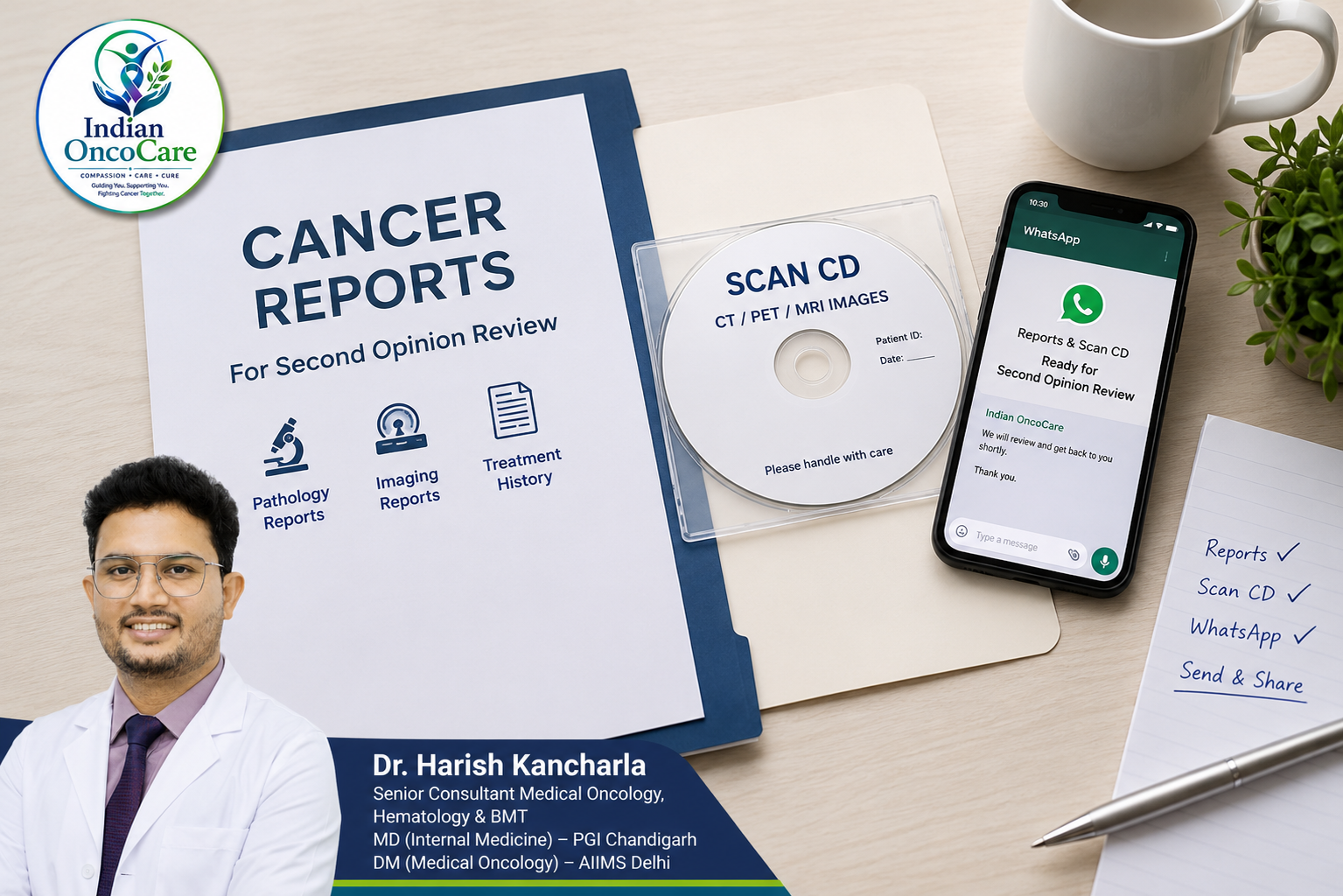
Asking for a second opinion is one of the most common things patients feel guilty about — and one of the least necessary things to feel guilty about.
In oncology, a second opinion is a normal, expected step. If you want to go straight to booking one, see our cancer second opinion in Hyderabad service page; this guide explains when it genuinely changes your treatment and exactly what to send.
This guide covers three things: when a second opinion genuinely changes something, when it probably will not, and exactly what to send so the review is worth your time.
What a second opinion actually is
A second opinion is an independent review of your diagnosis and treatment plan by another specialist — in medical oncology, usually a review of four things:
- The diagnosis itself — is the biopsy interpretation correct, and complete?
- The stage — has the cancer been fully mapped before treatment was planned?
- The plan — is the proposed sequence of surgery, chemotherapy, radiation and targeted drugs the right one, in the right order?
- What is missing — biomarker or mutation testing that has not been done, but should have been.
That fourth point is where second opinions most often add value in India. A plan is rarely "wrong." It is more often incomplete — built on testing that stopped one step too early.
When a second opinion is clearly worth it
Before you start treatment
This is the single best moment. Once chemotherapy begins, some options narrow — and re-testing on treated tissue is harder to interpret. If you are going to get one second opinion, get it before cycle one.
When the pathology report is uncertain
Phrases like "poorly differentiated," "favour," "cannot be excluded," "carcinoma of unknown primary," or an IHC panel that does not clearly point one way are all reasons to have the slides reviewed again.
When no mutation or biomarker testing was done
For several cancers — lung, colorectal, breast, and others — the drug you should receive depends on a molecular result, not on the cancer's location alone. If your file has no EGFR, ALK, HER2, PD-L1, MSI or similar report and treatment is being planned, ask why. This is the core of precision oncology and targeted therapy.
When surgery is proposed first — or ruled out entirely
The order matters. For some tumours, chemotherapy before surgery shrinks the disease and improves what the surgeon can achieve. For others, operating first is correct. A "not operable" opinion is also worth reviewing, because operability sometimes changes after systemic treatment.
When the cancer is rare
Sarcomas, neuroendocrine tumours, unusual lymphomas, and cancers in young adults are all situations where volume of experience genuinely changes the recommendation.
When you have been told nothing more can be done
Sometimes that is honest and accurate, and the right next step is good pain and palliative care. Sometimes there is a trial, a later-line targeted option, or an immunotherapy route that has not been considered. Both answers are worth hearing clearly.
At relapse or progression
A cancer that returns is biologically a different problem from the one first treated. Re-biopsy and re-testing are often appropriate, and the plan should be rebuilt rather than repeated.
When a second opinion probably will not change much
Being honest about this matters, because unnecessary rounds of opinions cost time, money and energy you will need later.
- The diagnosis is common, early-stage and the plan follows standard guidelines. Most oncologists will independently arrive at the same answer.
- You are mid-way through a treatment that is working. Changing course because of a corridor conversation is rarely wise.
- You have already had three or four opinions. If they broadly agree, a fifth is usually anxiety-seeking, not information-seeking. Pick the team you trust and start.
- You are shopping for a different answer to the same question. If four specialists say the same difficult thing, the fifth probably will too.
The goal of a second opinion is confidence in a decision — not an endless search for a better one.
Most second opinions confirm the original diagnosis. Their real value is in what gets added — a missing mutation test, a corrected stage, a better sequence of treatment — not in overturning what your first doctor said.
Exactly what to send: the complete checklist
A review is only as good as the file it is based on. Incomplete uploads are the most common reason a second opinion turns into "please send more and we will revert."
Send whatever you have from this list. Do not wait until you have everything — send what exists, and the gaps will be identified for you.
1. Pathology — the most important item
- Biopsy / histopathology report (HPE)
- Immunohistochemistry (IHC) report — often issued separately, a few days after the biopsy
- Molecular / NGS / mutation report, if done
- Bone marrow aspiration and biopsy reports, for blood cancers
- Flow cytometry report, for leukaemia and lymphoma
2. Paraffin blocks and unstained slides
This is the item most patients do not know about, and the one that most often unlocks a real second opinion.
Your tumour tissue is preserved as a paraffin block at the lab that processed your biopsy. You have the right to request it. With the block, a reviewing pathologist can re-examine the diagnosis and run additional IHC or molecular tests without putting you through a second biopsy.
Ask the original lab for the block plus 10–15 unstained slides. Keep the receipt or acknowledgement — labs will usually issue the block against a written request and return it afterwards.
3. Imaging — reports and the actual images
- PET-CT, CT, MRI, ultrasound, mammogram, bone scan reports
- The scan images themselves — the CD, DVD or the download link from the imaging centre
The written report is a radiologist's interpretation. For treatment planning, the oncologist frequently needs to look at the images directly. If you only have a CD, most imaging centres in Hyderabad will now email you a link on request — ask for it, because a CD is hard to share online.
4. Blood investigations
- Complete blood count (CBC)
- Liver function tests (LFT) and kidney function tests (RFT)
- Tumour markers, if done — CEA, CA-125, CA 19-9, PSA, AFP, beta-hCG, LDH
- Any recent viral markers, cardiac evaluation or 2D echo
5. Treatment records so far
- Discharge summaries from any admission
- Surgery notes, if you have had an operation
- Chemotherapy charts — this matters more than people expect. Send the drug names, doses, and the dates of each cycle, not just "I took 6 cycles." Which drug you have already received determines what can safely be used next.
- Radiation records — site treated, total dose, dates
- Current prescription, including drugs for diabetes, blood pressure, thyroid, heart conditions and blood thinners
6. A short written summary from you
Half a page, in your own words. Not medical language — just:
- When you first noticed something wrong, and what it was
- The order in which things happened, with rough dates
- What you have been told so far, and by whom
- Other illnesses you live with
- The specific question you want answered
That last line is the most useful sentence in the whole file. "Should I have surgery first or chemotherapy first?" gets you a far better review than "please advise."
How to send it — practically
- PDFs beat photos. If a report exists as a PDF, send the PDF. If you must photograph a paper report, shoot it flat in daylight, one page per photo, and check that the smallest text is readable before you send.
- Name your files. PET-CT-12-Mar-2026.pdf is instantly usable. IMG_2847.jpg is not.
- Send in date order. Oldest first.
- Do not crop. The header, date and lab name on a report are part of the information.
- Do not send only the last page. The full report matters, including the parts that look like formalities.
You can send everything through the enquiry form or directly on WhatsApp. For scan images that are too large to share, mention it — a transfer link will be arranged.
Will waiting for a second opinion make things worse?
This is the fear that stops most people, so it deserves a direct answer.
For the majority of solid tumours, a few days to two weeks spent getting a properly informed second opinion does not measurably worsen the outcome — and frequently improves it, because treatment starts on a complete plan rather than a partial one. Cancers that have been growing for months are not usually altered by a fortnight.
But some situations are genuine emergencies and must not wait. Go to a hospital immediately, and get the second opinion afterwards, if there is:
- Difficulty breathing, or swelling of the face and neck
- New weakness in the legs, numbness, or loss of bladder or bowel control
- Fever during or after chemotherapy, especially with chills
- Uncontrolled bleeding
- Severe, rapidly worsening pain
- Confusion, drowsiness or seizures
- A newly diagnosed acute leukaemia — these are treated urgently by design
If you are unsure which category you are in, call rather than wait for a written reply.
What happens after the review
A useful second opinion ends with a clear, written position on four points:
- Whether the diagnosis and stage are confirmed — or what further testing is needed to confirm them
- What the recommended treatment plan is, and in what sequence
- Where it agrees or differs from the first plan, and why
- What it will realistically involve — number of cycles, likely side effects, monitoring schedule, and cost
If the plan involves chemotherapy, immunotherapy or targeted therapy, you should leave the consultation knowing what the drug is, why it was chosen for your specific tumour, and what it is meant to achieve.
You are also under no obligation to transfer your care. Many patients take the second opinion back to their original oncologist and continue there. That is a completely legitimate outcome — and a good doctor will not be offended by it.
If you do decide to start treatment here, the first cycle is described step by step in What to Expect During Your First Chemotherapy Cycle.
Second opinions from outside Hyderabad
You do not need to travel for a review.
Patients from across Telangana and Andhra Pradesh, from other Indian states, and from abroad regularly begin with an online consultation — reports are shared in advance, the review happens over video, and travel only becomes necessary if and when treatment is actually planned here.
For patients travelling to Hyderabad from overseas, the sequence and coordination are set out on the International Patients page.
Frequently asked questions
Will my current doctor find out, or be offended?
Second opinions are routine and expected in oncology. You are not obliged to inform anyone, though telling your treating doctor usually makes the process smoother — records are shared faster and the two plans can be reconciled properly.
Do I need to repeat all my scans and tests?
Usually not. That is precisely why the original reports, images and paraffin blocks are worth collecting — most reviews can be done on existing material. Repeat testing is requested only where the existing information is genuinely inadequate.
How long does a second opinion take?
Once a reasonably complete file is received, a review is typically possible within a few days. Incomplete files are what create delay — which is what the checklist above is designed to prevent.
Can I get a second opinion if treatment has already started?
Yes. It is more useful before cycle one, but a mid-treatment review is entirely reasonable — particularly if the disease is not responding as expected, or if side effects are becoming difficult to manage.
Is a second opinion useful if I cannot afford expensive treatment?
Yes, and arguably more so. A large part of what a review does is establish what is genuinely necessary versus what is optional, and identify effective treatment within a realistic budget. Cost is a legitimate thing to raise in the consultation, not something to hide.
What if the two opinions disagree?
This happens, and it is not a disaster. Ask each doctor specifically why they favour their approach and what evidence supports it. Genuine disagreement usually reflects a real grey area in the evidence — and understanding that grey area helps you choose. A multidisciplinary tumour board discussion can also be requested.
In short: get a second opinion before treatment starts, when pathology is uncertain, when mutation testing is missing, when the cancer is rare, or when you have been told there are no options left. Send the pathology report, the IHC, the blocks and slides, the scan images, the blood work, the treatment history and one clear question.
That file, reviewed properly, is worth more than any number of conversations.
Reviewed by Dr. Harish Kancharla DM (Medical Oncology), BRAIRCH — AIIMS, New Delhi · MD (Internal Medicine), PGIMER, Chandigarh Senior Consultant – Medical Oncology & Hemato-Oncology, Yashoda Hospitals, Somajiguda, Hyderabad Telangana State Medical Council Registration No. 77186 Last reviewed: 25 July 2026
This article is general information, not personal medical advice. Cancer treatment decisions depend on your individual diagnosis, stage, test results and overall health. Please see our Medical Disclaimer.