What is targeted therapy?
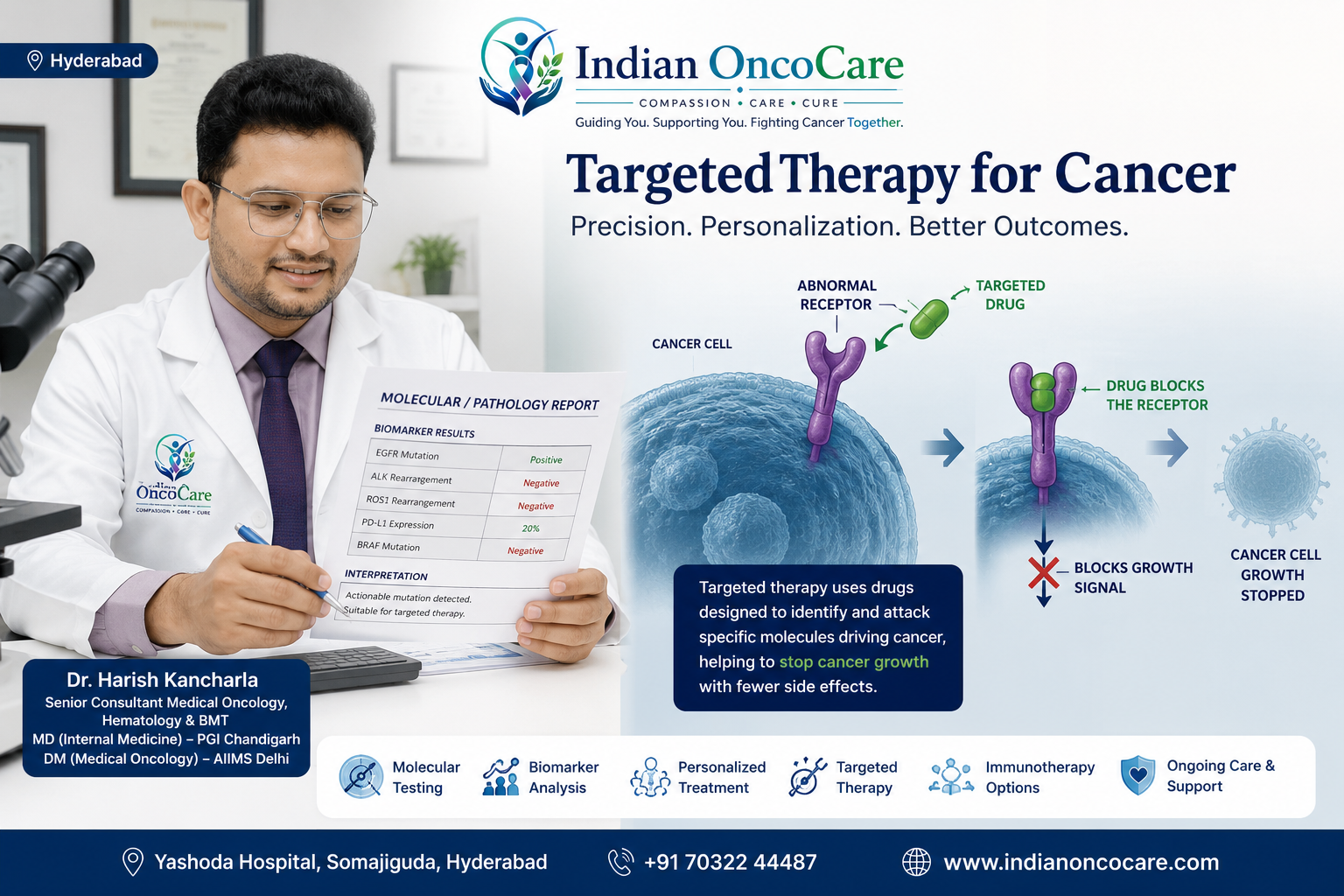
Targeted therapy uses drugs designed to block one specific molecule — a mutated gene, a protein or a signalling pathway — that a particular cancer depends on in order to grow. Because healthy cells do not rely on that same faulty switch, the drug affects the tumour far more than the rest of the body.
This is what separates it from chemotherapy, which acts on all rapidly dividing cells, and from immunotherapy, which works by releasing your own immune system against the tumour. Targeted therapy attacks the cancer's machinery directly.
The consequence is important: targeted therapy only works if your tumour actually carries the target. Identifying that target through laboratory testing is not an optional extra — it is the entire basis of the treatment, and it is why this approach is also called precision oncology.
Testing comes first
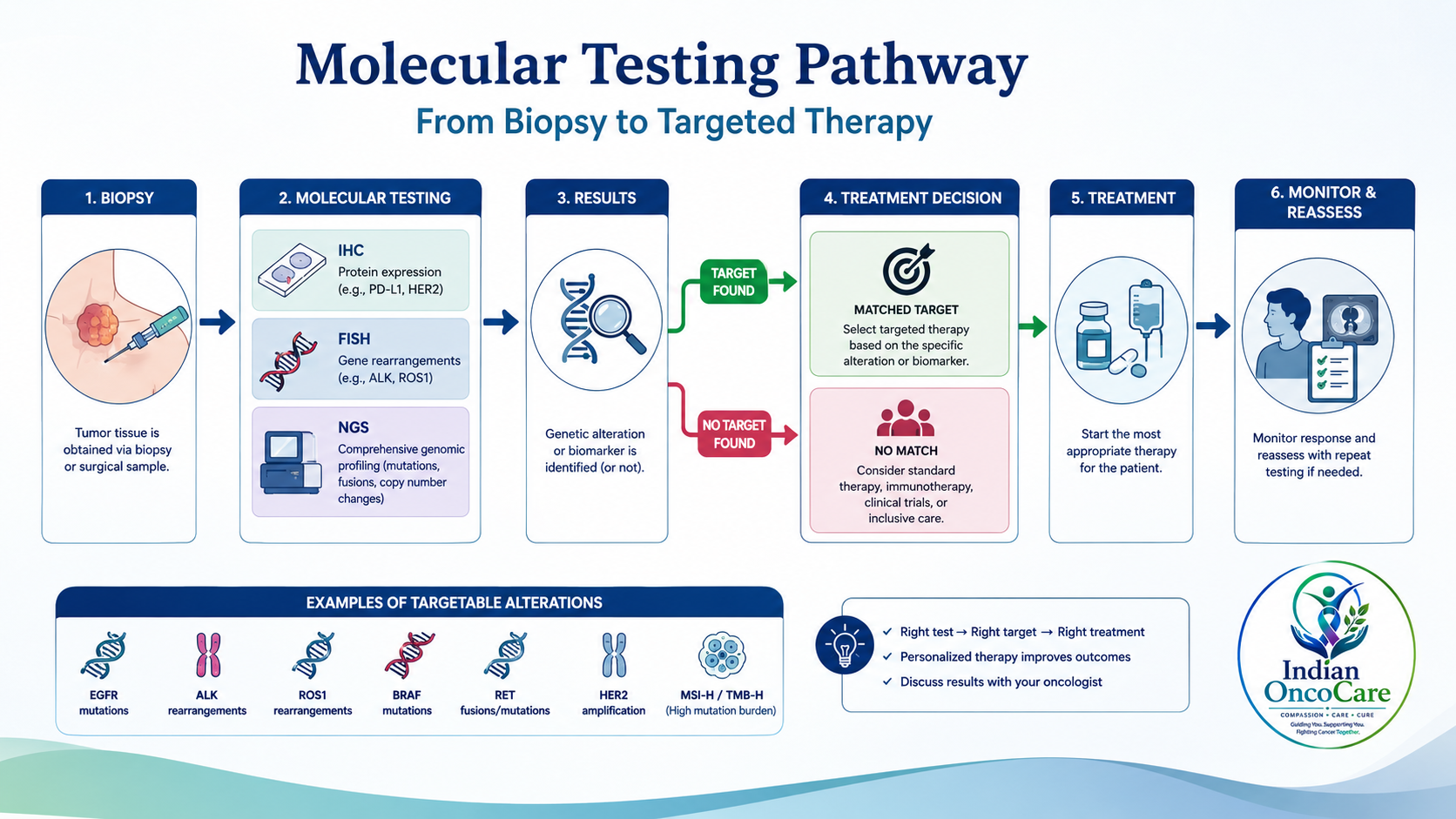
Before targeted therapy can be considered, your tumour tissue or blood is tested to find out whether an actionable target is present:
- Immunohistochemistry (IHC) — protein-level testing on the biopsy, used for markers such as HER2 and ER/PR.
- FISH and PCR — detect specific gene rearrangements and mutations one at a time.
- Next-generation sequencing (NGS) — a panel that reads many genes simultaneously from a single sample, increasingly the standard first test in advanced cancer.
- Liquid biopsy (ctDNA) — mutation testing from a blood sample, useful when tissue is insufficient, when the tumour is difficult to biopsy, or to detect resistance later in treatment.
In most cases this testing is performed on the paraffin block from your original biopsy, so a fresh procedure is not needed. If your diagnosis was made elsewhere, carry the block or unstained slides with you to the consultation — it usually saves several weeks and avoids a repeat biopsy.
Results typically take between a few days and two to three weeks depending on the test. Where treatment cannot safely wait, an interim plan is started and revised once the report arrives.
Common targets and the cancers they occur in
These are among the targets most often found in Indian patients. The list is illustrative, not exhaustive — new targets are added to practice regularly.
- EGFR, ALK, ROS1, MET, RET, KRAS, BRAF — non-small cell lung cancer, where mutation testing is now routine at diagnosis
- HER2 — breast cancer and some stomach and oesophageal cancers
- ER and PR with CDK4/6 pathway — hormone receptor positive breast cancer
- BRCA1, BRCA2 and other HRD mutations — ovarian, breast, prostate and pancreatic cancers, treated with PARP inhibitors
- BCR-ABL — chronic myeloid leukaemia, one of the earliest and most successful targeted therapy stories
- BTK pathway — chronic lymphocytic leukaemia and certain lymphomas
- FLT3 and IDH — acute myeloid leukaemia
- VEGF and angiogenesis — colorectal, kidney, liver and ovarian cancers
- NTRK fusions — rare, but treatable across almost any tumour type regardless of where the cancer started
Types of targeted drugs
Small-molecule inhibitors, whose names usually end in -inib, are taken as tablets or capsules at home, most often once or twice daily and continuously rather than in cycles.
Monoclonal antibodies, whose names end in -mab, are too large to be absorbed as tablets and are given as an intravenous infusion, typically every two to four weeks in the day-care unit.
Antibody-drug conjugates are a newer class that combines both principles: an antibody finds the cancer cell and delivers a chemotherapy payload directly to it, concentrating the drug where it is needed and sparing much of the rest of the body.
Which form applies to you depends entirely on which target your tumour carries, not on preference.
Targeted therapy, chemotherapy and immunotherapy — how they differ
These three treatments are frequently confused, including in second opinions patients bring to us.
Targeted therapy blocks a specific fault inside the cancer cell. It requires a positive mutation test, usually works quickly, and is often taken as a daily tablet. Its main limitation is that cancers eventually find a way around the block.
Chemotherapy destroys rapidly dividing cells throughout the body. It does not need a biomarker, works in a broad range of cancers, and remains the correct first treatment in many situations — you can read how chemotherapy is planned and delivered on our chemotherapy page.
Checkpoint immunotherapy releases your own immune system to attack the tumour. It takes longer to show effect but can produce durable control in patients whose tumours carry the right markers.
They are frequently combined or sequenced rather than chosen between. A HER2-positive breast cancer may receive a targeted antibody alongside chemotherapy; a lung cancer without a driver mutation may receive chemotherapy with immunotherapy. Your histopathology report and molecular results decide this, not the general reputation of any one treatment.
Taking oral targeted therapy safely
Most targeted tablets are taken at home every day, which makes them convenient but places real responsibility on the patient. These points matter:
- Take it at the same time every day. Consistent blood levels are what keep the target blocked.
- Follow the food instruction exactly. Some drugs must be taken on an empty stomach, others with food — the difference can substantially change how much drug is absorbed.
- Never stop or restart on your own, even if you feel well or feel unwell. Stopping abruptly can allow rapid regrowth in some cancers.
- Ask what to do about a missed dose before it happens, so you are not guessing at night.
- Check every other medicine with your oncologist. Antacids and proton pump inhibitors, antifungals, some antibiotics, anti-TB drugs, cardiac medicines, St John's Wort and grapefruit juice all interfere with common targeted drugs.
- Tell us about ayurvedic, homeopathic and herbal preparations. Several alter drug levels directly.
- Store and handle the tablets as advised, and keep them out of reach of children.
Side effects and monitoring
Targeted therapy does not usually cause the pattern of side effects people associate with chemotherapy. Significant hair loss and severe vomiting are uncommon, and blood counts are affected less by most agents.
The effects that do occur are specific to the pathway being blocked. Drugs acting on EGFR commonly cause an acne-like rash, dry skin and inflammation around the nails.
Diarrhoea is frequent with several classes. Anti-angiogenic drugs can raise blood pressure, cause protein loss in urine and increase bleeding risk. Some agents cause hand-foot syndrome, mouth ulcers, altered liver tests, thyroid changes or eye disturbance. HER2-directed antibodies require periodic heart scans because they can reduce heart pumping function, usually reversibly.
Because of this, monitoring is scheduled rather than occasional: blood pressure checks, liver and kidney function, blood counts, and an echocardiogram or ECG where the drug requires it. Dose reduction is a normal part of treatment, not a failure — many patients continue on a lower dose for years with the same benefit.
Symptoms that need urgent attention
Do not stop your targeted therapy tablet on your own because of a side effect. Call us first — most problems are managed with a short break, a dose adjustment or supportive treatment, and stopping without advice can cost you the response you have gained.
Contact the team promptly if you develop:
- New or worsening breathlessness or dry cough
- Severe or persistent diarrhoea, or inability to keep fluids down
- A rash that is spreading, blistering or involves the mouth or eyes
- Yellowing of the eyes or skin, or dark urine
- Chest pain, palpitations, or swelling of the legs
- Severe headache, or blood pressure readings much higher than your usual
- Bleeding that does not settle, or black stools
- Painful mouth ulcers preventing you from eating or drinking
Keep an up-to-date list of your targeted therapy tablet with you and show it to any doctor you consult, including in an emergency department. Several of these drugs interact with medicines commonly prescribed elsewhere.
When targeted therapy stops working
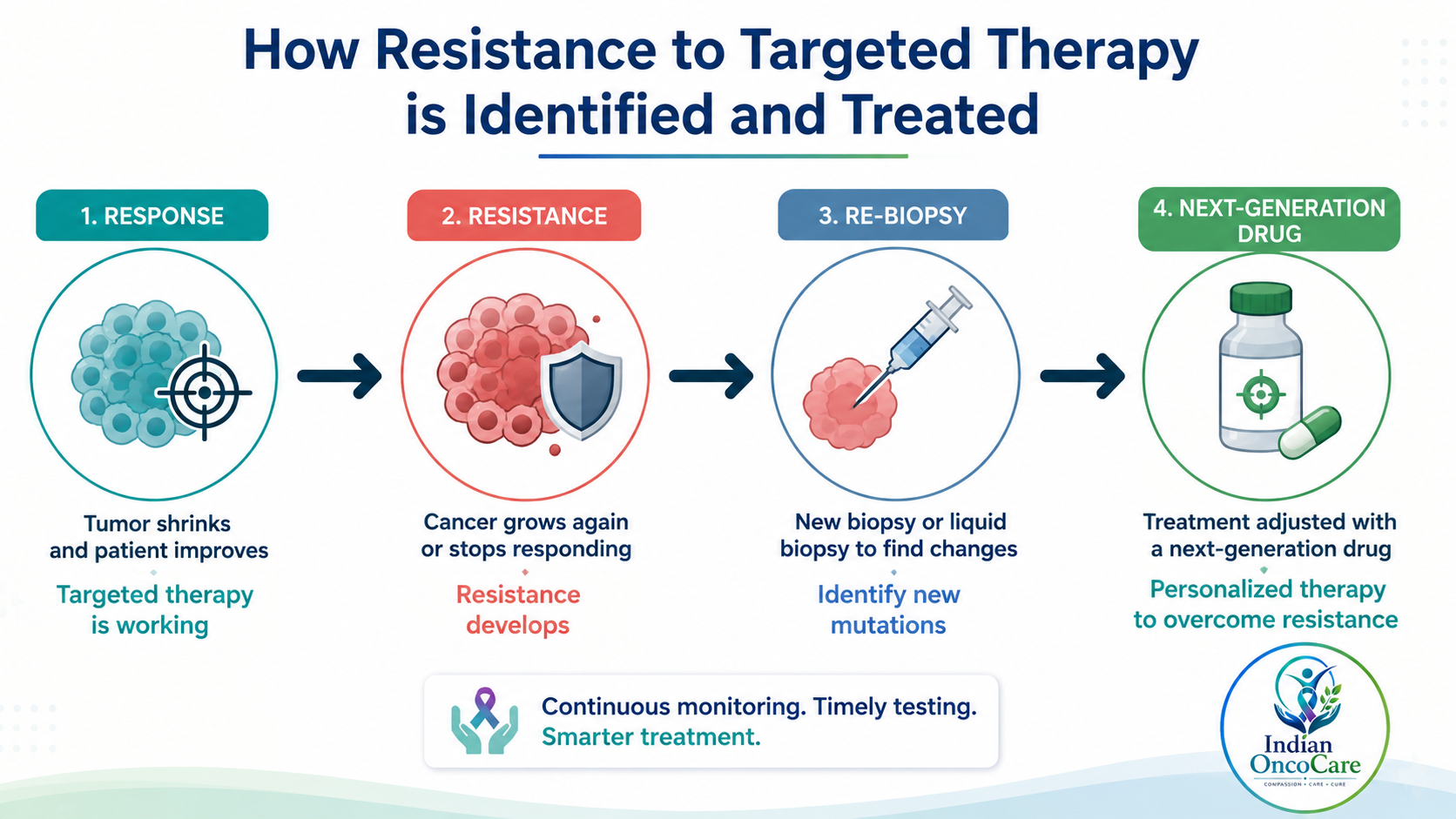
Most cancers treated with targeted therapy eventually develop resistance — the tumour acquires a new mutation that bypasses the blocked pathway. This is expected, and it is not the end of treatment options.
At that point a repeat biopsy or a liquid biopsy is often done to identify the resistance mechanism. In several cancers, particularly EGFR and ALK-positive lung cancer, a next-generation drug exists that works specifically against the new mutation. Where it does not, treatment moves to another approach.
This is why molecular testing is not a one-time event. Re-testing at progression is part of good practice, and it is a conversation worth having before the situation arises rather than during it.
If no target is found
A negative mutation report is a genuinely useful result, not a wasted test. It rules out drugs that would not have worked, spares you their cost and side effects, and directs treatment to what will work.
Many cancers have no actionable target, and for those, chemotherapy treatment, immunotherapy, or a combination of the two remains the established and effective approach. A negative report changes the plan; it does not reduce it.
Cost, access and second opinions
Targeted drugs vary widely in cost. Several older tyrosine kinase inhibitors are available as Indian generics at a fraction of their original price, while newer agents remain expensive. Manufacturer patient assistance programmes exist for a number of drugs, and insurance coverage differs between policies and schemes.
Molecular testing itself also has a cost, and a broad NGS panel costs more than testing for a single mutation. Which test is appropriate depends on your cancer — for some, one targeted test is sufficient and a full panel would be unnecessary spending.
Share your diagnosis and reports with the coordination team for an indicative estimate before you commit. If targeted therapy has been advised elsewhere, a second opinion confirming both the molecular finding and the drug choice is reasonable and routine.
Patients outside Hyderabad and overseas usually begin with an online consultation and continue treatment in person at Yashoda Hospitals, Somajiguda.
Frequently asked questions
Q1. How is targeted therapy different from chemotherapy?
Targeted therapy blocks one specific fault the cancer depends on and requires a positive mutation test. Chemotherapy destroys rapidly dividing cells generally and does not need a biomarker. Side effect patterns differ completely. See our chemotherapy page for how that treatment is planned.
Q2. Is targeted therapy the same as immunotherapy?
No. Targeted therapy acts on the cancer cell itself; immunotherapy acts on your immune system so that it can attack the cancer. Both are guided by testing, but by different tests and different drugs.
Q3. Can everyone have targeted therapy?
No. It works only when your tumour carries an actionable target, which is confirmed by laboratory testing. Where no target is found, other treatments are used.
Q4. Is it always a tablet?
Not always. Small-molecule inhibitors are tablets; monoclonal antibodies and antibody-drug conjugates are intravenous infusions given in day care.
Q5. How long will I be on it?
Usually for as long as it is working and tolerated, which can mean many months or several years of continuous daily treatment — a different pattern from a fixed number of chemotherapy cycles.
Q6. Does targeted therapy eventually stop working?
Often, yes. Cancers develop resistance over time. A repeat or liquid biopsy at that point may identify a resistance mutation for which a next-generation drug exists.
Q7. Do I need a fresh biopsy for mutation testing?
Usually not. Testing is generally performed on your existing paraffin block. Where tissue is inadequate or a resistance mutation is being looked for, a liquid biopsy from a blood sample may be used.
Q8. Who will supervise my treatment?
Dr. Harish Kancharla, DM (Medical Oncology, AIIMS Delhi), MD (Internal Medicine, PGIMER Chandigarh), Senior Consultant – Medical Oncology & Hemato-Oncology at Yashoda Hospitals, Somajiguda, interprets the molecular reports and reviews treatment personally.
Related treatments: Chemotherapy · Immunotherapy · Cellular Therapy (CAR-T) · Bone Marrow Transplantation · Genetic Counselling for Hereditary Cancers · Patient Support
Medically reviewed by Dr. Harish Kancharla, DM (Medical Oncology), MD (Internal Medicine), Senior Consultant – Medical Oncology & Hemato-Oncology, Yashoda Hospitals, Somajiguda, Hyderabad. Telangana Medical Council Registration No. 77186.
Last reviewed: July 2026.
This page is general information about targeted therapy and is not a substitute for personal medical advice. Targeted therapy is only appropriate where molecular testing confirms a treatable target, and all treatment decisions must be made with a qualified oncologist who has reviewed your reports.