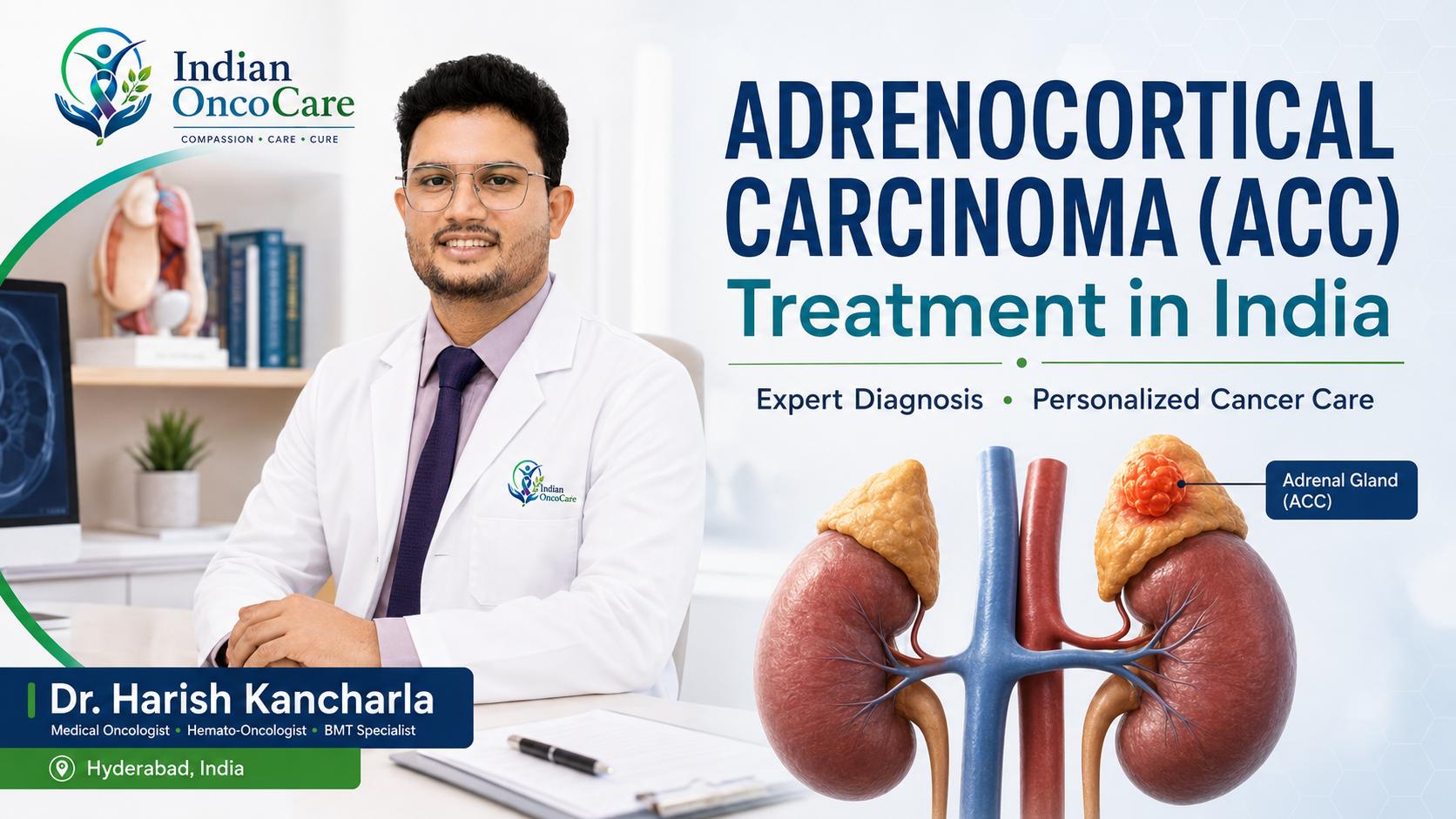
- What it is: a malignant tumour of the adrenal cortex (outer layer of the adrenal gland).
- How common: rare — roughly 0.7–2 cases per million people per year.
- Who it affects: all ages; most common around 40–50, with a smaller peak in young children.
- Main symptom driver: about 60% are "functioning" and over-produce hormones.
- Best chance of cure: complete surgical removal (R0) by an experienced surgeon.
- Only approved drug: mitotane, used after surgery in high-risk cases and in advanced disease.
- Advanced-disease chemotherapy: the EDP-M regimen (etoposide, doxorubicin, cisplatin + mitotane).
- Where treated in Hyderabad: Dr Harish Kancharla, Indian OncoCare.
What is adrenocortical carcinoma?
Adrenocortical carcinoma is a cancer that begins in the adrenal cortex — the outer layer of the adrenal gland — which produces hormones controlling blood pressure, salt and water balance, metabolism, and male/female characteristics. Because it is rare and behaves unpredictably, outcomes are closely tied to being treated at a centre that manages it regularly. At Indian OncoCare in Hyderabad, Dr Harish Kancharla coordinates surgery, mitotane therapy, chemotherapy and precision-medicine testing within a single connected plan.
"With a rare cancer like adrenocortical carcinoma, the difference isn't one drug — it's a team that knows the disease, sequences every step correctly, and manages the hormone problems alongside the tumour."
What are the symptoms of adrenocortical carcinoma?
Symptoms of ACC come either from hormone over-production or from the tumour itself. About six in ten ACCs are "functioning" and release excess hormones, so the first sign is often hormonal rather than a lump.
- Cortisol excess (Cushing's syndrome): weight gain around the trunk and face, easy bruising, high blood pressure, new or worsening diabetes, muscle weakness, mood changes.
- Androgen excess (more visible in women): new facial/body hair, acne, deepening voice, changes to periods.
- Oestrogen excess (in men): breast enlargement, reduced libido.
- Aldosterone excess: high blood pressure with low potassium.
- Local, non-hormonal signs: pain or fullness in the abdomen or flank; a mass found incidentally on a scan.
Any adrenal mass larger than about 4 cm, or one that grows or looks irregular, should be assessed by a specialist.
Benign adrenal tumour vs adrenocortical carcinoma
| Feature | Benign adenoma (common) | Adrenocortical carcinoma (rare) |
|---|---|---|
| Nature | Non-cancerous | Malignant, can spread |
| Typical size | Usually under 4 cm | Often larger than 4–6 cm |
| Growth | Stable over time | Grows; may look irregular |
| Hormones | Often none or mild | Frequently high, sometimes multiple |
| Action needed | Monitor | Urgent specialist referral |
How is adrenocortical carcinoma diagnosed?
Diagnosis combines dedicated imaging, hormone testing and expert pathology, and the stage at diagnosis shapes the whole treatment plan. Work-up usually includes:
- Imaging: an adrenal-protocol CT or MRI of the abdomen, a chest CT, and often an FDG-PET scan to check for spread.
- Hormone testing: blood and urine tests to identify which hormones the tumour makes; tests to exclude a phaeochromocytoma are done before surgery.
- Pathology and grading: after removal, the Ki-67 proliferation index and completeness of resection strongly predict behaviour. Our guide to Understanding Your Biopsy Report .
A needle biopsy is usually avoided when the tumour looks removable and a phaeochromocytoma has been excluded, because removing the whole tumour intact is both the diagnosis and the treatment.
Molecular and genetic testing. Some ACCs are linked to inherited conditions such as Li-Fraumeni syndrome (TP53). Where useful, we offer Cancer Genetic Testing and, in selected advanced cases, Molecular Oncology and Liquid Biopsy to find treatment targets.
ENSAT stages of adrenocortical carcinoma
| Stage | What it means |
|---|---|
| Stage I | Tumour 5 cm or smaller, confined to the adrenal gland |
| Stage II | Tumour larger than 5 cm, still confined to the gland |
| Stage III | Spread to nearby tissue, lymph nodes or veins |
| Stage IV | Spread to distant organs |
How is adrenocortical carcinoma treated?
| Situation | Main approach |
|---|---|
| Early / localised (I–II) | Complete surgery; mitotane if high-risk features |
| Locally advanced (III) | Surgery where possible + adjuvant mitotane ± radiotherapy |
| Advanced / metastatic (IV) | Mitotane + EDP-M chemotherapy; clinical trials; symptom control |
| Recurrent | Re-surgery if feasible; further chemotherapy; targeted/immunotherapy options |
ACC is best managed by a multidisciplinary team — surgeon, medical oncologist, endocrinologist, radiation oncologist and pathologist — working from one plan. The main treatments are below.
Surgery — the only curative treatment
Complete surgical removal of the tumour intact, with clear margins (R0), by a surgeon experienced in adrenal cancer, offers the only realistic chance of cure. For a known or suspected ACC, open surgery is usually preferred over keyhole surgery to avoid rupturing the tumour.
Mitotane and hormone control
Mitotane is the only drug specifically approved for ACC; it acts on adrenal-cortex cells and can also control hormone over-production. It is used after surgery for high-risk patients (incomplete removal, Ki-67 above 10%, or stage III) and in advanced disease. Blood levels are monitored to keep it effective, and steroid replacement is given. Managing hormone excess is part of care — see Hormonal Therapy .
Chemotherapy (EDP-M) for advanced disease
For advanced or metastatic ACC, the established first-line regimen is EDP-M — etoposide, doxorubicin and cisplatin with mitotane. If disease progresses, gemcitabine with capecitabine, streptozocin or temozolomide may be considered. Treatment is delivered through our Chemotherapy service, much of it as Day Care Chemotherapy .
Radiation therapy
Radiotherapy to the tumour bed can lower the risk of local recurrence in selected high-risk patients and helps control symptoms such as pain from areas of spread.
Immunotherapy, targeted and precision approaches
For advanced ACC that no longer responds to standard treatment, Immunotherapy and Targeted Therapy are being studied and may help selected patients, guided by tumour testing. Our Precision Medicine programme matches the right patient to the right option and identifies suitable clinical trials.
What is the survival rate for adrenocortical carcinoma?
Survival depends heavily on stage and on whether the tumour is fully removed — five-year survival ranges from roughly 15% to over 45%. It is best when the cancer is caught early and taken out intact by an experienced team, which is exactly why the first treatment decision matters so much, and why a second opinion before starting is worthwhile.
Getting a second opinion
A specialist review at diagnosis can confirm the stage and make sure the treatment sequence is right from day one. We welcome Second Opinion for Cancer requests; see how it works in Cancer Second Opinion in Hyderabad .
Why choose Dr Harish Kancharla and Indian OncoCare, India
- Experience with a rare cancer. Dr Harish Kancharla is among the few medical oncologists in India who treat adrenocortical carcinoma. [Add verified qualifications, years of experience, hospital affiliations and fellowships here — important for trust and search.]
- One connected plan. Surgery, mitotane management, chemotherapy, radiation and hormone control are coordinated so nothing falls between specialists.
- Modern testing built in. Genetic, molecular and liquid-biopsy testing are used where they change decisions.
- Support beyond the medicine. Patients and families are guided through every step.
Location & contact:
Indian OncoCare, at Yashoda Hospitals , 6-3-905, Raj Bhavan Rd, Matha Nagar, Somajiguda, Hyderabad, Telangana 500082 · Phone: +917032244487 · Serving patients across India and Internationally.
Cost, support and financial guidance
Explore Patient Support and Patient Financial Guidance , and read our honest overview of The Cost of Cancer Treatment in India . More reading is on Patient Resources .
International patients
Patients travelling to Hyderabad for ACC care are welcome. Our International Patients service helps with opinions on scans and reports, treatment planning and travel logistics.
Frequently asked questions
Is adrenocortical carcinoma curable? Yes, it can be — especially when found early and the whole tumour is removed intact by an experienced surgeon. Mitotane after surgery lowers the chance of it returning in high-risk cases. Advanced disease is harder to cure but can often be controlled.
What is the survival rate for adrenocortical carcinoma? Five-year survival ranges from about 15% to over 45%, depending mainly on the stage and whether the tumour is completely removed. Early diagnosis and complete surgery make the biggest difference.
Is mitotane available in India? Yes. Mitotane therapy — including the blood-level monitoring and steroid support it requires — can be managed in India as part of your treatment plan at an experienced centre.
What is the EDP-M regimen? EDP-M is the standard first-line chemotherapy for advanced adrenocortical carcinoma. It combines etoposide, doxorubicin and cisplatin (EDP) with mitotane (M).
How is ACC different from a benign adrenal tumour? Most adrenal growths are benign adenomas, but ACC is a malignant cancer that can spread. Larger size, an irregular appearance, growth over time and high hormone levels raise concern and call for specialist review.
Can adrenocortical carcinoma be treated without surgery? Surgery offers the only chance of cure, so it is preferred whenever the tumour is removable. When surgery isn't possible, mitotane, EDP-M chemotherapy, radiotherapy and — in selected cases — immunotherapy or targeted therapy are used to control the disease.
Who treats adrenocortical carcinoma in Hyderabad? Dr Harish Kancharla at Indian OncoCare is among the few medical oncologists in Hyderabad and India experienced in treating this rare cancer, offering surgery coordination, mitotane, EDP-M chemotherapy and precision medicine.
See more common questions on our main FAQ
About the author / medical review
Medically reviewed by Dr Harish Kancharla, Consultant Medical Oncologist, Indian OncoCare, Hyderabad.
A note on this information
This page is for general education and is not a substitute for personal medical advice. Adrenocortical carcinoma is complex and every case is different — please discuss your own situation with a qualified oncologist.
Trusted external references
- National Cancer Institute — Adrenocortical Carcinoma (patient information)
- National Organization for Rare Disorders (NORD) — Adrenal Cortex Carcinoma
- American Association for Cancer Research (AACR) — Adrenocortical Carcinoma overview
- The Lancet Diabetes & Endocrinology — Adrenocortical carcinoma: a practical guide for clinicians (2025)
- New England Journal of Medicine — FIRM-ACT trial (EDP-M in advanced ACC)