
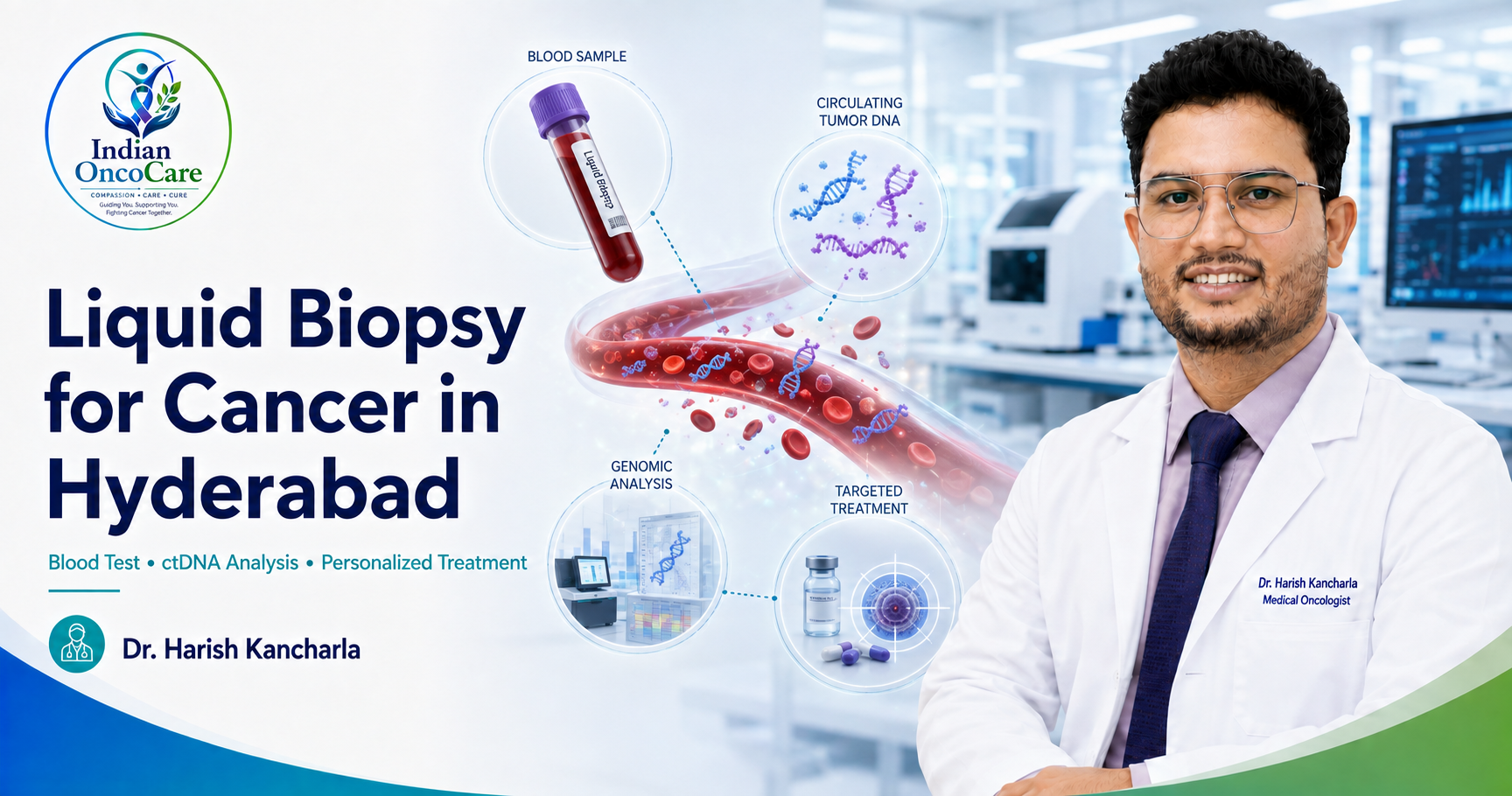
Quick answer: A liquid biopsy is a blood test that detects tumour DNA (and other cancer-derived material) circulating in the bloodstream, so cancer can be genotyped and monitored without cutting tissue. It is used when a tumour is hard to biopsy, to genotype quickly, and to track a cancer's response and resistance over time. At Indian OncoCare in Hyderabad, liquid-biopsy results are interpreted and applied personally by Dr. Harish Kancharla, DM (Medical Oncology, AIIMS New Delhi), Senior Consultant – Medical Oncology & Hemato-Oncology at Yashoda Hospitals, Somajiguda, Hyderabad, with consultations in person and online for patients across India and abroad.
Key facts at a glance
- What it is: a blood-based test that reads circulating tumour DNA (ctDNA) shed by the cancer.
- Minimally invasive: a simple blood draw — no surgical biopsy, and easily repeatable.
- What it finds: mutations, gene fusions and other markers that guide targeted therapy and immunotherapy.
- When it helps most: limited or hard-to-reach tissue, rapid genotyping, and monitoring over time.
- Important limit: a negative liquid biopsy does not rule cancer out — tissue testing remains the reference in many situations.
What is a liquid biopsy?
A liquid biopsy analyses tumour-derived material — most often circulating tumour DNA (ctDNA) — found in a sample of your blood. As a tumour grows, it sheds tiny fragments of DNA into the bloodstream; a liquid biopsy captures and reads them. In effect, it lets your oncologist study the cancer's genetics from a blood draw rather than a surgical sample.
It is a key tool within molecular oncology, feeding directly into a precision-medicine plan — but its defining advantage is that it is minimally invasive and can be repeated as often as clinically useful.
What can a liquid biopsy detect?
From a blood sample, a liquid biopsy can identify:
- Gene mutations — such as EGFR, KRAS or BRAF.
- Gene fusions and rearrangements — such as ALK or ROS1.
- Resistance mutations — new changes that emerge when a cancer stops responding to treatment (for example, EGFR T790M in lung cancer).
- Other genomic markers — depending on the panel used, features that help select systemic therapy.
These findings map to the same actions as tissue testing: a driver mutation may point to a matched targeted therapy, while other markers may guide immunotherapy or confirm that standard chemotherapy is the best route.
When is a liquid biopsy used?
A liquid biopsy is especially valuable in specific situations:
- When tissue is limited or hard to obtain — for tumours in locations that are risky or difficult to biopsy, or when an earlier sample is exhausted.
- For rapid, tissue-sparing genotyping — sometimes results return faster than a repeat tissue procedure allows.
- To monitor response — repeat testing can show whether a treatment is working at the molecular level.
- To detect resistance early — at progression, a liquid biopsy can reveal why a therapy has stopped working and open a new line of treatment.
Some newer applications — such as detecting minimal (molecular) residual disease after curative treatment, and multi-cancer early detection — are advancing rapidly but remain emerging and are used selectively. Your oncologist advises where a liquid biopsy genuinely adds value in your case.
Liquid biopsy vs tissue biopsy: which is better?
They are complementary, not competing. A tissue biopsy remains the reference standard for confirming a diagnosis under the microscope and for many molecular tests. A liquid biopsy adds a minimally invasive, repeatable window into the cancer's genetics — invaluable when tissue is scarce or when the cancer needs tracking over time. In practice, the two are often used together, and understanding your original biopsy report helps put liquid-biopsy results in context.
How does the test work, and how long do results take?
The test itself is simply a blood draw — no anaesthesia, no procedure. The sample is processed to isolate and sequence circulating tumour DNA. Turnaround varies by the panel used, but results are typically available within days to a couple of weeks. Because it is just a blood test, it can be repeated at intervals to follow the cancer's behaviour without additional procedures.
What are the limitations of a liquid biopsy?
Being honest about limits matters. A liquid biopsy depends on the tumour shedding enough DNA into the blood — so a negative result does not necessarily mean a mutation is absent; it may simply be below the level of detection. For that reason, tissue testing is still preferred in many situations, and a negative liquid biopsy is often followed by tissue analysis. A liquid biopsy also cannot replace tissue for the initial histological diagnosis. This is exactly why expert interpretation — rather than a report read in isolation — is essential.
How results guide your treatment
Each finding points to an action: a driver mutation may indicate a matched targeted therapy; resistance mutations at progression may switch you to a new line of treatment; and monitoring results may confirm a therapy is working or prompt an earlier change. Where a hereditary risk is suspected, separate cancer genetic testing may also be advised. If a plan has been made elsewhere, a second opinion that considers whether a liquid biopsy is warranted can be worthwhile.
Care for patients travelling to Hyderabad
A blood-based test is particularly convenient for patients at a distance:
- Start online. Overseas and out-of-state patients usually begin with an online consultation and report review before travelling.
- Coordinated testing. Sample collection, testing and treatment continue in person at Yashoda Hospitals, Somajiguda.
- Practical support. Our international patients service assists with report review, estimates and coordination, and patient support resources help you and your family prepare for each step. For cost context, see the cost of cancer treatment in India and our financial guidance page.
Why choose Indian OncoCare
A liquid-biopsy result is only useful when it is interpreted correctly and acted on in context. Your care is led personally by Dr. Harish Kancharla — DM (Medical Oncology), BRAIRCH, AIIMS New Delhi; MD (Internal Medicine), PGIMER Chandigarh; Telangana State Medical Council Reg. No. 77186 — who reads the molecular findings alongside your full clinical picture and translates them into a practical plan, delivered through Yashoda Hospitals, Somajiguda, Hyderabad. What this means for you:
- Expert interpretation, including knowing when a liquid biopsy will and will not help.
- One consultant across the journey, from testing through treatment and follow-up.
- The full diagnostic toolkit — molecular oncology, liquid biopsy and cancer genetic testing — feeding directly into precision medicine.
- Support for the whole family, including practical and financial guidance.
Frequently asked questions
Is a liquid biopsy just a blood test? Yes. It analyses tumour DNA circulating in a blood sample — no surgical procedure — and can be repeated as needed.
Can a liquid biopsy replace a tissue biopsy? Not entirely. Tissue remains the reference for diagnosis and many tests; a liquid biopsy complements it, and a negative result does not rule a mutation out.
When is a liquid biopsy most useful? When tissue is limited or hard to obtain, for rapid genotyping, to monitor response, and to detect resistance when a treatment stops working.
Can international and out-of-state patients access this? Yes. Many begin with an online consultation and report review before travelling, then continue in person at Yashoda Hospitals, Somajiguda.
Who interprets the results? Dr. Harish Kancharla, DM (Medical Oncology, AIIMS New Delhi), interprets the findings and plans treatment personally.
Related services at Indian OncoCare
Molecular Oncology · Precision Medicine · Cancer Genetic Testing · Targeted Therapy · Immunotherapy · Chemotherapy · Day Care Chemotherapy · Second Opinion · Lung Cancer · Colorectal Cancer · Breast Cancer · Ovarian Cancer · Lymphoma · Head & Neck Cancer · Stomach Cancer · Liver Cancer · Pancreatic Cancer · Leukemia · Multiple Myeloma · Bone Marrow Transplant
Further reading (external, authoritative)
- U.S. National Cancer Institute — Liquid Biopsy (definition)
- U.S. National Cancer Institute — Biomarker Testing for Cancer Treatment
- American Cancer Society — Tumor Marker Tests
- ASCO / Cancer.Net — Biomarker Testing for Cancer
- European Society for Medical Oncology (ESMO) — Patient Guides
Medically reviewed by Dr. Harish Kancharla, DM (Medical Oncology, AIIMS New Delhi), MD (Internal Medicine, PGIMER Chandigarh), Senior Consultant – Medical Oncology & Hemato-Oncology, Yashoda Hospitals, Somajiguda, Hyderabad. Telangana State Medical Council Reg. No. 77186. Last reviewed: August 2026.
This page is general information about liquid biopsy testing and is not a substitute for personal medical advice. Treatment decisions must be made with a qualified oncologist who has reviewed your reports.