Liver cancer — most commonly hepatocellular carcinoma (HCC) — usually develops against a background of long-standing liver disease such as hepatitis B, hepatitis C or cirrhosis. This makes both surveillance in at-risk people and careful, liver-aware treatment planning especially important.
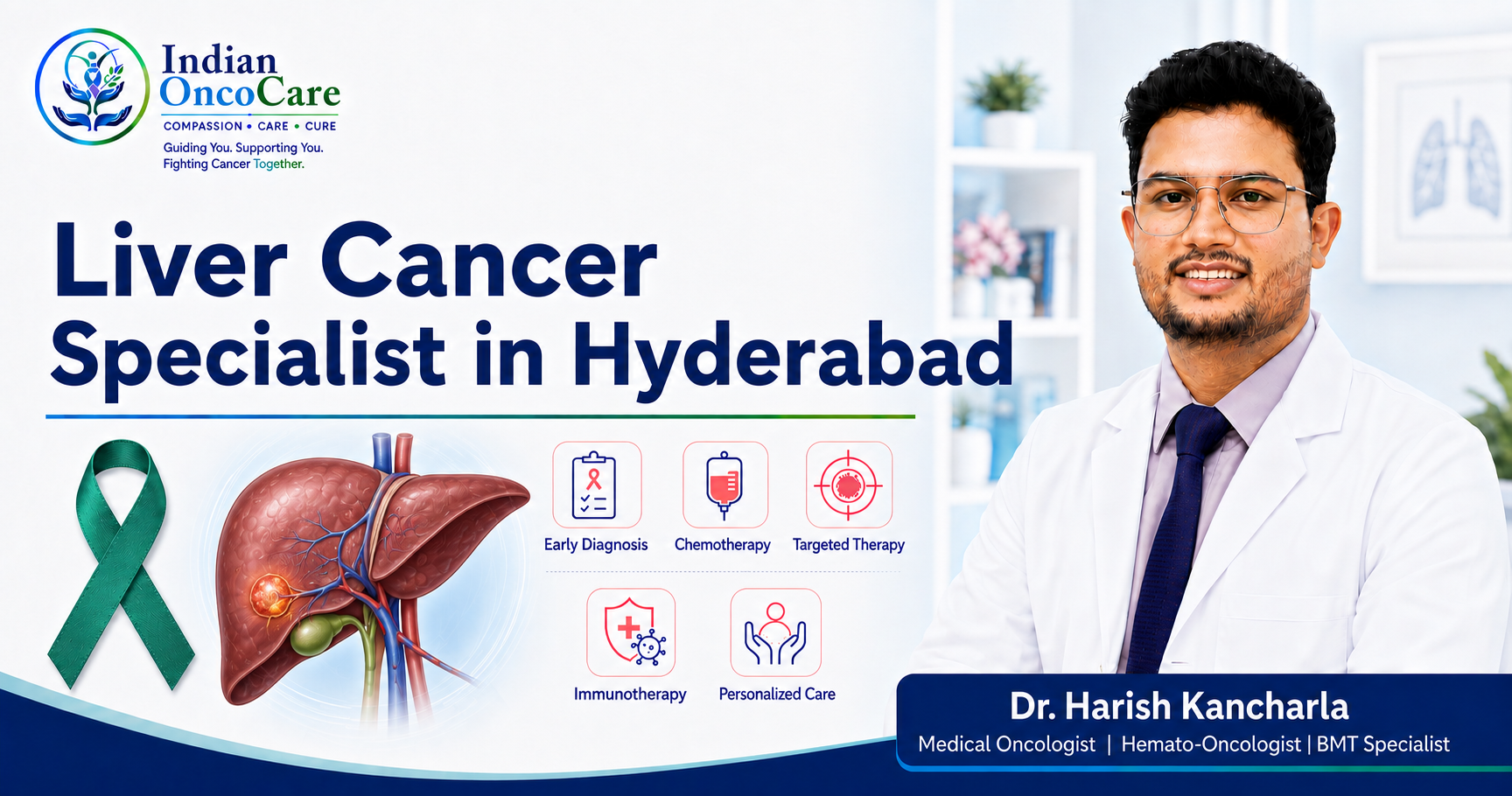
At Indian OncoCare, liver cancer treatment is planned and supervised personally by Dr. Harish Kancharla, DM (Medical Oncology, AIIMS Delhi), MD (Internal Medicine, PGIMER Chandigarh), Senior Consultant – Medical Oncology & Hemato-Oncology at Yashoda Hospitals, Somajiguda, Hyderabad, working with hepatobiliary surgeons, interventional radiologists and pathologists as one team.
When to see a liver cancer specialist
Early liver cancer often causes no symptoms, which is why people with chronic hepatitis or cirrhosis need regular surveillance. See a specialist for:
- Upper-abdominal pain or a mass on the right side
- Unexplained weight loss or loss of appetite
- Yellowing of the eyes or skin (jaundice)
- Abdominal swelling (fluid), or new worsening of known liver disease
Anyone with hepatitis B, hepatitis C or cirrhosis should ask about six-monthly surveillance, which can detect liver cancer early when it is most treatable.
How liver cancer is diagnosed
Liver cancer is often diagnosed on imaging alone. A multiphase (triple-phase) CT or MRI can show the characteristic appearance of HCC in a cirrhotic liver, sometimes without a biopsy. An AFP blood test supports the picture, and a biopsy is used where the diagnosis is unclear. Assessing the health of the rest of the liver is a crucial part of planning, because it determines which treatments are safe.
Treatment options
Liver cancer treatment depends on both the tumour and the underlying liver function:
- Surgery — removal of the tumour (resection), or in selected cases a liver transplant.
- Local treatments — ablation (such as RFA) and trans-arterial approaches (TACE/TARE) delivered by interventional radiology.
- Targeted therapy and immunotherapy — now central to treating advanced HCC, often in combination.
- Chemotherapy — used selectively, more so in other liver cancer types such as bile duct cancer.
The choice is made jointly by the team, matching treatment to the stage and to how well the liver is working.
Why choose Indian OncoCare
Your plan is prepared and reviewed personally by Dr. Harish Kancharla, DM (Medical Oncology, AIIMS Delhi), MD (Internal Medicine, PGIMER Chandigarh), delivered through Yashoda Hospitals, Somajiguda, Hyderabad, with surgery, interventional radiology and medical oncology working together. See our cancer services and the patient journey, and related pages for pancreatic, stomach and colorectal cancer.
Support for patients and families
A cancer diagnosis affects the whole family, and practical support matters as much as medical treatment. Our patient support resources help you prepare for consultations and understand each step, while our financial guidance can help you understand treatment costs and the insurance or assistance options that may be available.
You can find more guidance and checklists in our patient resources section. Patients travelling from outside Hyderabad or from abroad usually begin with an online consultation before continuing in person — see our international patients page for how this is coordinated.
Frequently asked questions
Do I always need a biopsy?
Not always. In a cirrhotic liver, characteristic imaging can be enough to diagnose HCC. A biopsy is used when the picture is uncertain.
Why does the health of my liver matter so much?
Because treatment must not harm the remaining liver. Liver function determines whether surgery, ablation, trans-arterial therapy or drug therapy is safest for you.
Can liver cancer be cured?
Early-stage liver cancer can be cured with surgery, transplant or ablation. Advanced disease is increasingly well controlled with modern targeted therapy and immunotherapy.
Who supervises my treatment?
Dr. Harish Kancharla, DM (Medical Oncology, AIIMS Delhi), MD (Internal Medicine, PGIMER Chandigarh) plans and reviews the medical-oncology component of your care personally.
Related reading: Targeted Therapy · Immunotherapy · Chemotherapy · Second Opinion in Hyderabad · Pancreatic Cancer Specialist · Patient Support · Blog
Medically reviewed by Dr. Harish Kancharla, DM (Medical Oncology, AIIMS Delhi), MD (Internal Medicine, PGIMER Chandigarh), Senior Consultant – Medical Oncology & Hemato-Oncology, Yashoda Hospitals, Somajiguda, Hyderabad. Telangana State Medical Council Registration No. 77186.
Last reviewed: August 2026.
This page is general information about liver cancer and its treatment and is not a substitute for personal medical advice. Treatment decisions must be made with a qualified oncologist who has reviewed your reports.