
Reviewed by Dr. Harish Kancharla — DM (Medical Oncology), AIIMS New Delhi · MD (Internal Medicine), PGIMER Chandigarh · Senior Consultant, Medical Oncology & Hemato-Oncology, Yashoda Hospitals, Somajiguda, Hyderabad · TSMC Reg. No. 77186 · Last reviewed: August 2026
In one line: Mouth cancer is one of the most common and most preventable cancers in India, and its earliest sign is usually a simple ulcer or patch that will not heal within two to three weeks. If you use tobacco, gutka, khaini, zarda or paan masala, an ulcer, white patch, red patch or lump that lasts beyond three weeks should be examined by a specialist — early cancers are often painless and are frequently cured with surgery alone.
Why mouth cancer is a public-health emergency in India
India carries one of the heaviest oral cancer burdens in the world. Under the GLOBOCAN 2022 estimates, cancer of the lip and oral cavity is the second most common cancer in India after breast cancer, with roughly 143,000 new cases in a single year, and India records among the highest age-standardised oral cancer rates for men anywhere on earth.
The reason is not mysterious. India is home to an estimated 267 million tobacco users — about 29% of all adults — and a large share consume smokeless tobacco: gutka, khaini, zarda, mawa, and paan with areca (betel) nut. These products sit against the cheek and gum for hours, bathing the mouth lining in carcinogens far more directly than a cigarette does. The result is a slow, silent rise in mouth cancers, often in people in their 30s, 40s and 50s — decades earlier than many other cancers strike.
We have written about this crisis in depth in India's mouth cancer emergency. This guide is the practical companion: the specific early signs every tobacco user should be able to recognise in the mirror.
The earliest signs, before it becomes serious
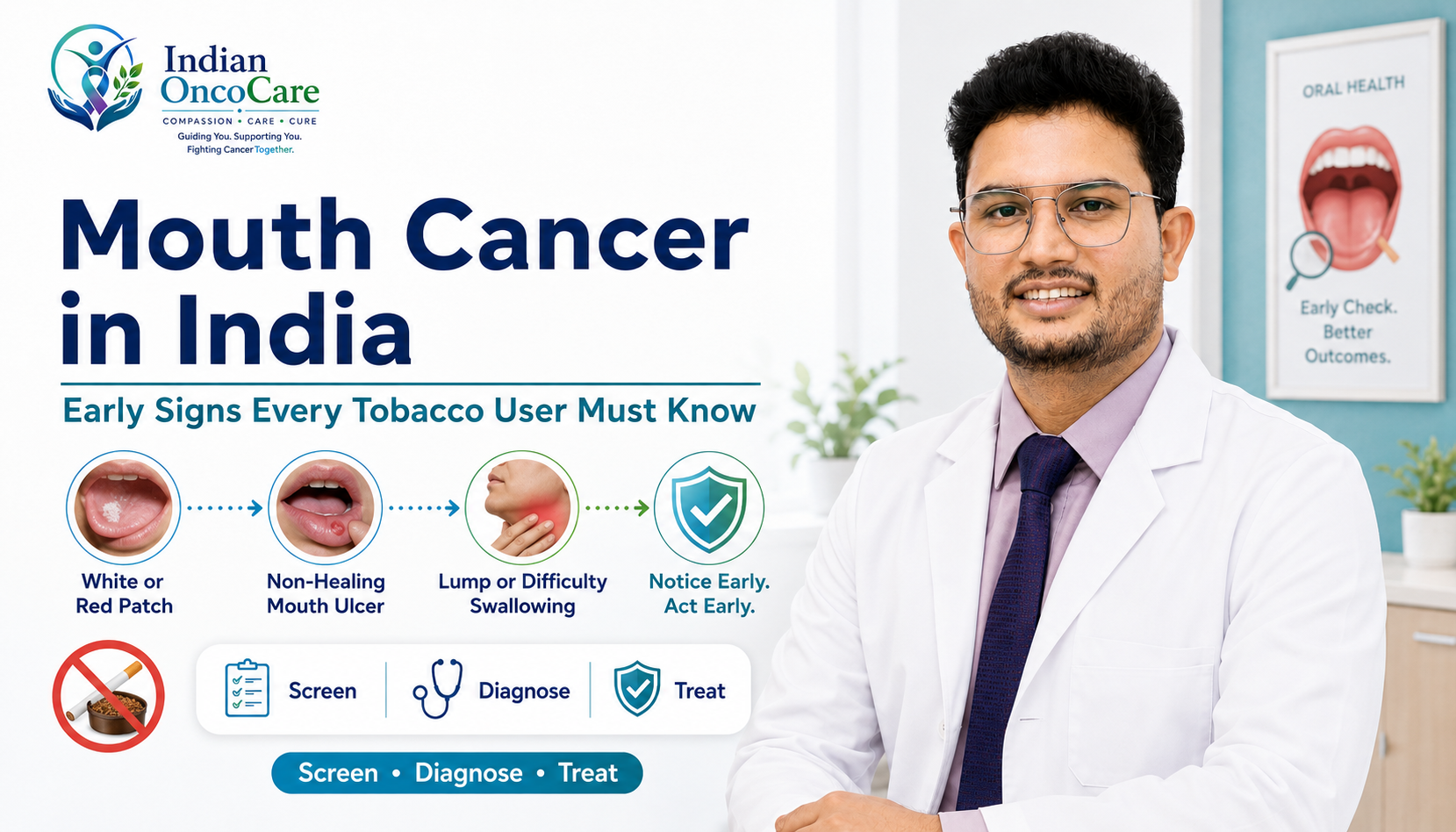
Mouth cancer usually announces itself early — if you know what to look for. See a specialist if any of the following lasts more than two to three weeks:
- A mouth ulcer or sore that does not heal
- A white patch (leukoplakia) on the tongue, gum, or inner cheek
- A red or mixed red-white patch (erythroplakia) — this carries a higher risk than a white patch
- A lump or thickening anywhere in the mouth, cheek, or neck
- A rough patch or an area that bleeds easily
- Persistent mouth pain, numbness, or a sore throat that does not settle
- Progressive difficulty opening the mouth fully — a classic warning of oral submucous fibrosis, a pre-cancerous condition strongly linked to areca nut
- Loose teeth, or dentures that suddenly stop fitting, with no dental cause
The difference between a mouth cancer caught early and one caught late is often just a few weeks of not ignoring an ulcer that would not heal.
Why early detection changes everything
Mouth cancer is one of the few cancers you can often see and feel before it spreads — which makes it one of the most survivable when acted on quickly.
- Caught early (a small, localised tumour), oral cancer is frequently cured with surgery alone, often with excellent function and appearance preserved.
- Caught late, once it has invaded deeper tissue or spread to lymph nodes in the neck, treatment becomes more extensive — combinations of surgery, radiation, and day-care chemotherapy — and outcomes fall sharply.
The tumour does not change overnight. What changes is how long the warning sign is ignored. A three-week rule is simple, safe, and can genuinely save a life.
Who is most at risk
You are at meaningfully higher risk if you:
- Use any form of smokeless tobacco — gutka, khaini, zarda, mawa, mishri
- Chew areca (betel) nut, with or without tobacco — areca nut alone is a recognised carcinogen
- Smoke bidis or cigarettes
- Drink alcohol, which multiplies the risk of tobacco
- Have long-standing white or red patches, or difficulty opening your mouth
- Have a previous oral cancer or a strong family history
If you chew but do not smoke, you are not in the clear — smokeless tobacco and areca nut are the leading drivers of mouth cancer in India, a link we explain in tobacco, gutka and oral cancer.
What to do if you notice a sign
- Do not wait for pain. Track the date you first noticed the ulcer or patch.
- If it lasts beyond three weeks, get it examined by a dentist or, better, a head and neck cancer specialist.
- Stop tobacco and areca nut now. Quitting at any stage lowers risk and improves treatment outcomes.
- Photograph the lesion so you can show a specialist how it has changed.
How mouth cancer is diagnosed and treated
If something suspicious is found, a biopsy confirms the diagnosis and imaging maps how far it has spread. If you receive a pathology report, our guide to understanding your biopsy report explains what the terms mean.
Modern oral cancer care is increasingly precise. Beyond surgery and radiation, advanced or recurrent cases may benefit from tools such as molecular oncology and precision medicine, which match treatment to the biology of an individual tumour. Where a diagnosis has already been made elsewhere, a second opinion for cancer is a sensible, low-cost step before committing to a treatment plan — and it helps you understand the real cost of cancer treatment in India up front.
Can mouth cancer be prevented?
Largely, yes. The single most powerful step is to stop all tobacco and areca nut. Add regular self-checks in the mirror, prompt attention to any patch or ulcer beyond three weeks, and routine dental review, and the great majority of oral cancers can be caught at a stage where cure is the expected outcome.
Frequently asked questions
Are early mouth cancers painful? Often not. Painless ulcers and patches that do not heal are exactly the ones that should still be checked.
I only chew, I don't smoke. Am I still at risk? Yes. Smokeless tobacco and areca nut are the leading causes of mouth cancer in India.
How long should I wait before seeing a doctor? Two to three weeks. Any ulcer, patch, or lump that outlives three weeks needs a specialist review.
Can quitting now still help? Absolutely. Quitting at any stage lowers your risk and improves outcomes if cancer is found.
Who should I see? A head and neck cancer team — start with our head and neck cancer specialist in Hyderabad.
Further reading (external, authoritative sources)
- World Health Organization — Tobacco fact sheet
- IARC / WHO Global Cancer Observatory — India cancer fact sheet (GLOBOCAN 2022)
- U.S. National Cancer Institute — Head and Neck Cancer
- World Cancer Research Fund — Mouth and oral cancer statistics
- Ray et al., Oral Diseases (Wiley, 2025) — Oral cancer in India: epidemiology and risk factors
Explore cancer care at Indian OncoCare, Hyderabad
Head & Neck Cancer Specialist · Stomach (Gastric) Cancer · Liver Cancer · Pancreatic Cancer · Colorectal Cancer · Ovarian Cancer · Lymphoma · Leukemia · Multiple Myeloma · Bone Marrow Transplant · Precision Medicine · Liquid Biopsy · Cancer Genetic Testing · Second Opinion for Cancer
This article is general information, not personal medical advice. Cancer decisions depend on your individual diagnosis, stage, test results, and overall health. Please see our Medical Disclaimer.