
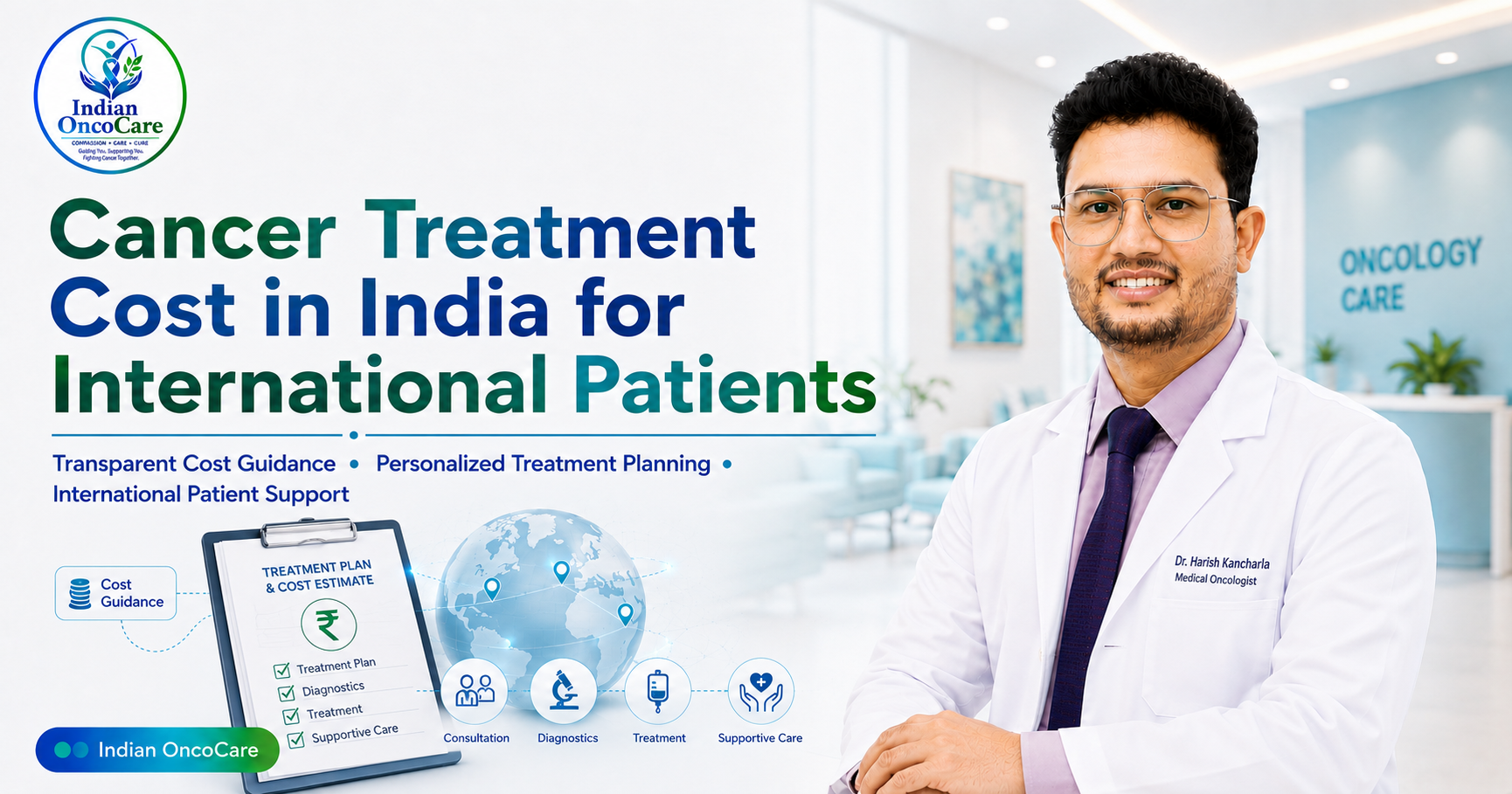
Why cancer treatment costs less in India
There is no single price for cancer treatment in India — it depends on the cancer type, the stage, the specific drugs, the number of cycles, and whether surgery, radiation or a transplant is involved. What is consistent is that treatment in India typically costs 50–80% lower than equivalent care in the UK, USA, Europe or the Gulf, using the same internationally approved drugs and protocols. At Indian OncoCare, you receive a personalised, itemised estimate after your reports are reviewed by Dr. Harish Kancharla.
India offers world-class oncology care at a fraction of Western prices, and the reasons are structural rather than a compromise on quality. India manufactures a large share of the world's generic oncology drugs, so medicine prices sit well below Western levels. Indian-made biosimilars have brought the cost of several modern immunotherapy and targeted drugs down substantially in recent years, and India has even produced its own cellular therapies at a small fraction of global pricing. Overall operating costs — from staffing to infrastructure — are lower, and strong competition among a large number of private cancer centres keeps pricing in check.
None of this comes at the cost of standards. Care is delivered through the day-care and inpatient facilities at Yashoda Hospitals, Somajiguda — one of Hyderabad's largest tertiary cancer centres — following the same global treatment protocols used in leading centres worldwide, with treatment planned personally by a consultant medical oncologist.
What determines your cost
Because every cancer and every patient is different, your total cost is built from several factors, not a single package price:
- Cancer type and stage — early disease treated with a short course costs far less than advanced disease needing prolonged therapy.
- Treatment type and combination — chemotherapy, immunotherapy, targeted therapy and hormonal therapy each have a different cost structure, and multimodal plans that combine several treatments cost more than one alone.
- Number of cycles and duration — the full course matters more than the per-cycle figure.
- The specific drugs used — a targeted or immunotherapy drug differs in price from standard chemotherapy, and the choice depends entirely on your tumour's biology.
- Diagnostic and molecular testing — precision medicine, molecular oncology and liquid biopsy add cost, but done well they save money by avoiding treatments unlikely to work.
- Supportive care — anti-nausea and growth-factor medicines, blood products, day-care or admission, and management of any complications.
- Surgery, radiation or a transplant — where these are part of your plan, they are estimated in coordination with the hospital's surgical and radiation-oncology teams.
What a cost estimate should include
A useful estimate is more than a headline number. When your reports are reviewed, the estimate you receive is built around your actual plan and sets out the main components — consultation and testing, the drug protocol and number of cycles, day-care versus admission, and supportive care — so there are no surprises. The most valuable thing an estimate does for an international patient is make the full course visible, not just the first cycle, so you can plan funding for the whole treatment rather than discovering costs step by step.
Some costs cannot be fixed at the outset — a complication, an ICU stay, or a change of plan after an interim scan can alter the total. A good estimate is honest about this, giving you a realistic planning range rather than a figure that looks precise but isn't.
Costs specific to international patients**
Beyond treatment itself, travelling patients plan for a few additional costs — flights, accommodation near the hospital during active treatment, and living expenses for the patient and any accompanying family. Because most treatment is delivered as day-care chemotherapy where possible, you go home the same day after each session rather than staying admitted, which keeps accommodation costs lower for families staying nearby.
The single most effective way to control cost is to start online. A second opinion and report review by video — before any travel — confirms the plan, identifies any missing test, and produces an estimate, so you only travel once the way forward and the cost are clear. Cycles can then be scheduled around your travel, and follow-up can continue online after you return home, reducing the number of trips required. Full coordination details are on our international patients page.
Insurance, funding and financial guidance
How treatment is funded varies by patient. Some international patients are self-funded, some have private insurance, and some are supported by employer or government schemes in their home country. Where insurance or a scheme applies, coverage differs between policies, so it is worth confirming what your policy includes before treatment begins. For newer treatments, our blog on the cost of immunotherapy, CAR-T and ADCs explains why these differ in price, and the cost of cancer treatment in India gives broader context.
Our financial guidance page explains how estimates are prepared, how staged payments can be arranged, and how to plan funding from abroad. Cost is a legitimate thing to raise openly at consultation — a large part of a good specialist review is establishing what is genuinely necessary versus optional, and finding effective treatment within a realistic budget.
How to get your personalised estimate
The process is simple and free of charge:
1. Send your reports. Share your biopsy/histopathology report, any immunohistochemistry (IHC) or molecular report, recent scans and blood tests through the enquiry form or on WhatsApp.
2. Specialist review. Dr. Kancharla reviews your file, confirms the diagnosis and stage, and identifies the right treatment plan for your tumour.
3. Itemised estimate. You receive an indicative, itemised estimate built around your actual plan, so you can arrange funds with confidence.
4. Decide with clarity. You proceed only when you understand what treatment involves and what it will cost. If your plan involves drug therapy, our guide on what to expect during your first chemotherapy cycle describes a treatment day step by step.
The cheapest treatment is the one that is correct from the start. A specialist review that confirms your diagnosis and completes your testing does not just quote a price — it prevents the far greater cost of treatment that was never going to work.
Support for you and your family
A cancer diagnosis is a financial worry as well as a medical one, and practical support matters. Our patient support and patient resources sections help you prepare for consultations and understand each step, our caregiver guide supports families, and common questions are answered in our FAQ and on the blog. To understand the treatments themselves, see our cancer services overview and the patient journey.
Frequently asked questions
Q1. How much does cancer treatment cost in India?
There is no single figure — it depends on the cancer type, stage, drugs and number of cycles, and whether surgery, radiation or a transplant is involved. Treatment is typically far lower than in Western or Gulf hospitals, and you receive a personalised, itemised estimate after your reports are reviewed.
Q2. Is cancer treatment really cheaper in India than in the West?
Yes — broadly 50–80% lower than the USA, UK, Europe or the Gulf for equivalent care, mainly because India manufactures many oncology drugs and biosimilars and has lower operating costs, without compromising on protocols or quality.
Q3. How much does chemotherapy cost per cycle?
It varies widely with the drugs used and your cancer type, so a per-cycle figure alone can mislead. The full course is what matters, and it is set out in your estimate. Chemotherapy is often one of the strongest value areas for international patients in India.
Q4. Why is immunotherapy or targeted therapy more expensive?
These use specialised drugs and are costlier than standard chemotherapy — though still substantially cheaper in India than in the West, helped by Indian biosimilars. Whether they apply to you depends on biomarker testing, not preference.
Q5. What does the estimate include?
Consultation and testing, the drug protocol and number of cycles, day-care versus admission, and supportive care. Some costs — a complication or ICU stay — cannot be fixed at the outset, so the estimate gives a realistic planning range rather than a false-precise number.
Q6. Are there hidden costs I should plan for?
Beyond treatment, plan for flights, accommodation near the hospital, and living expenses for the patient and any attendant. Supportive drugs, blood products and any complications can also add to the total — which is why an honest, itemised estimate matters.
Q7. Can I get an estimate before I travel?
Yes. Start with an online review of your reports — you receive the plan and an indicative estimate from your home country, and travel only once everything is clear.
Q8. Who prepares my treatment plan and estimate?
Dr. Harish Kancharla, DM (Medical Oncology, AIIMS Delhi), MD (Internal Medicine, PGIMER Chandigarh), Senior Consultant – Medical Oncology & Hemato-Oncology at Yashoda Hospitals, Somajiguda, reviews your case personally, and the estimate is built around your actual plan.
Related reading
Related reading: Cost of Cancer Treatment in India · Cost of Immunotherapy, CAR-T and ADCs · Financial Guidance · Chemotherapy · Immunotherapy · Targeted Therapy · Cancer Second Opinion in Hyderabad · International Patients · Patient Support · Blog
Further reading (external)
Further reading: World Health Organization — Cancer · National Cancer Institute — Managing Costs and Medical Information · American Cancer Society — About Cancer · Union for International Cancer Control — UICC · Indian Visa Online
Medical review disclaimer
Medically reviewed by Dr. Harish Kancharla, DM (Medical Oncology, AIIMS Delhi), MD (Internal Medicine, PGIMER Chandigarh), Senior Consultant – Medical Oncology & Hemato-Oncology, Yashoda Hospitals, Somajiguda, Hyderabad. Telangana State Medical Council Registration No. 77186.
Last reviewed: August 2026.
This page is general information about the cost of cancer treatment in India and is not a treatment offer, a quotation, or a guaranteed price. Actual costs depend on your individual diagnosis, plan and circumstances, and are confirmed in a personalised estimate. Treatment decisions must be made with a qualified oncologist who has reviewed your reports.