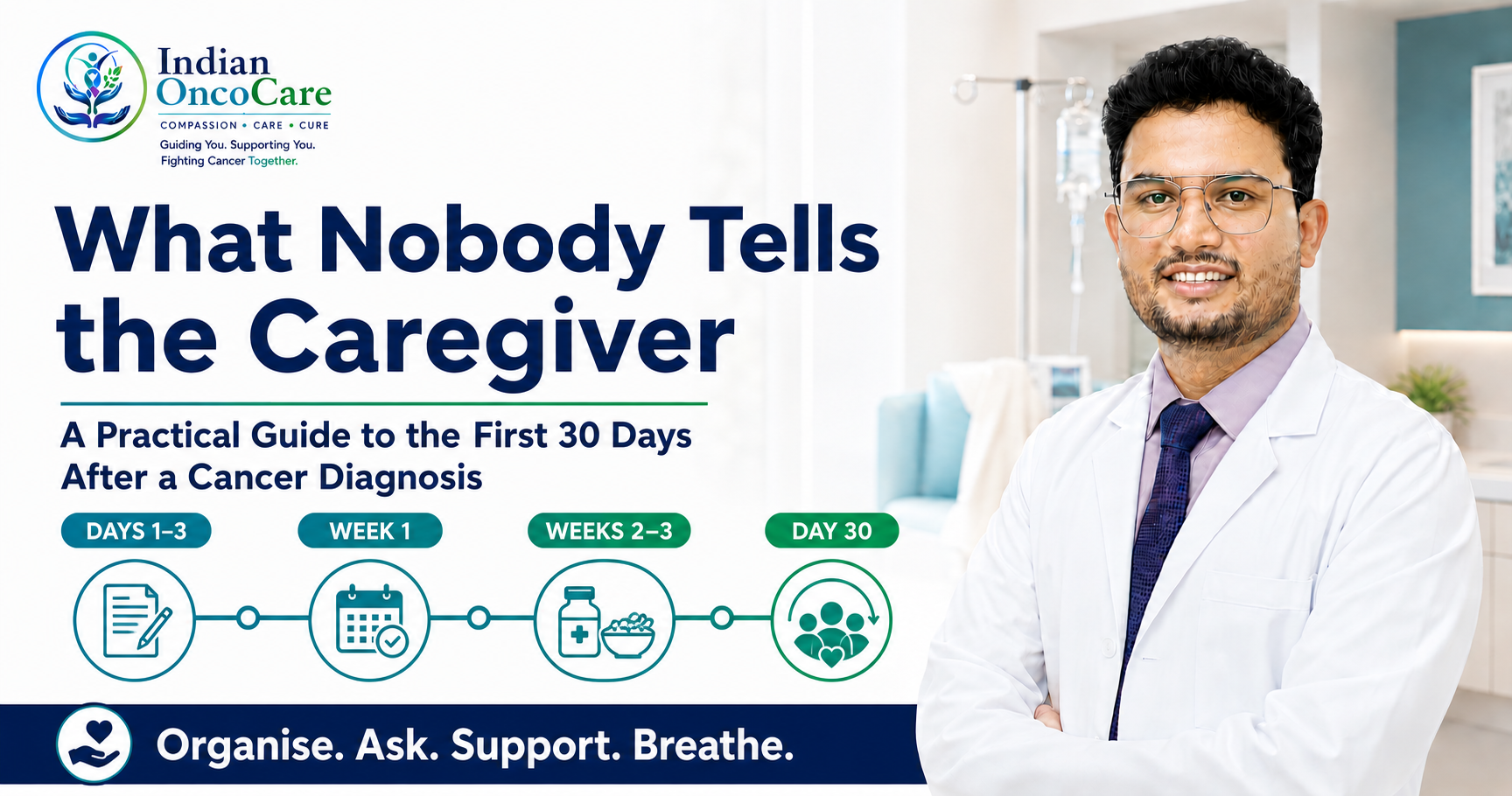
When someone you love is diagnosed with cancer, the first month is often the hardest — not because of treatment, which has usually not even started, but because of the sheer volume of decisions, reports and emotions arriving at once.
This is a practical guide to the first 30 days after a cancer diagnosis, written for the caregiver — the family member who suddenly finds themselves organising appointments, holding the file, and holding everyone together.
Week 1: gather, don’t panic
The instinct is to rush into treatment. The wiser first step is to assemble a complete file, because good decisions depend on complete information. Collect, in date order: the biopsy/histopathology report, any immunohistochemistry (IHC) or molecular report, scan reports and the actual images, and all blood tests.
Keep everything in one folder — physical and digital. A well-organised file is the single most useful thing a caregiver can create, and it makes any second opinion faster and more useful.
Week 2: understand the plan before it starts
Before treatment begins, make sure you understand four things: the exact diagnosis and stage, the recommended plan and its sequence, what is still being tested, and the goal of treatment. If the plan involves chemotherapy, immunotherapy or targeted therapy, ask what the drug is and why it was chosen.
This is also the right moment for a second opinion if anything is unclear — ideally before the first cycle. Our guide on what to send for a second opinion is a useful checklist even if you stay with your current team.
Week 3: set up the practical machinery
Cancer treatment is a logistics project as much as a medical one. In the third week, put systems in place: a shared calendar for appointments, a list of medicines and doses, a single point of contact in the family, and a plan for who accompanies the patient to treatment. Understanding how treatment will be delivered helps — much chemotherapy is given as day-care chemotherapy, so patients come and go the same day.
Our patient resources and patient support pages have checklists to help you prepare, and it is worth reading what to expect during the first chemotherapy cycle before day one.
Week 4: money, logistics and looking after yourself
By the fourth week, address the practical realities: understand the likely costs and check insurance early with our financial guidance; sort out travel and, for outstation families, accommodation. And — this matters — look after yourself. Caregiver burnout is real, and a caregiver who collapses helps no one.
Share the load. Let friends bring meals, let relatives take shifts, and give yourself permission to rest. You are running a marathon, not a sprint.
The best thing a caregiver can do in the first month is not to have every answer, but to keep a complete file, ask clear questions, and protect their own health so they can keep going.
Frequently asked questions
Should treatment start immediately?
For most cancers, a short, well-used delay of a few days to two weeks to complete testing and confirm the plan does not worsen the outcome — and often improves it. Some situations are genuinely urgent; if unsure, ask directly.
What is the most important document to keep safe?
The pathology report and the paraffin block from the biopsy. With the block, further tests can be done without a repeat biopsy.
How do I stop feeling overwhelmed?
Break it into weekly tasks, keep one folder, and delegate. You do not have to do everything at once, or alone.
Can we consult from another city?
Yes — many families begin with an online consultation. See our international patients page for outstation and overseas coordination.
Related reading: Patient Support · Patient Resources · Financial Guidance · Second Opinion for Cancer · Your First Chemotherapy Cycle · Day Care Chemotherapy · The Patient Journey · Blog
Further reading:
National Cancer Institute — Support for Caregivers · American Cancer Society — Caregiver Resource GuideReviewed by Dr. Harish Kancharla
DM (Medical Oncology), AIIMS, New Delhi · MD (Internal Medicine), PGIMER, Chandigarh
Senior Consultant – Medical Oncology & Hemato-Oncology, Yashoda Hospitals, Somajiguda, Hyderabad
Telangana State Medical Council Registration No. 77186
Last reviewed: July 2026
This article is general information, not personal medical advice. Cancer decisions depend on your individual diagnosis, stage, test results and overall health. Please see our Medical Disclaimer.