Reviewed by Dr. Harish Kancharla — DM (Medical Oncology), AIIMS New Delhi · MD (Internal Medicine), PGIMER Chandigarh · Senior Consultant, Medical Oncology & Hemato-Oncology, Yashoda Hospitals, Somajiguda, Hyderabad · TSMC Reg. No. 77186 · Last reviewed: Updated August 2026 to reflect India's national HPV vaccination programme.
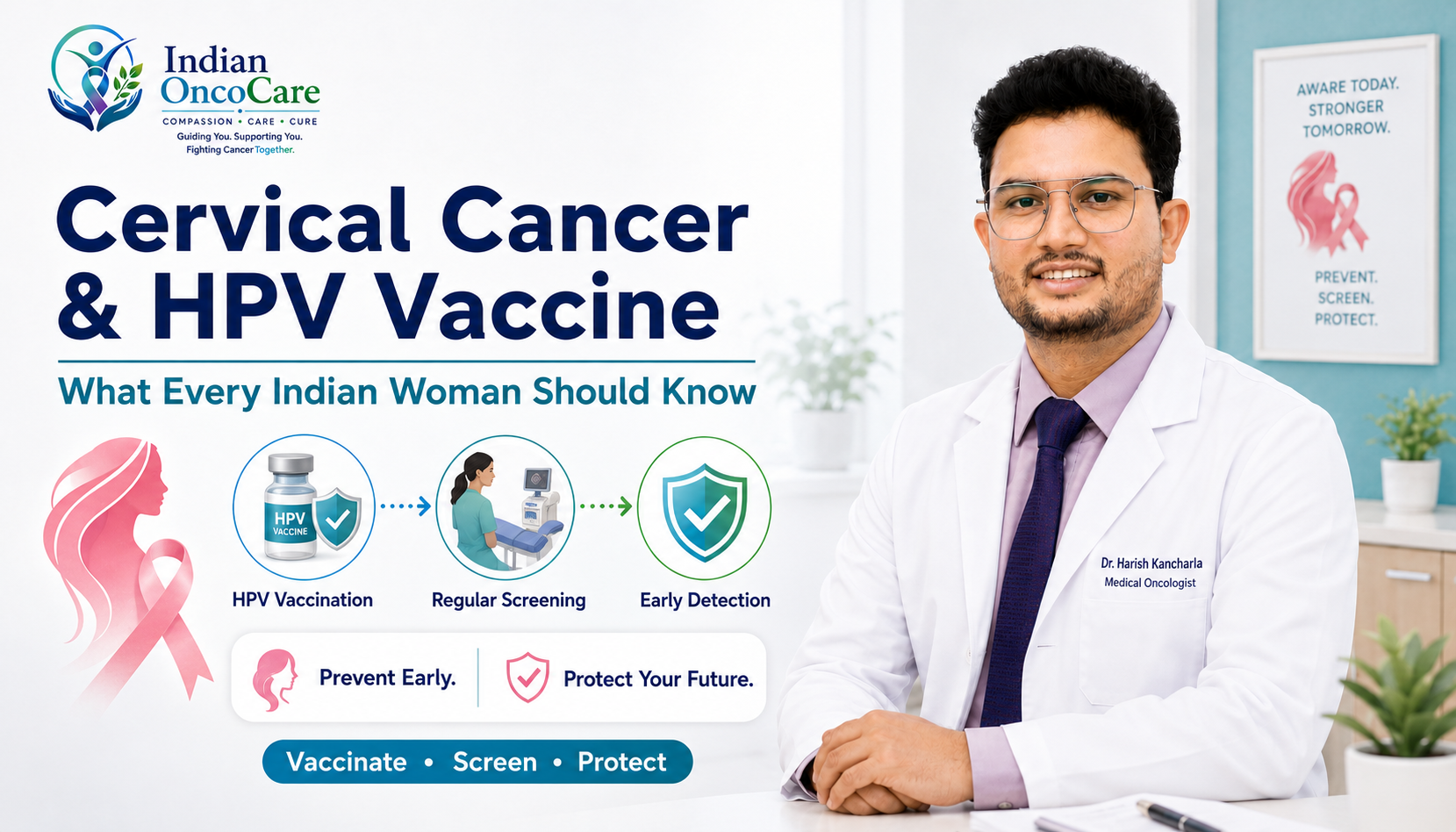
In one line: Cervical cancer is the second most common cancer among Indian women and one of the very few cancers that is almost entirely preventable — because it is caused by a virus (HPV) that a vaccine can block, and because screening can catch pre-cancer before it ever becomes cancer. If you are a woman, or the parent of a girl, understanding the HPV vaccine and screening is one of the most important health decisions you will make.
Why cervical cancer matters so much in India
India carries one of the heaviest cervical cancer burdens on earth. Under the GLOBOCAN 2022 estimates, India records roughly 127,000 new cases and nearly 80,000 deaths every year — the highest cervical cancer death toll of any country, and about one in four cervical cancer deaths worldwide. It is the second most common cancer among Indian women after breast cancer, and it strikes women in the prime of their lives, often in their 40s and 50s.
The tragedy is that almost none of this needs to happen. Cervical cancer is one of the only cancers we can prevent twice over: with a vaccine given before exposure to the virus, and with screening that stops pre-cancer from ever becoming cancer. Very few cancers give us that.
The HPV link
Almost all cervical cancers are caused by long-lasting infection with certain high-risk types of the human papillomavirus (HPV) — with HPV types 16 and 18 responsible for more than 80% of cases in India. HPV is extremely common and usually silent: most infections clear on their own, but when a high-risk type persists, it can slowly cause abnormal cell changes that develop into cancer over 10 to 15 years.
That long, silent window is exactly why prevention and screening work so well — there is time to intervene long before cancer appears. It is also why HPV is not only a "women's" issue: the same virus causes a share of throat, anal, penile and other cancers, which is why some countries vaccinate boys too and why HPV is a recognised driver of head and neck cancers (see our head and neck cancer specialist page).
The HPV vaccine: prevention that works
The HPV vaccine prevents infection with the HPV types that cause most cervical cancers. It works best when given before exposure to the virus, which is why it is recommended for adolescents — and it is one of the most effective cancer-prevention tools that exists, with studies showing 90–95% reduction in pre-cancer and cervical cancer when given early.
This is now a national reality in India. On 28 February 2026, the Government of India launched its first nationwide HPV vaccination programme under the Swastha Nari mission, offering the vaccine free of cost at government health facilities to about 1.15 crore (11.5 million) girls aged 14 each year. Key points every parent should know:
- The programme uses a single dose of a quadrivalent vaccine (Gardasil-4), which protects against HPV types 16, 18, 6 and 11.
- Girls who turn 15 within 90 days of the launch are also eligible during the intensive three-month drive; thereafter the vaccine continues on routine immunisation days as it is folded into the Universal Immunisation Programme.
- Vaccination is voluntary and requires parental consent, with registration through the government's U-WIN platform.
- India also has its own indigenous vaccine, Cervavac (Serum Institute of India), which is a lower-cost option available in the private market for those outside the free programme's age band.
Older girls and young women who missed the schedule can still benefit — ask your doctor about vaccination on an individual basis.
Screening catches it early
Vaccination and screening are partners, not alternatives. Alongside the vaccine, screening — with an HPV test and/or Pap test (and, in community programmes, VIA, visual inspection with acetic acid) — can detect precancerous changes and treat them before cancer develops, or catch cancer at an early, curable stage.
India's biggest gap is here: fewer than one in twenty eligible women is screened, one of the lowest rates in the world. If you are a woman aged 30 or above, ask your doctor when and how you should be screened. Newer options such as HPV-DNA testing with self-sampling are making screening far easier and less intimidating. Together, vaccination and screening can make cervical cancer a genuinely rare disease.
Symptoms — and why you should not wait for them
Early cervical cancer usually causes no symptoms at all — which is precisely why screening matters. When symptoms do appear, they can include bleeding after sex, between periods, or after menopause; watery, blood-stained or foul-smelling discharge; and pelvic pain or pain during sex. Any of these deserve prompt medical attention. But remember: waiting for symptoms means waiting too long. Screening is how you get ahead of the disease.
If cervical cancer is diagnosed
If something abnormal is found, a biopsy confirms the diagnosis and imaging shows how far it has spread — our guide to understanding your biopsy report explains the terms you will see.
Treatment depends on stage and may combine surgery, radiation, and chemotherapy, with immunotherapy now part of care in advanced disease. Early cervical cancer is highly treatable, and increasingly, treatment can be tailored to the biology of an individual tumour using molecular oncology and precision medicine. If a diagnosis or plan has been made elsewhere, a second opinion for cancer is a reasonable step — and it helps you understand the real cost of cancer treatment in India before you begin. Women navigating a gynaecological cancer diagnosis may also find our ovarian cancer specialist resources useful.
The bottom line: vaccinate and screen
If you take one thing from this article: vaccinate eligible girls, and screen adult women. Do both, and cervical cancer becomes a disease we can almost eliminate — which is exactly the goal India and the WHO are now working towards.
Frequently asked questions
Who should get the HPV vaccine? It is recommended mainly for adolescents around age 14 (and 9–14 more broadly), before exposure — India now offers it free to 14-year-old girls at government facilities. Older girls and young women can still benefit; ask your doctor.
If I'm vaccinated, do I still need screening? Yes. The vaccine does not cover every high-risk HPV type, so screening remains essential.
Is cervical cancer curable? Early-stage disease is highly curable — which is why screening and early detection matter so much.
Does the vaccine cause cancer or infertility? No. These are myths. The HPV vaccine is safe, extensively studied, and prevents cancer.
Who should I see? Start with a gynaecologist for screening and vaccination; for a cancer diagnosis, a specialist oncology team.
Further reading (external, authoritative sources)
- World Health Organization — Cervical cancer fact sheet
- Press Information Bureau, Government of India — Nationwide HPV Vaccination Programme (Feb 2026)
- IARC / WHO Global Cancer Observatory — India cancer fact sheet (GLOBOCAN 2022)
- U.S. National Cancer Institute — HPV and Cancer
- Gavi, the Vaccine Alliance — India launches nationwide HPV vaccination
Explore cancer care at Indian OncoCare, Hyderabad
Ovarian Cancer · Head & Neck Cancer · Colorectal Cancer · Stomach (Gastric) Cancer · Liver Cancer · Pancreatic Cancer · Lymphoma · Leukemia · Multiple Myeloma · Bone Marrow Transplant · Precision Medicine · Liquid Biopsy · Cancer Genetic Testing · Second Opinion for Cancer
This article is general information, not personal medical advice. Cancer decisions depend on your individual diagnosis, stage, test results, and overall health. Please see our Medical Disclaimer.