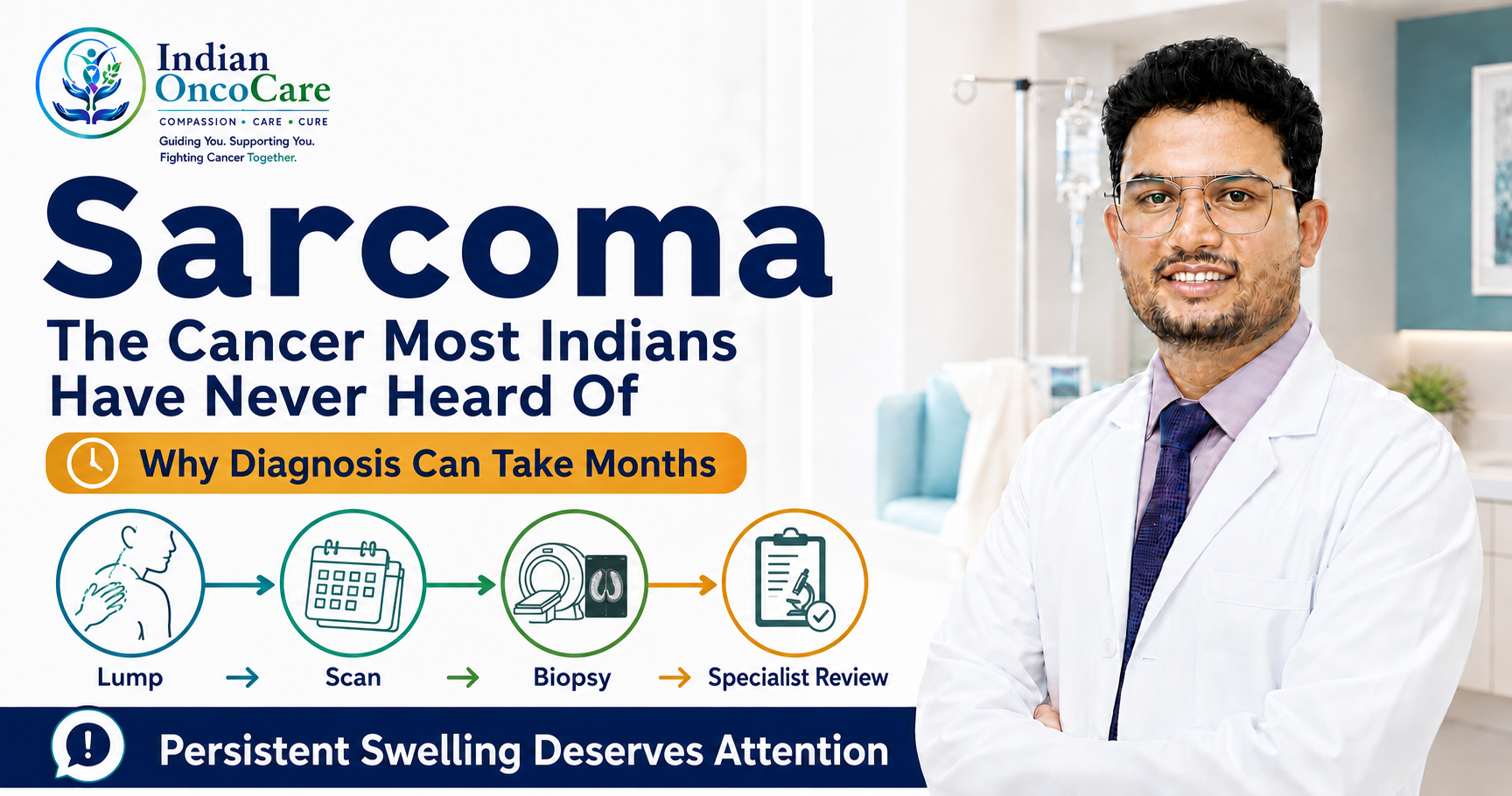
Sarcoma is one of the least understood cancers in India — and one of the most frequently misdiagnosed at first. Because it can appear as a painless lump or vague bone pain, it is often mistaken for a harmless swelling, a sports injury or a cyst, and the correct diagnosis can take months.
July is Sarcoma Awareness Month, and this guide explains what sarcoma is, why diagnosis is so often delayed in India, and what to do if you or a family member has a lump or persistent bone pain that no one has been able to explain.
What is sarcoma?
Sarcomas are cancers that begin in the body’s connective tissues — muscle, fat, bone, cartilage, nerves and blood vessels — rather than in the lining of an organ, where most common cancers start. There are more than 70 subtypes, broadly grouped into soft tissue sarcomas (in muscle, fat and other soft tissues) and bone sarcomas such as osteosarcoma and Ewing sarcoma.
They can occur at any age. Some, like osteosarcoma and Ewing sarcoma, are more common in children and young adults, which makes early, accurate diagnosis especially important.
Why diagnosis takes so long in India
The delay is rarely one person’s fault — it is built into how sarcoma presents:
- A painless, slowly growing lump does not feel like an emergency, so people wait.
- Early swellings are often treated as injuries, cysts or infections, sometimes for months.
- Because sarcoma is rare, it is not always the first thing considered.
- Crucially, a lump is sometimes operated on or “shelled out” before a proper biopsy — which can complicate later treatment.
The single most important principle in sarcoma is this: a deep, large (over ~5 cm) or growing soft-tissue lump should be biopsied and assessed by a sarcoma-aware team before any surgery, not removed first and questioned later.
With sarcoma, how the very first biopsy and surgery are handled often matters as much as the treatment that follows. Getting the sequence right at the start is the part patients cannot go back and redo.
Warning signs worth checking
- A lump anywhere that is larger than about 5 cm, deep, firm, or growing
- A lump that returns after being removed
- Persistent bone pain, especially at night or not linked to activity, or unexplained swelling over a bone
- An unexplained fracture after minor stress
Most lumps and aches are not sarcoma. But the ones that are benefit enormously from being caught before, rather than after, a first operation.
How sarcoma is diagnosed and treated
Diagnosis combines imaging (MRI for soft-tissue lumps, plus CT and sometimes PET) with a correctly planned core-needle biopsy, interpreted by a pathologist experienced in sarcoma — often with molecular testing to pin down the exact subtype. Treatment is decided by subtype, grade and location, and usually combines:
- Surgery — wide removal with a margin of healthy tissue, the cornerstone of cure.
- Radiation therapy — before or after surgery in many cases.
- Chemotherapy — central for bone sarcomas and some soft-tissue subtypes.
- Targeted therapy and, for select subtypes, immunotherapy in advanced disease.
Some sarcomas are linked to inherited syndromes, so genetic testing is considered where the pattern or family history suggests it.
What to do if you suspect a delay
If a lump has been watched for months, removed without a biopsy, or given an uncertain diagnosis, a focused review is worthwhile. Because sarcoma is rare and sequence-sensitive, a second opinion before surgery — or before the next step after an incomplete surgery — is one of the highest-value things you can do. Our guide on getting a cancer second opinion in Hyderabad lists exactly what to send.
Frequently asked questions
Is every lump a sarcoma?
No — the vast majority are benign. But a deep, large or growing lump deserves imaging and a properly planned biopsy rather than immediate removal.
Why should I not just get the lump removed quickly?
If it turns out to be sarcoma, an unplanned removal can leave cancer behind and make curative surgery harder. A biopsy first protects your options.
Can sarcoma be cured?
Yes, particularly when localised and treated correctly from the outset. Cure rates are strongly linked to getting the first biopsy and surgery right.
Which doctor treats sarcoma?
Care is team-based — a sarcoma-aware surgeon, a medical oncologist and a radiation oncologist, supported by an experienced pathologist. Drug therapy is planned by the medical oncologist.
Related reading: Chemotherapy · Targeted Therapy · Molecular Oncology · Cancer Genetic Testing · Second Opinion for Cancer · Cancer Second Opinion: What to Send · Patient Support · Our Services
Further reading:
National Cancer Institute — Soft Tissue Sarcoma · American Cancer Society — Treating Soft Tissue SarcomaReviewed by Dr. Harish Kancharla
DM (Medical Oncology), AIIMS, New Delhi · MD (Internal Medicine), PGIMER, Chandigarh
Senior Consultant – Medical Oncology & Hemato-Oncology, Yashoda Hospitals, Somajiguda, Hyderabad
Telangana State Medical Council Registration No. 77186
Last reviewed: July 2026
This article is general information, not personal medical advice. Cancer decisions depend on your individual diagnosis, stage, test results and overall health. Please see our Medical Disclaimer.