
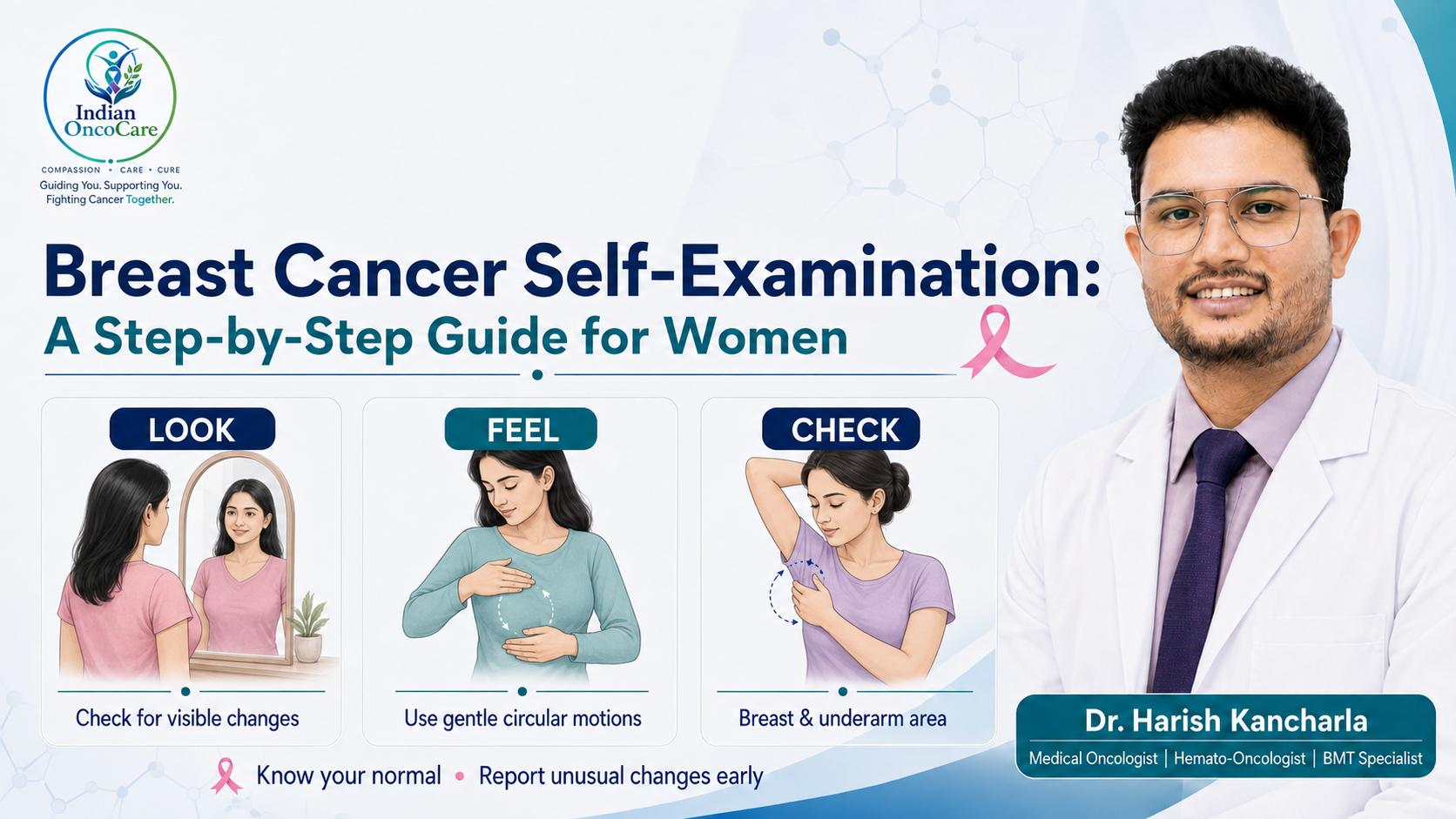
Being familiar with how your breasts normally look and feel is one of the simplest, most valuable habits a woman can build. It does not replace screening, but it helps you notice changes early — and early detection saves lives.
This is a step-by-step guide to breast self-examination and breast awareness for women in India.
Why breast awareness matters
Breast cancer is the most common cancer among women in India, and it is increasingly seen at younger ages. Many women notice a change themselves before any scan. Knowing your own normal makes it far easier to spot something new — and to act on it quickly.
How to examine your breasts, step by step
Do it once a month, a few days after your period ends (or a fixed date if you have stopped menstruating):
- Look: In front of a mirror, arms by your side, then raised. Look for changes in size, shape, skin dimpling, or nipple changes.
- Feel (standing): Using the flat pads of your fingers, feel the whole breast and up into the armpit in small circles, with light then firmer pressure.
- Feel (lying down): Repeat lying flat, which spreads the breast tissue and makes it easier to feel.
- Check the nipple: Note any discharge, especially if bloodstained or from one side.
The goal of self-examination is not to diagnose — it is simply to notice when something has changed, so you can get it checked without delay.
Changes worth getting checked
- A new lump or thickening in the breast or armpit
- A change in size or shape
- Skin dimpling, puckering, or an “orange-peel” texture
- Nipple turning inward, or nipple discharge
- Persistent redness, rash or scaling around the nipple
Most breast changes are not cancer — but a new, persistent change should always be assessed.
What happens if you find something
Evaluation usually involves an examination, imaging (ultrasound and/or mammogram), and if needed a biopsy — whose report guides everything, as explained in our guide on understanding your biopsy report. Treatment is personalised and may include surgery, chemotherapy, hormonal therapy (for hormone-positive cancers) and targeted therapy. For women with a strong family history, genetic testing may be advised. A second opinion is always reasonable before starting treatment.
Frequently asked questions
Does self-examination replace a mammogram?
No. It complements screening by helping you notice changes early, but it is not a substitute for mammography where that is recommended.
At what age should I start?
Building breast awareness is worthwhile from young adulthood; screening recommendations depend on age and risk — ask your doctor.
I found a lump — should I panic?
No. Most lumps are not cancer, but get it checked promptly for peace of mind and safety.
Does breast pain mean cancer?
Usually not — breast pain is rarely the main sign of cancer, but persistent changes should be assessed.
Related reading: Breast Cancer Specialist · Understanding Your Biopsy Report · Cancer Genetic Testing · Hormonal Therapy · Second Opinion for Cancer · Patient Support
Further reading:
National Cancer Institute — Breast Cancer · American Cancer Society — Diagnosing & Staging CancerReviewed by Dr. Harish Kancharla
DM (Medical Oncology), AIIMS, New Delhi · MD (Internal Medicine), PGIMER, Chandigarh
Senior Consultant – Medical Oncology & Hemato-Oncology, Yashoda Hospitals, Somajiguda, Hyderabad
Telangana State Medical Council Registration No. 77186
Last reviewed: August 2026
This article is general information, not personal medical advice. Cancer decisions depend on your individual diagnosis, stage, test results and overall health. Please see our Medical Disclaimer.