
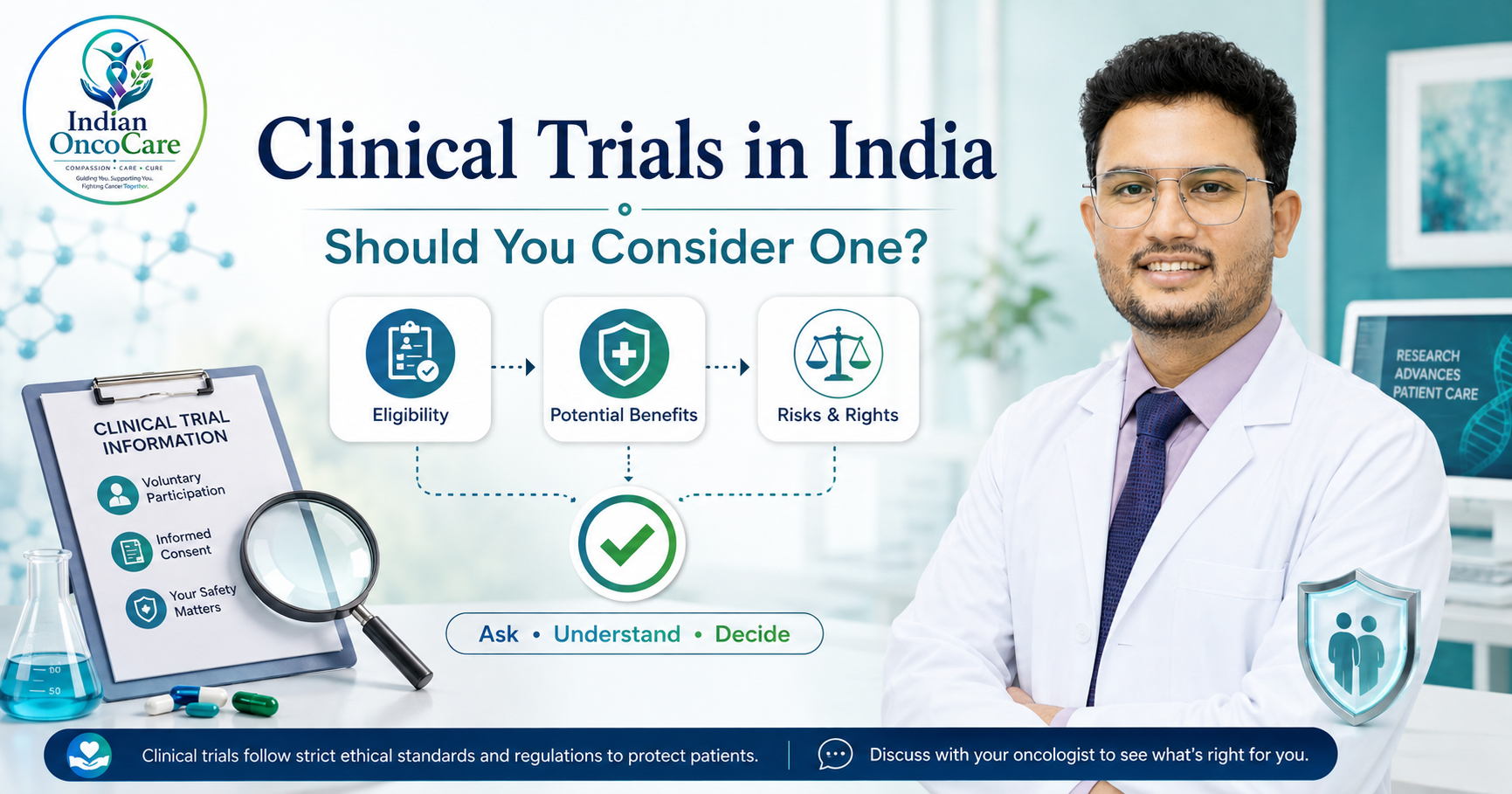
Clinical trials sometimes carry a reputation, in India, of being a last resort or “using patients as guinea pigs.” Both ideas are wrong. Trials are how new cancer treatments are proven, and taking part can sometimes give access to promising therapies. Here is a balanced look at whether to consider one.
What a clinical trial actually is
A clinical trial is a carefully designed study that tests whether a new treatment — a drug, combination, or approach — is safe and works better than the current standard. Modern treatments, including today’s immunotherapy and targeted therapies, exist because earlier patients took part in trials. Participants are closely monitored and protected by strict rules and ethics oversight.
Potential benefits and honest limitations
Possible benefits include access to a promising new treatment not yet widely available, and close monitoring. Honest limitations include uncertainty (the new treatment may or may not prove better), extra visits and tests, and specific eligibility rules. A trial is not automatically better than standard treatment — it is a considered option to weigh, not a guaranteed advantage or a last resort.
A clinical trial is neither a miracle nor an experiment done to you. It is a carefully governed choice — sometimes the right one, sometimes not — that deserves a clear, honest discussion rather than fear.
How to think about it
If you are considering a trial, ask: what is being tested and why; what are the possible benefits and risks; what does participation involve; what happens if it does not work; and what are my standard-treatment options. Precision-medicine and molecular testing sometimes open trial options matched to your tumour, and a second opinion can help you weigh them. Cost and logistics matter too — see our cost of cancer treatment guide and, for those travelling, our international patients page. You can always enquire with us.
Frequently asked questions
Are clinical trials safe?
They are governed by strict rules, ethics oversight and close monitoring designed to protect participants.
Will I get a placebo instead of treatment?
In cancer, trials rarely leave you untreated; comparisons are usually against the current standard treatment. Ask about the specific design.
Is a trial a last resort?
No — trials exist at many stages, and are an option to consider, not only when others are exhausted.
Can I leave a trial?
Yes — participation is voluntary and you can withdraw at any time.
Related reading: Precision Medicine · Molecular Oncology · Immunotherapy · Immunotherapy Side Effects · The Cost of Cancer Treatment · International Patients · Second Opinion for Cancer
Further reading:
National Cancer Institute — Cancer Clinical Trials · American Cancer Society — Clinical TrialsReviewed by Dr. Harish Kancharla
DM (Medical Oncology), AIIMS, New Delhi · MD (Internal Medicine), PGIMER, Chandigarh
Senior Consultant – Medical Oncology & Hemato-Oncology, Yashoda Hospitals, Somajiguda, Hyderabad
Telangana State Medical Council Registration No. 77186
Last reviewed: August 2026
This article is general information, not personal medical advice. Cancer decisions depend on your individual diagnosis, stage, test results and overall health. Please see our Medical Disclaimer.