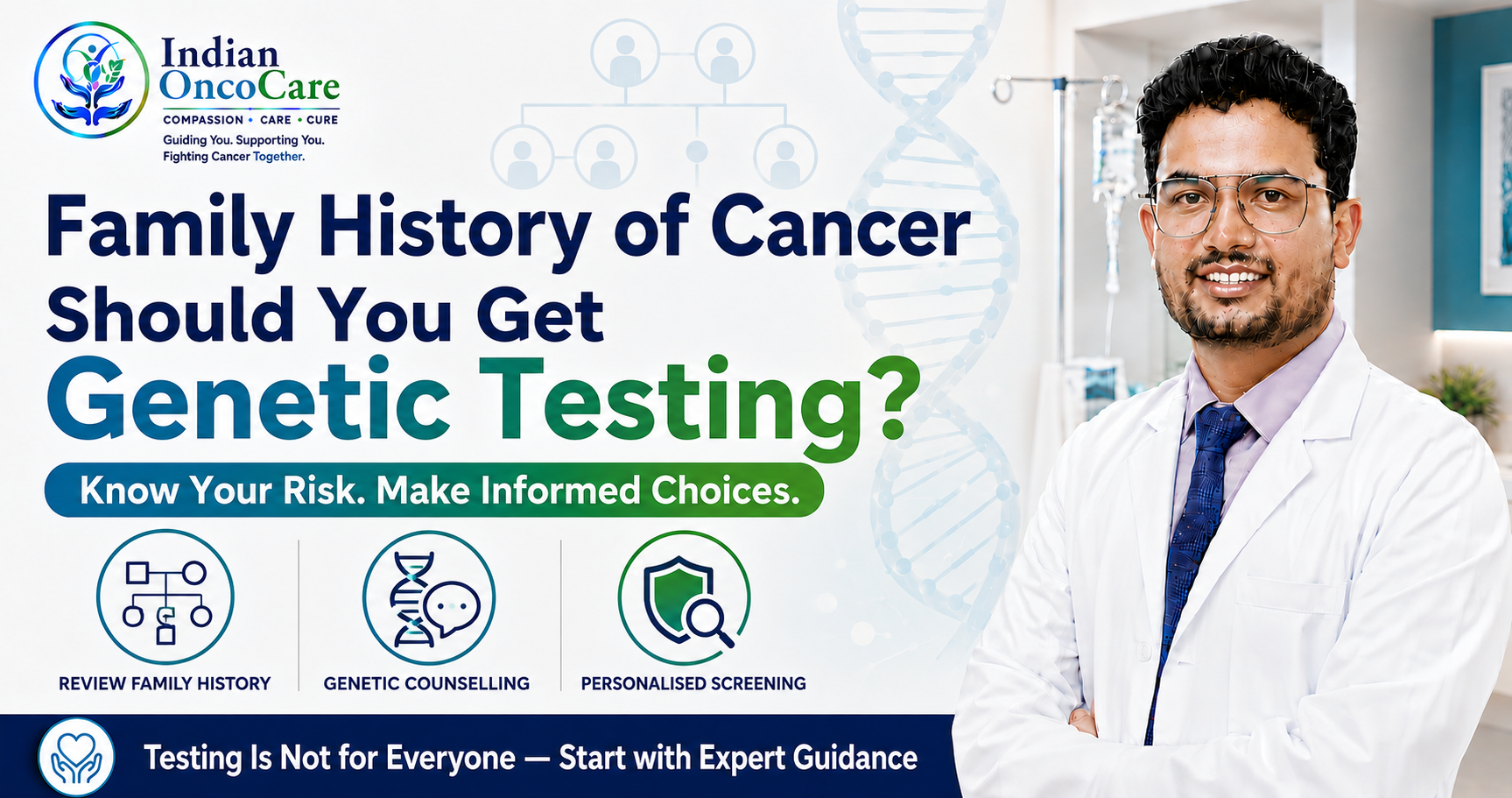
If cancer runs in your family, you may wonder whether you have inherited a higher risk — and whether genetic testing could help. For some families it genuinely can, guiding earlier screening and prevention. This guide explains who should consider it.
Most cancer is not inherited
An important reassurance first: only a minority of cancers are caused by an inherited gene change. Most cancer arises from changes that build up over a lifetime, by chance and from lifestyle and environment. So a single relative with cancer, especially at an older age, usually does not mean an inherited syndrome.
When family history suggests inherited risk
Certain patterns raise the possibility of an inherited cancer syndrome, and are worth discussing:
- Several close relatives with the same or related cancers
- Cancer diagnosed at a young age
- A relative with more than one cancer
- Cancers known to cluster in families — particularly breast, ovarian, colorectal and uterine
- A known cancer gene change in the family
These patterns are especially relevant for breast, ovarian, colorectal and pancreatic cancers, where syndromes such as BRCA and Lynch are well recognised.
Genetic testing is not about predicting the future — it is about turning a vague family fear into a specific, actionable plan: who should be screened, from when, and how often.
What testing involves — and why counselling matters
Inherited (germline) genetic testing is usually a blood or saliva test, and is different from the tumour molecular testing used to guide treatment. A positive result means higher risk, not certainty — and it can guide earlier screening, risk-reducing steps, and testing for relatives. Because the implications are personal and family-wide, genetic counselling is part of good care. Our dedicated cancer genetic testing page explains the process, and a second opinion can help you decide.
Frequently asked questions
Does a relative with cancer mean I’ll get it?
Usually not. Most cancer is not inherited, and one older relative rarely indicates a syndrome.
What does a positive genetic test mean?
Higher risk, not certainty — and a chance to screen earlier and take preventive steps.
Is inherited testing the same as tumour testing?
No. Inherited testing looks at genes you were born with; tumour testing guides treatment of an existing cancer.
Should my relatives be tested too?
If an inherited change is found, relatives can be offered testing and earlier screening.
Related reading: Cancer Genetic Testing · Molecular Oncology · Breast Cancer Specialist · Ovarian Cancer Specialist · Colorectal Cancer Specialist · Pancreatic Cancer Specialist · Precision Medicine · Liquid Biopsy
Reviewed by Dr. Harish Kancharla
DM (Medical Oncology), AIIMS, New Delhi · MD (Internal Medicine), PGIMER, Chandigarh
Senior Consultant – Medical Oncology & Hemato-Oncology, Yashoda Hospitals, Somajiguda, Hyderabad
Telangana State Medical Council Registration No. 77186
Last reviewed: August 2026
This article is general information, not personal medical advice. Cancer decisions depend on your individual diagnosis, stage, test results and overall health. Please see our Medical Disclaimer.