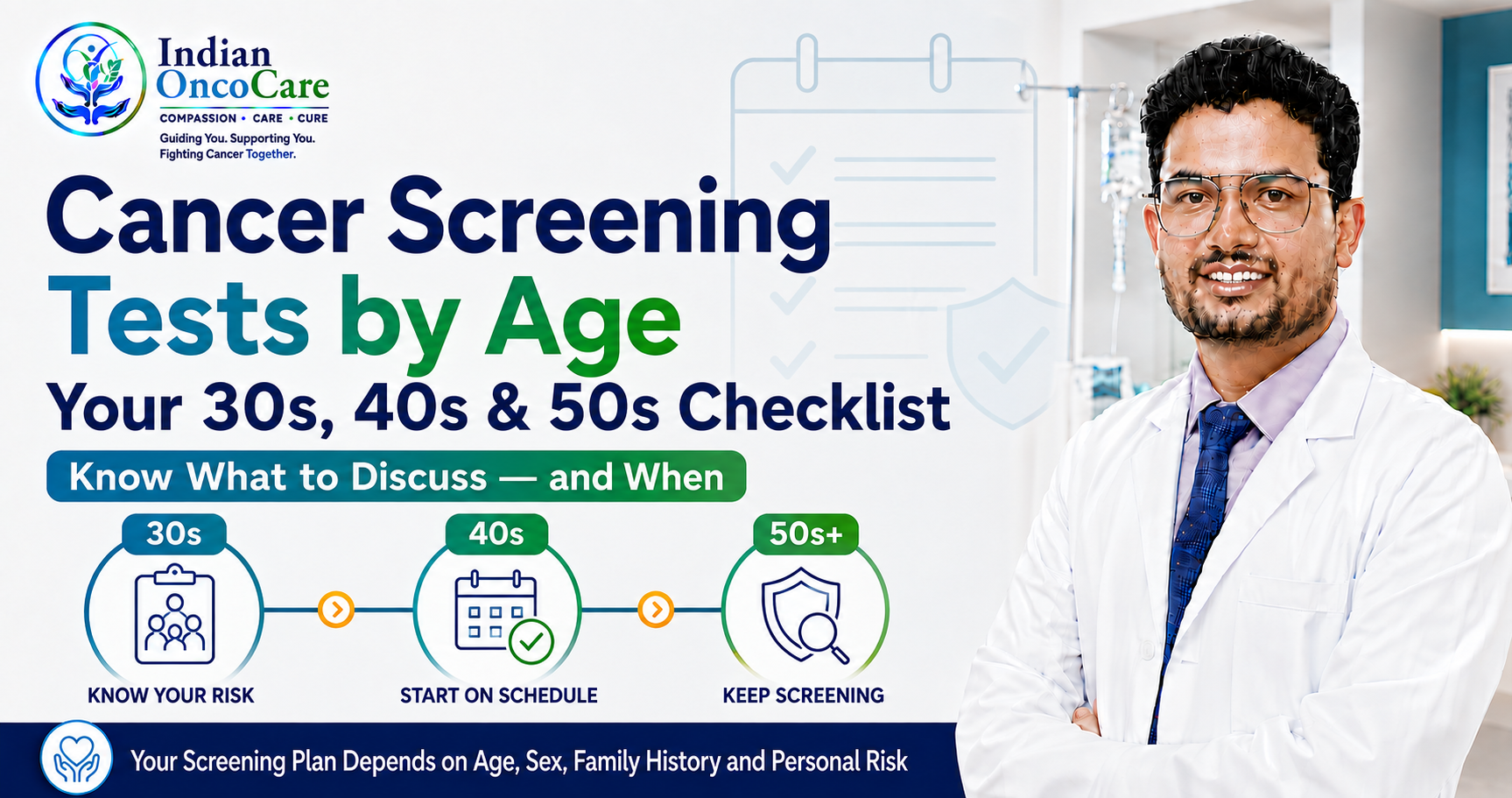
Cancer screening finds cancer early — or prevents it — in people who feel completely well. But which tests you need changes with age. Here is a practical checklist of cancer screening to discuss with your doctor in your 30s, 40s and 50s.
This is general guidance; your personal plan depends on your risk factors and family history.
In your 30s
For most people at average risk, this is the decade to build awareness and address specific risks:
- Cervical screening for women (Pap/HPV test), typically starting in the 20s–30s
- Breast awareness, and earlier breast screening if there is a strong family history
- Discussing genetic testing if there is a strong family history of cancer
In your 40s
Screening usually broadens in this decade:
- Breast cancer screening (mammography) for women, timing based on risk
- Colorectal cancer screening often begins around 45–50
- Continued cervical screening
In your 50s and beyond
Several screenings are well established by now:
- Colorectal cancer screening (colonoscopy or stool tests)
- Breast cancer screening continues
- A discussion about prostate (PSA) screening for men — see our post on prostate cancer after 50
The whole point of screening is that it is done when you feel perfectly well. By the time symptoms appear, screening has already done, or missed, its job.
Family history changes everything
These are general guides for average risk. A strong family history of cancer often means starting earlier and screening more often, and may warrant genetic testing — more in our post on family history and genetic testing. Screening is also different from acting on symptoms; if you notice warning signs, see a doctor regardless of your screening schedule.
Frequently asked questions
Do I need screening if I feel fine?
Yes — that is exactly who screening is for. It finds problems before symptoms appear.
When does breast/colon screening start?
Broadly, breast screening in the 40s and colorectal around 45–50 for average risk — earlier with risk factors.
Does family history change the schedule?
Yes — usually earlier and more frequent screening.
Is screening the same as diagnosis?
No. Screening in well people; if you have symptoms, that needs direct evaluation.
Related reading: Colorectal Cancer Specialist · Breast Cancer Specialist · Ovarian Cancer Specialist · Family History & Genetic Testing · Prostate Cancer After 50 · Cancer Genetic Testing · Second Opinion for Cancer
Further reading:
National Cancer Institute — Cancer Screening Overview · American Cancer Society — Diagnosing & Staging CancerReviewed by Dr. Harish Kancharla
DM (Medical Oncology), AIIMS, New Delhi · MD (Internal Medicine), PGIMER, Chandigarh
Senior Consultant – Medical Oncology & Hemato-Oncology, Yashoda Hospitals, Somajiguda, Hyderabad
Telangana State Medical Council Registration No. 77186
Last reviewed: August 2026
This article is general information, not personal medical advice. Cancer decisions depend on your individual diagnosis, stage, test results and overall health. Please see our Medical Disclaimer.