
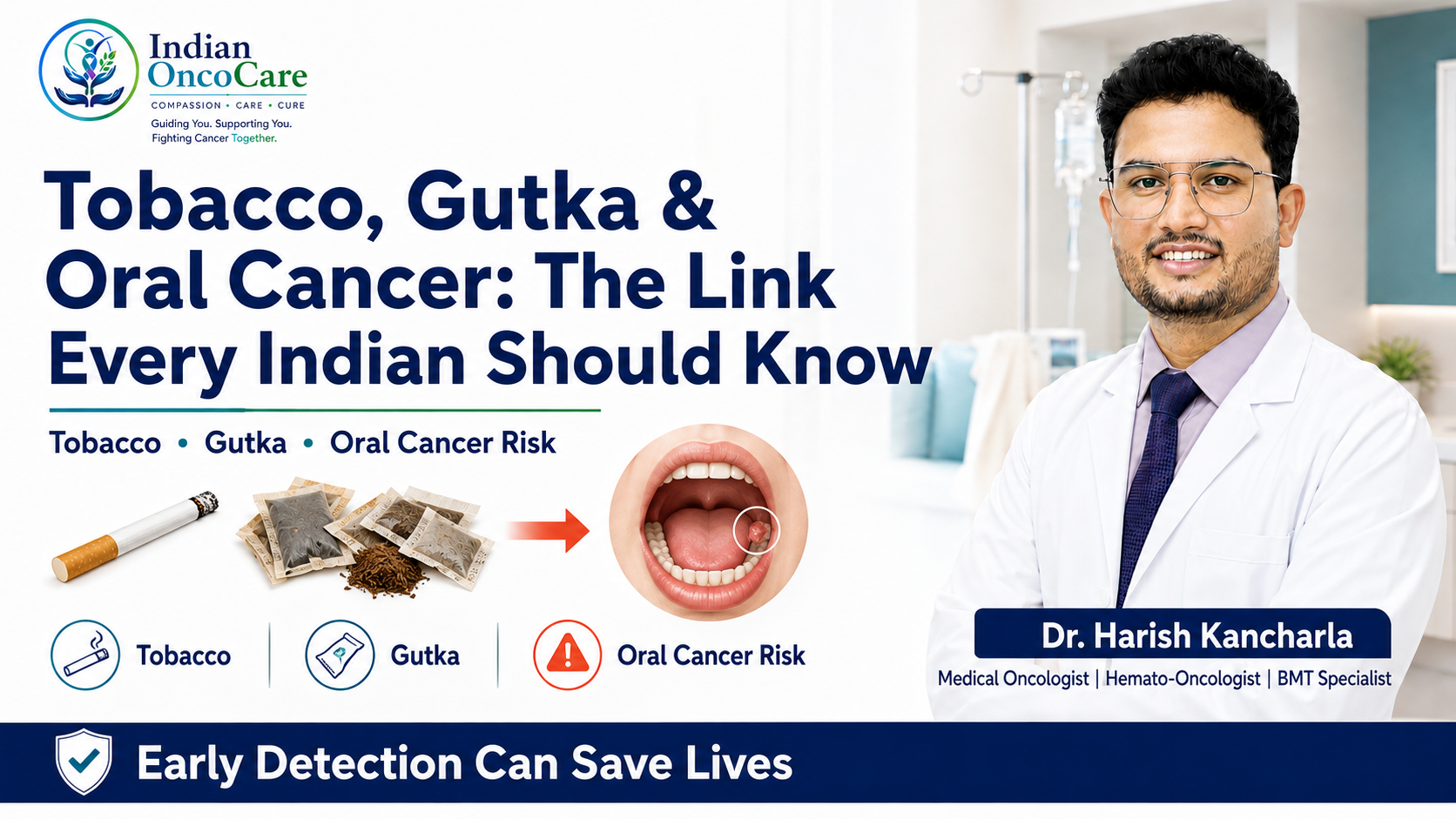
The link between tobacco and cancer is well known — but in India, it is smokeless tobacco and areca (betel) nut, not just cigarettes, that drive a huge share of cancers, especially of the mouth and throat. Every Indian should understand this link.
How tobacco and gutka cause cancer
Gutka, khaini, zarda, paan masala and betel-nut products are held against the cheek or gum for long periods, exposing the mouth lining to carcinogens for hours each day. Over time this causes cancer, and also a precancerous stiffening of the mouth called oral submucous fibrosis — strongly linked to areca nut and widespread in India. Smoking and alcohol add further risk.
The cancers it causes
Tobacco and areca nut are linked to a wide range of cancers — mouth, throat, voice box, food pipe, and others. In India, cancers coordinated by head and neck cancer specialists are among the most common, and they often appear in relatively young adults because use starts early. Our posts on India’s mouth cancer emergency and early signs of mouth cancer go deeper.
There is no safe form of tobacco. ‘Only chewing’ is not a safer choice than smoking — in India, it is one of the leading causes of cancer.
The good news: quitting works
Quitting tobacco and areca nut, at any age and any stage, measurably lowers cancer risk, improves treatment outcomes if cancer has already developed, and reduces the chance of a second cancer. It is the single most powerful step a person can take for their own health — and it is never too late to benefit.
Frequently asked questions
Is chewing tobacco safer than smoking?
No. Smokeless tobacco and areca nut are major causes of mouth and throat cancer in India.
Is plain betel nut (supari) safe?
Areca nut itself is linked to oral submucous fibrosis and cancer risk, with or without tobacco.
Does quitting really help if I’ve used it for years?
Yes — risk falls after quitting, and outcomes improve at any stage.
What early signs should I watch for?
Non-healing ulcers, white/red patches, lumps, or difficulty opening the mouth — see our early signs guide.
Related reading: Head & Neck Cancer Specialist · India’s Mouth Cancer Emergency · Mouth Cancer Early Signs · Chemotherapy · Immunotherapy · Second Opinion for Cancer
Reviewed by Dr. Harish Kancharla
DM (Medical Oncology), AIIMS, New Delhi · MD (Internal Medicine), PGIMER, Chandigarh
Senior Consultant – Medical Oncology & Hemato-Oncology, Yashoda Hospitals, Somajiguda, Hyderabad
Telangana State Medical Council Registration No. 77186
Last reviewed: August 2026
This article is general information, not personal medical advice. Cancer decisions depend on your individual diagnosis, stage, test results and overall health. Please see our Medical Disclaimer.